
Blog
CHIME Detects 21 cm Hydrogen Signal to Probe Dark Energy
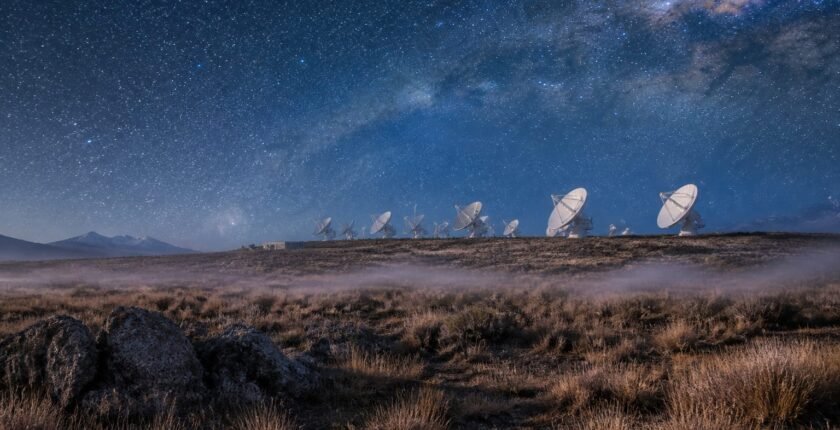
Estimated reading time: 5 minutes · Last updated:
The Canadian Hydrogen Intensity Mapping Experiment (CHIME) has reported a detection of the cosmological 21 cm hydrogen signal using only its own autocorrelation data, giving radio astronomers a new route to trace large-scale structure and probe dark energy. The measurement rests on 94 nights of observations taken in 2019 and is reported at roughly redshift z ∼ 1; the project team framed the finding as a 9‑billion‑year‑old signal while the analysis also discusses emission from an epoch when the universe was about five billion years old. As first reported by the University of British Columbia, the result appears in The Astrophysical Journal and marks a milestone for CHIME's original mapping goals.
Hydrogen is the most common element in the universe and the raw material from which stars form,
Dr. Arnab Chakraborty, co‑author
Key takeaways
- Autocorrelation detection: CHIME detected a cosmological 21 cm hydrogen signal using autocorrelation on 94 nights of data collected in 2019.
- Epoch identified: The team reports the signal at approximately z ∼ 1 and the press summary refers to it as a 9‑billion‑year‑old detection while the paper locates the emission near a time when the universe was about five billion years old.
- Neutral hydrogen fraction: CHIME's analysis indicates roughly two per cent of the hydrogen was neutral atomic hydrogen at the redshift probed.
- Cost and scope: Because CHIME measures hydrogen emission directly, the team says it can survey larger cosmic volumes at a fraction of the cost of galaxy surveys that can cost millions of dollars more.
Table of contents
- Key takeaways
- How CHIME pulled a 21 cm signal from its own data
- Why a 21 cm detection matters for dark energy
- Verification, foregrounds and the work that remained
- Next steps: seven years of CHIME data and wider implications
- How this finding could play out
- What to be careful about
- Frequently asked questions
How CHIME pulled a 21 cm signal from its own data
CHIME is a fixed‑dish radio telescope near Penticton, British Columbia, designed to map the sky at frequencies sensitive to the hydrogen 21 cm transition. Rather than locating individual galaxies, CHIME measures the combined radio emission from neutral hydrogen across large volumes of space. The new result uses autocorrelation — a technique that analyses each antenna's self‑signal rather than cross‑correlating pairs — and the team reports a cosmological measurement at about redshift z ∼ 1 based on 94 nights of observations taken in 2019.
Autocorrelation was long considered challenging because an instrument's own response and terrestrial interference can mimic a faint cosmological signal. The CHIME collaboration applied new data‑processing steps and rigorous tests over more than a year to discriminate instrumental and human‑made radio interference from genuine sky emission. The finding is published in The Astrophysical Journal in two companion papers that present the detection and an interpretation of the autopower spectrum.
Why a 21 cm detection matters for dark energy
Measuring how matter is distributed at different epochs lets cosmologists infer how the Universe's expansion rate changed over time; that history carries information about dark energy. CHIME's 21 cm approach maps hydrogen directly across vast volumes instead of assembling galaxy catalogues one object at a time. That reach lets the telescope probe cosmic expansion at redshifts around z ∼ 1 while using a single instrument and, the team argues, at much lower cost than surveys that 'build' large samples of galaxies and typically require tens of millions of dollars.
Because the method samples larger scales, it yields complementary information to traditional optical surveys. The CHIME papers show the detected hydrogen clustering can test models of how structure grew and, by extension, provide an independent constraint on hypotheses for dark energy. The collaboration frames the discovery as opening a new window: it makes it possible to cross‑check dark energy inferences made from other tracers and to search for departures from standard cosmological models.
Verification, foregrounds and the work that remained
Extracting a cosmological 21 cm signal from radio data requires separating it from far stronger foregrounds: Galactic synchrotron emission, point sources, human transmissions and instrument systematics. The CHIME team reports they spent over a year subjecting the candidate detection to tests for these contaminants before concluding the signal persisted. The paper set out tests of spectral smoothness, instrument modelling and null tests to reduce the chance of a false alarm.
The collaboration emphasizes conservative analysis choices and crosschecks. Even so, autocorrelation measurements are sensitive to subtle calibration errors, and the authors lay out systematic uncertainties in the autopower spectrum interpretation. Independent confirmation, including comparison with other instruments or cross‑checks against galaxy surveys where overlap exists, will be central to turning this detection into precision cosmology.
Next steps: seven years of CHIME data and wider implications
CHIME now has nearly seven years of observations available for further analysis, and the collaboration intends to extend the autocorrelation technique to earlier cosmic times. The team states a goal of pushing the method toward epochs corresponding to when the universe was about three billion years old. Achieving that will expand the redshift baseline available to measure cosmic expansion and structure growth.
Beyond dark energy, the measurement constrains galaxy formation models because clustering of neutral hydrogen traces how matter organized into the structures that later hosted stars. The papers list specific follow‑ups: refine the autopower measurement across more nights, quantify remaining systematics, and compare results with independent surveys. If the method scales as the authors expect, radio intensity mapping could become a routine, cost‑effective probe used alongside optical surveys to sharpen constraints on cosmology.
How this finding could play out
The case for
- Provides an independent route to measure expansion at z ∼ 1 using a single radio instrument, reducing reliance on costly galaxy surveys.
- If extended across CHIME's nearly seven years of data, the technique could tighten constraints on dark energy and on models of galaxy formation.
The case against
- Autocorrelation is vulnerable to instrument calibration errors and foreground residuals that can bias the inferred autopower spectrum.
- Systematic uncertainties may limit the method's precision compared with well‑calibrated cross‑correlation studies unless the instrument model and interference mitigation improve further.
What to be careful about
- Residual terrestrial radio frequency interference or miscalibrated instrument response being misinterpreted as cosmological signal in autocorrelation.
- Limited redshift resolution in intensity mapping could make it hard to separate evolution in hydrogen clustering from changes due to cosmological expansion.
- If independent instruments or cross‑survey checks disagree, the result could require substantial revision or additional mitigation.
The bottom line
CHIME's autocorrelation detection of the cosmological 21 cm hydrogen signal — based on 94 nights from 2019 and reported at roughly z ∼ 1 — promises a lower‑cost, wide‑volume way to map matter and test dark energy. The finding is a technical milestone but not the endpoint: the collaboration acknowledges significant systematic work remains and plans to exploit nearly seven years of data to push earlier in cosmic time. Independent confirmations and careful instrument modelling will determine whether intensity mapping becomes a routine, precision cosmological tool alongside optical surveys.
What to watch
- Watch for the team's expanded analysis of CHIME's nearly seven‑year dataset; no date has been set.
- Watch for follow‑up papers that push the autocorrelation method toward epochs when the universe was about three billion years old; no date has been set.
Frequently asked questions
What is the 21 cm signal and why is it useful?
The 21 cm signal is radio emission from neutral atomic hydrogen; CHIME measured its combined emission at about redshift z ∼ 1 to map large volumes of the universe. Because hydrogen traces matter on large scales, the signal lets astronomers infer how structure and cosmic expansion evolved and so test dark energy models.
How did CHIME confirm the detection?
The collaboration reports the candidate emerged from autocorrelation analysis of 94 nights of data collected in 2019 and survived more than a year of tests for foregrounds and instrumental effects, with results published in The Astrophysical Journal.
What are the immediate scientific implications?
If robust, the detection gives a single‑instrument route to trace expansion near z ∼ 1 and constrains the fraction of neutral hydrogen (the team reports roughly two per cent at the epoch studied), offering an independent cross‑check on dark energy inferences from galaxy surveys.
Related reading