
Blog
Amazfit T-Rex Dual Solar brings AMOLED plus two panels
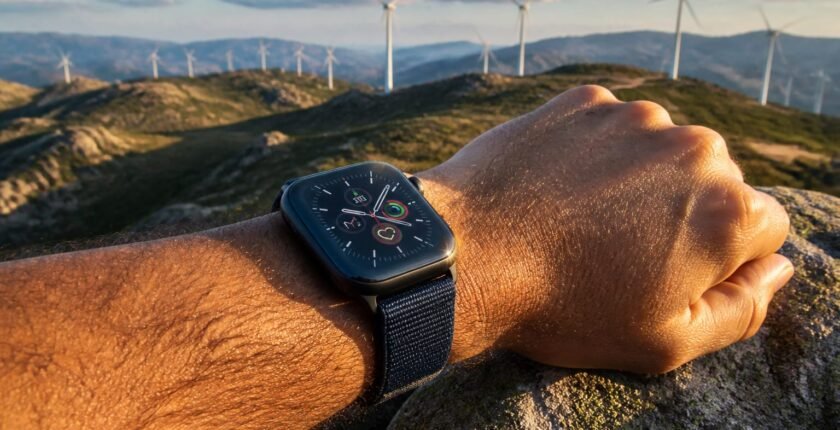
Estimated reading time: 6 minutes · Last updated:
Amazfit’s T‑Rex Dual Solar pairs an AMOLED screen with two separate solar panels — one on the front ring and a second on the caseback — in an attempt to reclaim battery life for a smaller battery-equipped smartwatch. The watch ships with a 660mAh battery, a 1.3″ AMOLED display and a $649 / 649EUR price, and it borrows most of its feature set from the T‑Rex Ultra 2. Ray Maker’s hands-on testing, as first reported by DC Rainmaker, measured measurable but limited solar returns: off-wrist exposure produced multi-day gains in low-power modes, while on-wrist GPS workouts typically showed only a near‑wash versus normal battery draw.
Key takeaways
- Price and hardware: The Amazfit T‑Rex Dual Solar is priced at $649 / 649EUR and uses a 660mAh battery and a 1.3″ AMOLED screen.
- Dual solar design: Amazfit fitted both a front solar ring and a rear-facing panel; the company says the rear area and gains are close to double the front panel.
- Measured gains: Ray Maker recorded solar gains of about 2.8 days in Smartwatch mode, 8.4 days in Battery Saver mode and 14.0 days in Watch‑only mode on off‑wrist daytime exposure.
- Real-world limits: During on-wrist GPS workouts the watch typically lost roughly 2% battery per hour and solar charging often produced little net benefit.
Table of contents
- Key takeaways
- How Amazfit built a two‑panel AMOLED solar watch
- Measured real‑world solar gains and limits
- Interface, diagnostics and overheating behaviour
- Trade‑offs: who benefits and where the design makes sense
- The case for and against further refinement
- What to be careful about
- Frequently asked questions
How Amazfit built a two‑panel AMOLED solar watch
Amazfit started from the T‑Rex Ultra 2 feature set but reworked the hardware to add two distinct solar collectors and a smaller battery. The Dual Solar ships with a 660mAh battery where the Ultra 2 uses 870mAh, and the display is reduced to 1.3″ from 1.5″ to accommodate a solar ring. The rear panel is integrated around the optical heart‑rate module and is intended to be used off‑wrist — for example when you take a long break during an all‑day adventure and can face the caseback toward the sun. Amazfit says the rear panel area and its energy contribution are roughly double the front ring.
To support the rear usage the company moved the charging connector to the side and changed its pin design, a compatibility trade‑off for owners of older Amazfit accessories. Software supports an automatic Solar Boost mode that activates when the rear panel detects sun; users can also force Solar Boost or Battery Saver from settings. The watch can even boot from 0% using only solar if left exposed long enough, though in practice overheating and panel selection software matter more to what you actually gain.
Measured real‑world solar gains and limits
Ray Maker’s hands‑on tests found solar useful only in narrow scenarios. When left off the wrist in bright sun, the Dual Solar produced gains reported as multi‑day equivalents: examples include 2.8 days added in Smartwatch mode, 8.4 days in Battery Saver mode and 14.0 days in Watch‑only mode on a day of exposure. Those figures are what the watch reports as time added, not raw watt‑hours.
By contrast, wearing the watch while actively using sensors and GPS erased most of that headroom. During several workouts the measured battery draw was about a 2% loss per hour in typical GPS modes with gesture display, and in some rides the solar panels contributed almost nothing. One long outdoor test showed zero solar charging for the duration of the ride — Amazfit is investigating whether the automatic panel‑selection logic sometimes activates the rear panel while it is against the wrist, which would block collection.
Interface, diagnostics and overheating behaviour
Where Amazfit stands out is the visibility it gives to solar input. The Solar widget shows the last four‑hour graph with separate colors for front and rear contributions, an instant inbound power readout, and a Solar Index that rates charging quality. The widget also breaks out estimated gains for Smartwatch, Battery Saver and Watch‑only modes and lets you change timeframe to 1, 7 or 30 days. Those choices and the companion app mirror provide more granular feedback than many competitors.
But practical use is constrained by heat. In warm ambient temperatures the rear, off‑wrist orientation overheats quickly — Ray reported shutdowns within roughly ten minutes in 27–32°C (80–90°F) conditions — which halts charging until the unit cools. In cooler alpine environments Amazfit expects better sustained gains, but that remains conditional on ambient temperature and whether the rear panel is actually unobstructed.
Trade‑offs: who benefits and where the design makes sense
The Dual Solar answers a specific request — an AMOLED solar watch — but it does so with trade‑offs. To fit two panels and their routing Amazfit reduced battery capacity to 660mAh and shrank the display; that combination, plus AMOLED power draw, means everyday worn battery life can be worse than a non‑solar model with a larger cell. The product is also $100 more than the equivalent T‑Rex Ultra 2, putting the cost premium squarely on innovation rather than on longer run times.
Practically, the Dual Solar is best for users who can reliably expose the caseback to sunlight during long low‑use periods (for example, a long midday stop while hiking) or who prioritize the AMOLED look and data‑rich solar readouts. For typical athletes who wear the watch while active and rely on GPS, the solar system often nets out as negligible because charging and consumption roughly offset each other.
| Model | Battery | Display | Price |
|---|---|---|---|
| Amazfit T‑Rex Dual Solar | 660mAh | 1.3″ AMOLED | $649 / 649EUR |
| Amazfit T‑Rex Ultra 2 | 870mAh | 1.5″ AMOLED | $549 / 549EUR |
The case for and against further refinement
The case for
- Amazfit’s dual‑panel implementation and the Solar widget create a clearer user experience for solar gains, which competitors could copy.
- In cooler climates, or when users can reliably expose the rear panel off‑wrist, measured multi‑day gains in low‑power modes show the concept can add value.
The case against
- Thermal throttling in warm ambient temperatures limits rear‑panel usefulness, with overheating reported within roughly ten minutes in 27–32°C conditions.
- When worn during GPS workouts the watch typically lost about 2% battery per hour, making on‑wrist solar gains minimal and leaving the product with shorter everyday runtime versus larger‑battery models.
What to be careful about
- Overheating that halts rear‑panel charging in warm ambient temperatures, as observed in 27–32°C testing.
- Software panel‑selection errors that may activate the rear panel while the caseback is against the wrist, producing little or no charging during activities.
- Higher price and smaller battery (660mAh) compared with the Ultra 2 (870mAh) that may deliver worse everyday runtime for active users.
The bottom line
The Amazfit T‑Rex Dual Solar is a deliberate experiment: it delivers an AMOLED watch with both a front solar ring and a rear solar panel, visible and detailed solar telemetry, and the novelty of off‑wrist charging. In practice the combination produces measurable but narrow benefits — multi‑day gains in low‑power, off‑wrist conditions and limited or negligible benefits during active, on‑wrist GPS use. Thermal limits and occasional panel‑selection software issues further constrain real‑world returns. For users who can reliably expose the caseback to sun and value the AMOLED and telemetry, the Dual Solar is intriguing; for athletes who wear their watch while training, the trade‑offs in battery size and price make the Ultra 2 or other larger‑cell models a stronger everyday choice.
What to watch
- Look for an Amazfit firmware update that addresses automatic solar‑panel selection and the ride‑time no‑charge reports; no date has been set.
- Look for an Amazfit notice or patch that reduces rear‑panel overheating or changes Solar Boost thermal thresholds; no date has been set.
Frequently asked questions
Does the Dual Solar meaningfully extend on‑wrist battery life?
In typical on‑wrist use with GPS and sensors active the hands‑on tests show roughly a 2% battery loss per hour and often little net solar benefit; some rides recorded no solar charging at all during the activity.
How much does off‑wrist solar exposure deliver?
When left exposed in bright sun Ray Maker recorded gains the watch reports as roughly 2.8 days in Smartwatch mode, 8.4 days in Battery Saver mode and 14.0 days in Watch‑only mode, but those figures apply to off‑wrist daytime exposure and assume the unit does not overheat.
What are the main trade‑offs compared with the T‑Rex Ultra 2?
Amazfit reduced the battery from 870mAh to 660mAh and the display from 1.5″ to 1.3″ to fit the two solar panels; the Dual Solar costs $649 versus $549 for the Ultra 2, so buyers pay a $100 premium for the dual‑panel design.
Related reading