
Blog
Botswana Battery Storage Plan Adds 100MWh at Mmadinare
Estimated reading time: 7 minutes · Last updated:
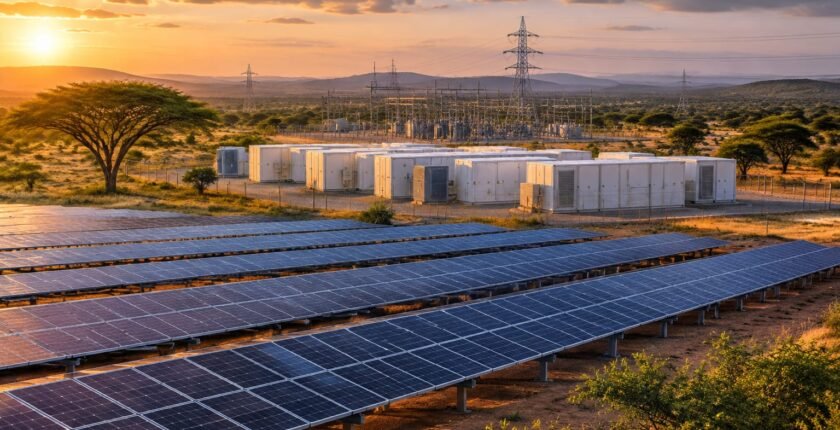
Botswana battery storage is moving from policy into site plans. Botswana Power Corporation (BPC) has filed a revised environmental and social management plan, dated 6 November, for a 25MW battery holding 100MWh next to the 100MW Mmadinare Solar PV Cluster in the Bobirwa District. BPC says the World Bank will pay for the first construction phase, which it expects to start in 2027 and run for 9 to 12 months. The battery is meant to steady the solar cluster's output, cut regional demand peaks and support grid frequency. The plan arrives as Botswana takes a climate plan to COP31 in Antalya. That plan names power generation as the country's largest carbon market opportunity.
Key takeaways
- The battery: BPC's revised plan, dated 6 November, describes a 25MW, 100MWh battery in 20 containers beside the 100MW Mmadinare Solar PV Cluster, with the World Bank funding the first build.
- Timeline: BPC has scheduled construction for 2027 over 9 to 12 months, and the battery needs grid-connection and regulatory approval from the Botswana Energy Regulatory Authority before commissioning.
- Solar share: Statistics Botswana figures show solar produced 9.1% of domestic generation in the first quarter of 2026, up from 3.2% a year earlier, while the Morupule A and B coal plants supplied 90.8%.
- Carbon markets: Botswana's third NDC rates energy generation as its largest carbon market opportunity and puts conditional mitigation needs at $1.5 billion between 2026 and 2035.
Table of contents
- Key takeaways
- A Four-Hour Battery Planned for the Mmadinare Solar Cluster
- What the Mmadinare Solar Cluster Has Already Delivered
- Mmadinare Is One Piece of a 50 Percent Renewables Goal
- Power Generation Tops Botswana's Carbon Market Plans
- Regulatory Approval Still Stands Before Commissioning
- What could speed or slow the Mmadinare battery
- What to be careful about
- Frequently asked questions
A Four-Hour Battery Planned for the Mmadinare Solar Cluster
BPC's plan pairs 20 battery containers with five power conversion units. These are the inverter units that turn stored direct current into alternating current for the grid. Rated at 25MW with 100MWh of energy, the system could discharge at full power for about four hours.
The fenced compound will use 2 hectares of a 40-hectare plot roughly 8km south-east of Mmadinare. BPC lodged the revised plan with the Department of Environmental Protection in Selebi Phikwe.
BPC gives the battery three jobs. Firming means filling dips in the cluster's output so the grid receives steadier supply. Peak shaving means releasing stored power when regional demand is highest. Frequency services are fast injections or withdrawals of power that keep the grid stable.
BPC says the World Bank will pay for the first round of construction. It has scheduled that work for 2027 and expects it to take 9 to 12 months. Those dates come from an environmental filing. They are not a signed build contract.
What the Mmadinare Solar Cluster Has Already Delivered
Scatec built and owns the 100MW cluster next door. Scatec is a Norwegian independent power producer, and it sells the plant's electricity to BPC under a 25-year power purchase agreement. David Kgoboko, BPC's Chief Executive, said the plant had sent more than 243,288MWh into the grid by its official launch on 31 August. He said it has stayed above 99% for availability and reliability since it began running.
Solar is now a measurable slice of national supply. Statistics Botswana figures, carried by Mmegi, show the plants at Bobonong, Phakalane, Shakawe and Mmadinare generating about 82,520MWh in the first quarter of 2026. That equals 9.1% of domestic generation, compared with 3.2% a year before.
Imports dropped 29.8% from the previous quarter. Coal still dominates, though. The Morupule A and B stations supplied 90.8% of locally generated power. On a grid that leans this hard on coal, solar can only cover the evening if some of its daytime output is stored.
Mmadinare Is One Piece of a 50 Percent Renewables Goal
Botswana's revised Integrated Resource Plan is the government's long-range blueprint for power supply. It aims for renewables to provide 50% of the generation mix by 2030, up from about 8%.
At Maun, President Duma Boko broke ground in April on a 500MW solar plant with a 500MWh battery. BPC is delivering it with Okavango Solar through a government-to-government partnership with Oman, backed by a 30-year power purchase agreement. The Maun battery holds about one hour of output at full power. Mmadinare's holds roughly four, so the two are built for different jobs.
Separately, the World Bank approved its Renewable Energy Support and Access Accelerator project in July 2024. The project combines an $88 million loan with $34 million from the Green Climate Fund, and it includes 50MW of utility-scale battery storage. BPC's plan does not say whether the Mmadinare battery counts toward that 50MW.
Power Generation Tops Botswana's Carbon Market Plans
A nationally determined contribution, or NDC, is the climate pledge each country files under the Paris Agreement. Botswana's delegation has carried its third NDC to COP31 in Antalya, and Argus reported that the document puts energy generation at the top of its ranking for carbon market activity, describing its potential as the "largest". It rates nature-based removals as "significant" and bushfire management and refrigerant transitions as "moderate". It expects a "lower volume" from energy efficiency.
Carbon Pulse said the government aims to complete a draft carbon market framework in the first quarter of 2027. The draft splits the work by cost. Cheap reductions stay at home to meet Botswana's own target. Under Article 6, costlier ones would go to foreign buyers in the form of internationally transferred mitigation outcomes. For energy generation, the draft lists Article 6.2 and the Paris Agreement Crediting Mechanism as suitable routes.
The NDC puts mitigation under the unconditional target at $224 million between 2026 and 2035. It puts conditional mitigation at $1.5 billion over the same years. The second NDC, filed in December 2024, had set the conditional need to 2030 at $2.7 billion. Argus reported that about $50 million of that has been secured.
Regulatory Approval Still Stands Before Commissioning
BPC's plan states that the battery cannot be commissioned until the Botswana Energy Regulatory Authority (BERA) grants grid-connection and regulatory approvals. BERA's own legal footing is also shifting. Mmegi reported that BERA's Chief Executive, Never Tshabang, told the National Business Conference in Francistown in October that amendments to the authority's Act were due in Parliament's November sitting. The changes would introduce electricity trading and give independent transmission providers legal recognition.
Those reforms could matter beyond this one site. If electricity trading arrives, storage owners could find buyers other than a single utility. Until BERA signs off and World Bank terms are settled, the 2027 start remains a target.
The site raises fewer questions. The Ngwato Land Board allocated the plot to BPC, and fieldwork found nobody living there, so no resettlement plan is needed.
| Project | Storage | Linked generation | Backing | Status |
|---|---|---|---|---|
| Mmadinare battery | 25MW / 100MWh | 100MW Mmadinare Solar PV Cluster | World Bank (first construction, per BPC) | Build scheduled for 2027 |
| Maun solar and battery | 500MWh | 500MW solar | BPC with Okavango Solar, Oman partnership, 30-year PPA | Ground broken in April |
| World Bank accelerator | 50MW utility-scale | Renewables programme | $88 million loan, $34 million Green Climate Fund | Approved July 2024 |
What could speed or slow the Mmadinare battery
The case for
- About four hours of storage at 25MW lets the battery shift daytime solar into the evening, which the one-hour Maun design does not.
- BPC says World Bank money will cover the first construction phase.
- Solar's share of domestic generation rose from 3.2% to 9.1% in a year, and the adjoining cluster has run above 99% availability, Kgoboko said.
- BERA Act amendments allowing electricity trading could open more revenue routes for storage.
The case against
- Coal from Morupule A and B still supplies 90.8% of local generation.
- Commissioning depends on BERA grid-connection and regulatory approvals that have not yet been granted.
- Argus reported that only about $50 million of the $2.7 billion conditional need to 2030 has been secured.
- The 2027 build date appears in an environmental plan, not in a signed construction contract.
What to be careful about
- BERA approvals or delays to the BERA Act amendments could push commissioning beyond the 9 to 12 month build window.
- The World Bank's commitment is described by BPC. The amount and terms for this battery have not been published.
- Botswana's own NDC warns that selling cheap reductions abroad could leave too little for its unconditional target, so carbon revenue from power projects has limits.
The bottom line
The Mmadinare battery is small next to Maun. Its four-hour duration, though, suits it to carrying solar into the evening on a grid where coal still does most of the work. It also sits beside a plant that, on Kgoboko's figures, has run reliably since start-up. What it still lacks is everything that turns a filing into hardware: BERA approval, published World Bank terms and crews on site in 2027. The national picture looks similar. Botswana wants half its power from renewables by 2030 and hopes generation projects will earn carbon revenue. Yet it has secured about $50 million against a $2.7 billion conditional need. The test from here is delivery, not ambition.
What to watch
- Watch for the draft carbon market framework, which Carbon Pulse reported is targeted for the first quarter of 2027, and whether it keeps Article 6.2 and the Paris Agreement Crediting Mechanism as routes for power projects.
- Watch for construction at Mmadinare to begin in 2027, as BPC has scheduled. The build is expected to take 9 to 12 months.
- Watch for BERA's grid-connection and regulatory approvals for the battery. No date has been set for them.
Frequently asked questions
Will the Mmadinare battery displace farmers or residents?
The Ngwato Land Board allocated a 40-hectare site to BPC, and the company's fieldwork turned up no residents there, so no resettlement is planned. Only about 2 hectares will be fenced. The other 38 stay open for neighbouring farmers' livestock and for communities that collect non-timber forest products there.
What is an ITMO and why does Botswana want to sell them?
An internationally transferred mitigation outcome is an emission cut that one country sells to another under Article 6 of the Paris Agreement. Botswana's draft framework would sell its higher-cost reductions this way and keep the cheaper ones for its own target. Carbon Pulse reported that the framework is targeted for the first quarter of 2027.
How much climate finance is Botswana seeking at COP31?
BOPA, the state news agency, reported that the government will seek $4.32 billion in climate finance at COP31 in Antalya. Under the second NDC, Argus reported, only about $50 million of a $2.7 billion conditional need to 2030 had been secured.
Does Botswana still import electricity?
Yes, though less than before. Statistics Botswana figures show imports fell 29.8% in the first quarter of 2026 compared with the previous quarter. The Morupule A and B coal plants supplied 90.8% of power generated in the country.
Related reading