
Blog
Audubon of Rhode Island Goes Solar to Hit Net-Zero
Estimated reading time: 4 minutes · Last updated:
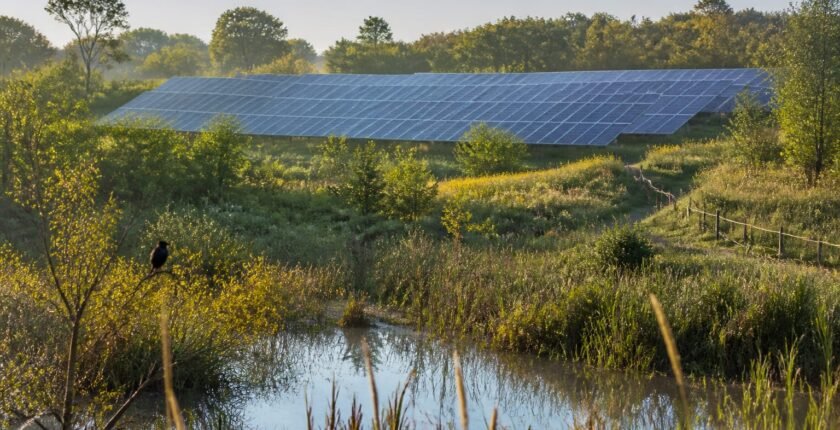
The Audubon Society of Rhode Island is installing solar canopies at its Bristol nature center and at its Smithfield headquarters to offset all of the group’s electricity use and move its RePower Audubon plan toward net-zero energy. The projects include 288 solar panels in Bristol that installers say will generate roughly the electricity used by about 25 homes and contribute to an expected $100,000 annual saving in energy costs. The work sits inside a $4.25 million electrification programme funded by federal and state grants plus private philanthropy and aims to eliminate all fossil fuel use by 2040.
At Audubon we decided that if we were asking others to take climate change seriously, we needed to look at ourselves. We needed to walk the talk,
Jeff Hall
Key takeaways
- Audubon Society of Rhode Island broke ground on the Bristol solar canopy on Sept. 25 and plans a similar project at its Smithfield headquarters.
- The Bristol array will deploy 288 solar panels, estimated to power about 25 homes and to deliver $1.4 million in savings over a 25-year lifespan.
- The society says electrifying its properties is part of a $4.25 million plan funded by federal grants, state support and private philanthropy.
Table of contents
What RePower Audubon covers and where the canopies will sit
RePower Audubon is the society’s multi-year programme to replace fossil-fuel systems across its properties with electric alternatives and on-site generation. The initiative has already fitted energy-efficient electric heat pump systems in the Bristol nature center and the Smithfield offices, and now adds ground-up solar canopies to meet electricity demand directly.
The first canopy broke ground on Sept. 25 at the Bristol center. NEC Solar is installing the array there and expects construction to finish soon; Audubon says it will begin construction at the Smithfield headquarters early next year on a similar canopy. Once both arrays operate, Audubon of Rhode Island expects to be a net-zero energy operation for electricity use and will proceed to electrify seven houses, barns and other buildings on its 14 properties.
How the solar arrays translate into savings and energy impact
Audubon says the Bristol canopy will include 288 solar panels, which it estimates will generate enough power for about 25 homes; Audubon cites calculations showing the system should save $1.4 million over a 25-year lifespan. Audubon estimates that electrifying operations and adding on-site generation will reduce its annual energy bill by about $100,000, funds the society plans to redirect into conservation work.
Beyond direct generation, the society has added battery storage at Smithfield and plans more storage to remove the remaining need for fossil-fuel backup at Bristol, where aquarium demands still force limited furnace use. Federal grants, a specific grant from the Natural Resources Conservation Service for an electric tractor from the Netherlands, state funding and private philanthropy are named as funding sources for the $4.25 million package.
Remaining constraints, technical steps and the 2040 objective
Audubon of Rhode Island frames the solar canopies as the step that will allow it to convert heating and vehicle fleets to electricity across its properties. The society reports a 97 percent reduction in natural gas use at the Bristol center to date but says a supplemental furnace remains because aquarium heating imposes peak loads that current batteries cannot yet cover.
The Audubon Society’s ultimate aim is to eliminate all fossil fuel use by 2040. That objective depends on completing the canopy projects, adding further batteries to replace remaining furnace reliance, and converting transport and equipment to EVs and electric machines; a battery-powered tractor is already being delivered with support from a Natural Resources Conservation Service grant.
What could move this either way
The case for
- Federal grants, a named NRCS grant for equipment and state support supply most of the $4.25 million plan, which reduces the society’s need for large up-front capital.
- On-site generation from the two canopies plus existing batteries and heat pumps already cuts fossil fuel consumption sharply: the Bristol center reports a 97 percent reduction in natural gas use so far.
The case against
- The Bristol aquarium’s peak heating demand still requires the old furnace until further battery capacity is installed, meaning full fossil-fuel elimination is conditional on successful battery deployment.
- Planned savings rely in part on projected generation and grant funding; delays to construction, lower-than-expected output or gaps in later funding would slow progress toward the 2040 goal.
What to be careful about
- Remaining reliance on the Bristol furnace until batteries can cover aquarium peak loads creates a technical barrier to true-zero emissions.
- The plan’s scale depends on continued grant funding and philanthropy under a $4.25 million budget; shortfalls would force slower phasing of building and vehicle conversions.
- Projected lifetime savings and generation figures assume the installed arrays perform as forecasted; lower output or higher maintenance costs would reduce the expected $1.4 million and $100,000 benefits.
The bottom line
Audubon of Rhode Island’s canopy projects convert a conservation mission into operational change: on-site solar, batteries and heat-pump retrofits together target immediate electricity offsetting and longer-term elimination of fossil fuels by 2040. The Bristol array’s 288 panels and existing heat-pump installations already cut natural gas use dramatically and are expected to yield substantial lifetime savings, but completing the transition depends on adding battery capacity and finishing construction at Smithfield. If the funding and technical pieces hold, the society will move from demonstration projects into full electrification across its 14 properties.
What to watch
- watch for an announcement that NEC Solar has completed the Bristol canopy; no date has been set.
- watch for the start of construction on the Smithfield canopy at the society’s headquarters; no date has been set.
Frequently asked questions
How much will the solar projects save Audubon of Rhode Island?
Audubon estimates about $100,000 a year in energy-cost savings and says the Bristol system will save roughly $1.4 million over a 25-year lifespan.
What does the Bristol canopy include and how much generation will it provide?
The Bristol array comprises 288 solar panels; installers say that output will be roughly equivalent to the electricity used by about 25 homes, contributing most of the generation needed to reach net-zero for electricity.
Who is funding the electrification programme?
The society says the $4.25 million plan is being funded by federal grants, state support and private philanthropy, and that the Natural Resources Conservation Service provided a grant tied to the purchase of an electric tractor.
Related reading