
Blog
Long-duration energy storage and UK energy resilience
Estimated reading time: 5 minutes · Last updated:
Long-duration energy storage (LDES) has emerged as a practical lever infrastructure specialists are using to shore up the UK’s energy resilience. Firms such as Jacobs, Arcadis and WSP point to a mix of measures — LDES projects, National Grid’s Great Grid Upgrade and design standardisation — as the routes to capture curtailed renewable output and smooth system demand. The paper trail is specific: Ofgem progressed its LDES selection on 26 June 2026 with 16 projects identified as 'minded to approve', the Great Grid Upgrade covers 17 major projects, and Jacobs says it is involved in five shortlisted LDES schemes.
The UK is very much in the energy transition and it’s multi-faceted – we have to consider sustainability, affordability, security and more increasingly sovereignty around the transition. It’s very complex and there are a lot of moving parts associated with it.
Alan Fotheringham, Jacobs low carbon solutions director, energy and power
Key takeaways
- On 20 March 2025 an outage at North Hyde Substation caused an electrical fire and forced a full-day closure at Heathrow Airport, a failure cited as exposing UK resilience gaps.
- Ofgem moved its LDES programme into project selection on 26 June 2026, identifying 16 projects as 'minded to approve', and Jacobs says it is involved in five of those schemes.
- National Grid’s Great Grid Upgrade comprises 17 major transmission projects across England and Wales to expand and modernise the network.
- Jacobs is developing a 4MWh compressed-air energy storage pilot in Cyprus using ballasted seabed tanks as a first-of-a-kind man-made storage cavity.
Table of contents
- Key takeaways
- Why the North Hyde outage focused attention on resilience
- How long-duration energy storage is being positioned in the UK system
- Managing climate, cyber and supply-chain risk in parallel
- Speeding delivery through standardisation and the Great Grid Upgrade
- The cases for and against rapid LDES-led resilience
- What to be careful about
- Frequently asked questions
Why the North Hyde outage focused attention on resilience
The 20 March 2025 electrical fire at North Hyde Substation and the resulting day-long closure of Heathrow crystallised a wider view among infrastructure teams: single-asset failures can cascade into major economic and safety impacts. Specialists now view resilience as both system-wide planning and asset-level hardening. That shift is visible in commissioning decisions and in how owners prioritise upgrades to substations, protection schemes and cyber segmentation.
Infrastructure consultancies point out that the incident did not arise in isolation. Rising demand from data centres, supply-chain fragility and geopolitical shocks have added to operational stress. Practically, that has translated into a dual track approach: accelerate low-carbon capacity while protecting immediate supply through a mix of domestic hydrocarbons and faster-build resilience measures.
How long-duration energy storage is being positioned in the UK system
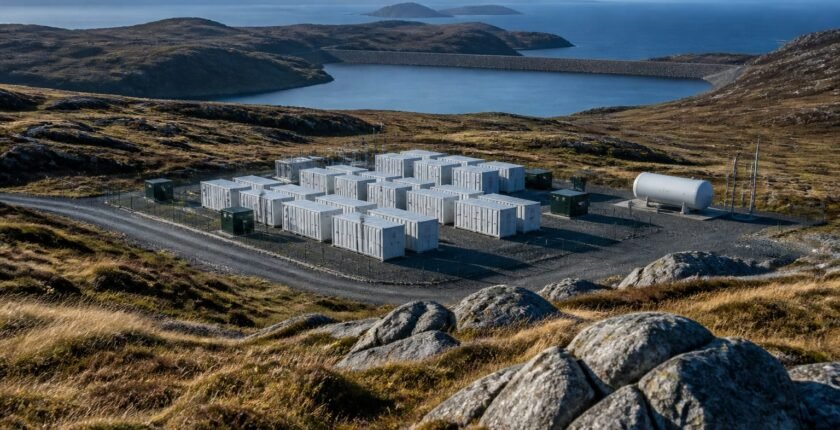
Specialists treat LDES as a mechanism to absorb generation when supply outstrips demand and to release it later, matching intermittent wind and solar to periods of need. Industry participants highlight both electrochemical batteries for shorter-duration balancing and larger, novel approaches such as compressed-air systems and hydrogen storage for longer holds. Ofgem’s LDES programme moved into project selection on 26 June 2026 with 16 projects identified as 'minded to approve', signalling regulator-level support for deployment.
Technical opportunity is one reason for the emphasis: the UK’s geology includes halite deposits and depleted gas fields that can host high-capacity, naturally airtight cavities suitable for compressed-air or hydrogen storage. Jacobs describes work across multiple LDES bids and notes a 4MWh compressed-air pilot in Cyprus that stores air in ballasted seabed cylinders as an example of innovation transferable to the UK context.
Managing climate, cyber and supply-chain risk in parallel
Consultancies underscore that resilience planning now spans climate adaptation, cybersecurity and procurement. Arcadis points to more frequent extreme heat — with temperatures reaching 40°C in the UK in recent seasons — and heavier winter rainfall as drivers for flood defences, heat-tolerant transformers and buried cables. Those physical upgrades are being combined with vulnerability mapping and targeted civil works on substations.
On cybersecurity, firms are implementing network segmentation for operational technology so that an incident at one substation cannot propagate across zones. Supply-chain pressures are equally concrete: build programmes worldwide are competing for large transformers, circuit breakers and synchronous condensers, and project teams are using centralised digital platforms to map lead times and lock in capacity.
Speeding delivery through standardisation and the Great Grid Upgrade
Delivery scale is the central programme management challenge. National Grid’s Great Grid Upgrade is a package of 17 major infrastructure projects across England and Wales to expand transmission capacity and connect new generation. Consultancies are responding by reusing standard design templates for substations, overhead-line components and civils to reduce engineering time and supply-chain friction.
WSP, for example, applies kit-of-parts approaches and centralised pools of designs so teams can adapt rather than redesign foundations, switchgear layouts and haul roads. That approach aims to shorten consenting and construction windows and to free manufacturing capacity for repeat items such as precast foundation frames and transformer kits.
| Item | Role in resilience | Status/number | Key participants |
|---|---|---|---|
| North Hyde Substation outage | Catalyst for resilience action and asset hardening | 20 March 2025 | Heathrow Airport; local network operators |
| LDES (Ofgem programme) | Store curtailed renewables for later dispatch | 16 projects minded to approve (26 June 2026) | Ofgem; Jacobs (in five bids) |
| Great Grid Upgrade | Expand transmission capacity and connect renewables | 17 major projects | National Grid; WSP (nine projects involvement) |
| Compressed-air pilot (Cyprus) | Technical trial of seabed ballasted tank storage | 4MWh pilot | Jacobs |
The cases for and against rapid LDES-led resilience
The case for
- Ofgem’s progression of LDES selection and a portfolio of 16 projects create regulatory momentum and an investment signal for long-duration technologies.
- The UK’s geology — halite deposits and depleted gas fields — offers technically favourable sites for large-volume storage such as compressed air or hydrogen, reducing deployment costs versus fully engineered tanks.
- Standardised design and kit-of-parts construction applied across the Great Grid Upgrade can shorten delivery timelines and concentrate manufacturing demand into repeatable orders.
The case against
- Global demand for large electrical components is creating long lead times for transformers, circuit breakers and synchronous condensers, slowing grid and storage projects alike.
- Climate extremes and asset exposure (summer heat and winter flood risk) increase the complexity and cost of upgrades required for resilience.
- Cybersecurity vulnerabilities in operational technology remain a persistent risk that can limit the benefits of distributed storage unless network segmentation is fully implemented.
What to be careful about
- Competing demand for large transformers and switchgear across multiple national build programmes could delay both grid upgrades and LDES deployment.
- Insufficient site-level climate adaptation (flood defences, heat-tolerant transformers) risks asset outages during extreme weather in summer or winter.
- Incomplete OT network segmentation would allow a single substation incident to affect wider zones, undermining the resilience benefit of distributed storage.
The bottom line
Infrastructure specialists are approaching UK energy resilience as a programme of complementary moves: deploy storage at scale, expand and modernise transmission, harden assets against climate extremes, and reduce delivery friction through standardised designs. Ofgem’s LDES progression on 26 June 2026 and the Great Grid Upgrade’s 17-project scope give a clear policy and delivery spine, while pilots such as a 4MWh compressed-air tank in Cyprus test practical options. Success will depend on resolving supply-chain pinch points and embedding cyber and climate adaptations at pace so that storage and grid upgrades deliver the resilience they promise.
What to watch
- Watch for Neso to open the public consultation on the draft Strategic Spatial Energy Plan; the interviewee says this will open in early next year.
- Watch for Neso to publish the final Strategic Spatial Energy Plan in Autumn 2027 as planned.
- Watch for Ofgem to confirm which LDES projects move from 'minded to approve' to a final funding decision; no date has been set.
Frequently asked questions
What is long-duration energy storage and why is it relevant to UK resilience?
Long-duration energy storage (LDES) stores electricity for many hours or days, allowing curtailed wind or solar to be held and dispatched later; Ofgem advanced its LDES programme into project selection on 26 June 2026 with 16 projects identified as 'minded to approve'.
How does the Great Grid Upgrade interact with storage plans?
The Great Grid Upgrade is a set of 17 major transmission projects to expand capacity and connect renewables; standardised substation and overhead-line designs are being used to speed delivery and to make room for LDES assets at strategic nodes.
What immediate risks are infrastructure teams prioritising?
Teams are prioritising climate adaptation and supply-chain resilience after events such as the 20 March 2025 North Hyde Substation outage and recent UK summer heat reaching 40°C; practical measures include flood defences, heat-tolerant transformers and buried cables.
Related reading