
Blog
Power beaming could keep PHASA-35 drone aloft 24/7
Estimated reading time: 4 minutes · Last updated:
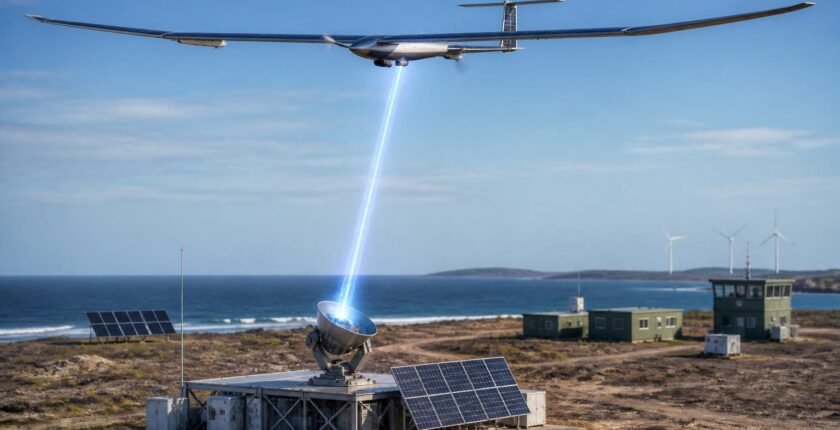
Power beaming PHASA-35 is the technique BAE Systems will test to keep its solar stratospheric drone flying through long nights. Under a £15.7-million (US$21 million) contract, BAE’s Prismatic subsidiary — with funding from the Advanced Research + Invention Agency (ARIA) — will develop ground stations that beam microwaves to a receiver built into the wing. That receiver will convert the beam back into electricity for the PHASA-35’s motors and batteries, a change the company says could let the craft patrol for up to a year while cutting onboard battery mass. The programme runs for three and a half years.
PHASA-35 has already proven its worth in the stratosphere as a low-cost alternative to satellites and now this exciting project will explore whether we can make it even more capable.
Bob Davidson, CEO BAE Systems' Prismatic
Key takeaways
- BAE Systems won a £15.7-million (US$21 million) contract, with ARIA backing, to develop ground-to-air power beaming for PHASA-35.
- PHASA-35 is designed to operate above 66,000 ft (20,117 m) on 115-ft (35-m) carbon-composite wings and cruises at 49 knots (56 mph, 90 km/h).
- The project will run for three and a half years and aims to let the aircraft patrol for up to a year by supplementing solar power with beamed microwaves.
- BAE says shifting some energy off batteries could free structural weight for heavier communications and sensor payloads.
Table of contents
How ground-to-air beaming is intended to power PHASA-35
The technical plan is straightforward: fixed ground stations will convert grid electricity into a microwave beam, aim that beam at the aircraft while it cruises in the stratosphere, and the aircraft will recover the energy through a receiver built into the wing skin. Onboard power electronics will turn the received RF energy back into the direct electricity needed by motors and battery charging systems.
That receiver design must balance conversion efficiency against weight and aerodynamic integration. PHASA-35 carries solar arrays across 115-ft (35-m) carbon-composite wings and operates where the air is thin; any receiver hardware therefore needs to be both light enough not to harm endurance and rugged enough to withstand stratospheric temperatures and ultraviolet exposure.
Why beaming matters for high-latitude endurance
Solar alone can sustain the PHASA-35 in equatorial sun for long stretches, but at higher latitudes seasonal darkness and long nights reduce available generation. BAE identifies this seasonal deficit as the central limit on persistent solar pseudo-satellites: when sunlight falls away, batteries must supply all propulsion and payload power.
Replacing a fraction of battery capacity with externally supplied energy reduces the mass penalty of carrying large battery stores through long nights. BAE argues that freeing structural weight previously dedicated to batteries would allow the aircraft to carry heavier communications or sensor packages while maintaining long-endurance flight profiles in places such as Northern Europe.
Project scope, partners and schedule
ARIA is funding the work and BAE Systems assigned the contract to its Prismatic subsidiary. The award is reported at £15.7-million (US$21 million) and the development window is three and a half years. BAE frames the effort as proof-of-concept engineering rather than immediate operational rollout.
That timetable covers design, ground-station development, integration of the beaming receiver into the wing structure and demonstration flights. The company says the aim is to test whether ground-to-air microwaves can be made reliable enough, and light enough, to deliver the claimed endurance gains without compromising flight handling or payload capacity.
Operational benefits and practical challenges
If the beaming system meets its goals, the immediate benefit is endurance: BAE says the aircraft could patrol for up to a year while shifting some of the energy burden away from batteries. That creates a choice designers can exploit—less battery mass for more sensor and communications capability—useful where persistent coverage is the objective.
Those gains depend on several technical and regulatory conditions. The project requires a network of ground stations with line-of-sight to the aircraft, certified safe microwave transmission levels, and receivers whose conversion efficiency and mass produce a net endurance gain. Weather, air-traffic coordination and spectrum allocation for high-power microwave links are practical hurdles the programme will need to address.
What could move this either way
The case for
- Extending operational endurance could let PHASA-35 deliver continuous communications or monitoring in regions where satellites are costly or impractical.
- Reducing battery mass would allow larger communications and sensor payloads on the same airframe, improving the craft’s utility for long-endurance missions.
The case against
- The programme depends on building ground-station coverage; sparse stations limit where beaming can extend endurance.
- Regulatory approval for high-power microwave transmission, and the net energy-conversion efficiency of the receiver, are both unresolved technical and policy hurdles.
What to be careful about
- Insufficient conversion efficiency: receivers that are too heavy or inefficient could erase any endurance gains from beam charging.
- Limited ground-station footprint: without a network of transmitters, beaming will not enable continuous coverage over wide regions.
- Regulatory and safety constraints on high-power microwave links could restrict operating bands or transmission power, limiting practical performance.
The bottom line
BAE Systems’ ARIA-backed programme aims to test whether a ground-to-air microwave link can fill seasonal gaps in solar generation and let PHASA-35 remain on station longer. The contract and three-and-a-half-year timetable set clear engineering goals: demonstrate a receiver that is light and efficient enough to justify cutting battery mass, build prototype ground stations and prove safe, reliable beam transfer. Success would change the trade-offs designers make between batteries and payload on stratospheric pseudo-satellites; failure would leave the platform reliant on current solar-and-battery limits. The coming demonstrations will show which outcome is nearer.
What to watch
- watch for announcements of ground-to-air power-beaming test flights under the ARIA-backed programme; no date has been set.
- watch for BAE Systems or Prismatic updates on trial results and performance targets; no date has been set.
Frequently asked questions
What is PHASA-35?
PHASA-35 is BAE Systems’ high-altitude pseudo-satellite designed to fly above 66,000 ft (20,117 m) on 115-ft (35-m) carbon-composite wings, cruising at about 49 knots (56 mph, 90 km/h) for long-endurance missions.
How would power beaming keep the drone aloft?
Fixed ground stations will beam microwaves to the aircraft; an onboard receiver converts the received RF energy back into electricity for motors and battery charging, supplementing the solar arrays on the wing.
What are the programme’s cost and timeline?
The work is backed by ARIA and funded by a reported £15.7-million (US$21 million) contract to BAE’s Prismatic; the development window is three and a half years.
Related reading