
Blog
Ken Caryl Shows Ground-Source Heat Pumps’ Potential
Estimated reading time: 6 minutes · Last updated:
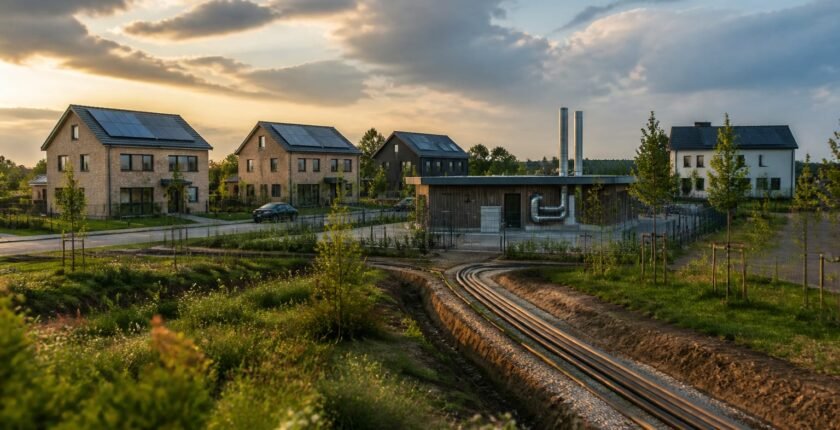
A new subdivision at Ken Caryl Ranch, south of Denver, is the first large-scale test of a builder-led roll-out of ground-source heat pumps in single-family homes. Dandelion Energy and Lennar have completed nearly 100 homes there with a single bore between 200 and 500 feet and ground temperatures of about 50 degrees Fahrenheit, and Dandelion says its rig and workflow can finish projects twice as fast and at half the cost of traditional installations. The project and its economics, as first reported by Inside Climate News, show how faster drilling, utility rebates and builder scale can change the calculus for residential geothermal.
the only system that actually reduces peak demand and electrifies homes at the same time,
Dan Yates, Dandelion Energy CEO and chairman
Key takeaways
- Deployment: Dandelion Energy and Lennar completed nearly 100 homes with ground-source heat pumps at Ken Caryl Ranch in Littleton, Colorado.
- Design: Each home uses a single bore between 200 and 500 feet deep where temperatures are approximately 50 degrees Fahrenheit year-round.
- Market size: The U.S. Department of Energy reports just over 1 million homes have ground-source heat pumps and about 100,000 new installations each year.
Table of contents
Why Ken Caryl matters for residential heating
Ken Caryl Ranch matters because it packages a technology that is usually custom and costly into a volume-built workflow. Dandelion and Lennar completed nearly 100 new homes equipped with ground-source heat pumps, each installed before foundations were poured. Doing similar work one house at a time usually adds transport delays and bespoke designs; in a neighbourhood build, crews move a lightweight rig from lot to lot and keep a steady cadence.
The headline technical point is simple: ground-source heat pumps draw on stable subsurface temperatures to pre-condition the water that feeds a heat pump in the basement. At Ken Caryl the boreholes are between 200 and 500 feet deep and the subsurface is about 50 degrees Fahrenheit year-round. That steadiness lowers the electricity a heat pump needs, especially during cold snaps when air-source units become less efficient.
How Dandelion is trying to cut time and cost
Dandelion says it can finish geothermal heating and cooling projects twice as fast and at half the cost of similar installations by standardising designs and using a mobile drilling rig. Dan Yates, Dandelion’s CEO and chairman, described the company’s approach as applying a “mass market and maximally efficient lens” to a product that has historically been bespoke. On a tract development the crew can drill boreholes for one or more homes per day; transporting a comparable rig to a single retrofit site can consume an entire day.
That operational change matters because upfront drilling and installation are the chief barriers. Drilling alone often costs more than $10,000, and the U.S. Department of Energy reports upfront installation for a typical new home averages around $25,000. Standardising the job, installing before foundations, and eliminating custom HVAC retrofits are the levers Dandelion and builders like Lennar use to bring costs down.
Economics: incentives, scale and the DOE picture
Economics set the pace for adoption. The Department of Energy found just over 1 million U.S. homes have ground-source heat pumps today, with roughly 100,000 new installs each year, and projected that geothermal could reach 7 million homes by 2035. The DOE model estimated that shift would cut winter peak demand by more than 40 gigawatts and lower U.S. electric grid costs by about $4 billion per year.
Those system-level gains rest on household-level affordability. Utilities and state governments are offering substantial incentives: in Colorado, Xcel Energy runs a program that allocates roughly $25,000 to each new, high-efficiency home that installs a ground-source heat pump, and the state provides a $2,000 tax credit. Federal tax law makes commercial geothermal projects eligible for tax credits that cover 30 percent or more of installation costs, improving the economics where those incentives apply.
Barriers remain: geology, space and permitting
Even with faster drilling and big rebates, barriers persist. The DOE and industry observers point to upfront cost — about $25,000 on average per home — and drilling expenses that can exceed $10,000. Juliet Simpson, lead author of a study published in iScience, said the technology is “technically possible everywhere” but that local subsurface conditions affect feasibility and cost.
Other practical limits include space constraints in dense urban lots and permitting processes that vary across jurisdictions. Yara van Ingen of BloombergNEF highlights that air-source heat pumps outsold ground-source units by a wide margin last year—3.6 million air-source heat pumps were sold in the U.S.—which means installers, supply chains and consumer familiarity currently favour air-source systems even where geothermal is economically viable.
| Attribute | Ground-source heat pump | Air-source heat pump | Source |
|---|---|---|---|
| Typical upfront cost | $25,000 (typical new home, DOE) | Lower than ground-source on average (not quantified in source) | U.S. Department of Energy; Inside Climate News reporting |
| Seasonal efficiency in cold snaps | Uses about one-quarter the electricity of air-source heat pumps (per Dandelion in cold snaps) | Less efficient in cold snaps (per Dandelion) | Dandelion Energy; Inside Climate News |
| Annual sales (U.S., recent year) | About 100,000 new installs per year (ground-source) | 3.6 million units sold (air-source) | U.S. Department of Energy; BloombergNEF |
How this could scale — and why it might stall
The case for
- Builder-led installs, like Lennar’s work at Ken Caryl, reduce mobilisation time and bespoke design costs, enabling crews to drill multiple boreholes per day and cut per-home labour.
- Existing incentives materially improve project economics: Xcel’s program offers approximately $25,000 per home in Colorado and Colorado provides a $2,000 tax credit, while federal tax credits cover 30 percent or more of some commercial installations.
- A 2025 DOE projection showing potential adoption to 7 million homes by 2035 implies substantial grid benefits — more than 40 gigawatts less winter peak demand and roughly $4 billion a year in avoided grid costs.
The case against
- High upfront costs remain a hurdle — drilling alone often exceeds $10,000 and DOE cites average new-home installation near $25,000 — which keeps many buyers and builders on the sidelines without continued incentives.
- Site-level constraints — variable geology, limited lot space and uneven permitting — can raise costs or rule out geothermal even when state- or national-level studies show technical potential.
- Market inertia favours air-source heat pumps: 3.6 million air-source units were sold in the U.S. last year, outpacing ground-source adoption and the installer base needed for rapid nationwide scale-up.
What to be careful about
- Program dependence: projects in Colorado rely on Xcel’s roughly $25,000-per-home rebate; removal or reduction of that rebate would worsen household economics.
- Upfront-cost exposure: drilling costs often exceed $10,000 and DOE cites about $25,000 average installation cost, which can deter builders and buyers absent scale or subsidies.
- Permitting and site limits: permitting requirements vary across the U.S. and dense lots or unfavourable subsurface conditions can make projects infeasible or much more expensive.
- Supply and labour bottlenecks: scaling to thousands of homes a year requires more rigs, trained crews and supply-chain capacity than currently exists in many regions.
The bottom line
The Ken Caryl build illustrates how pairing a builder and a specialised installer can change geothermal’s economics: standardised designs, coordinated drilling and large rebates push a technology once seen as niche toward mainstream use. The Department of Energy’s figures — just over 1 million installed today, 100,000 new installs annually, and an estimated path to 7 million homes by 2035 with sizable grid savings — show the upside if those local lessons scale. At the same time, drilling costs, site constraints and the persistence of air-source sales mean the transition will depend on continued incentives, permitting reform and a rapid expansion of crews and rigs.
What to watch
- Watch for progress reports on Dandelion and Lennar’s larger Colorado initiative to install geothermal at more than 1,500 homes in the state; no date has been set.
- Watch for Dandelion’s announcements about scaling to 10,000 homes per year nationwide; no date has been set.
- Watch for changes to Xcel Energy’s rebate program in Colorado, which currently provides approximately $25,000 per home; no date has been set.
Frequently asked questions
How much does a ground-source heat pump installation cost?
The U.S. Department of Energy reports the upfront cost for a typical new-home ground-source heat pump averages around $25,000, and drilling alone often costs more than $10,000.
How many U.S. homes already use geothermal, and how big could adoption get?
According to the DOE, just over 1 million U.S. homes have ground-source heat pumps today, with about 100,000 new installations per year; the agency found geothermal could reach 7 million homes by 2035.
What incentives exist to lower the cost for homeowners?
In Colorado, Xcel Energy offers approximately $25,000 per home for new high-efficiency buildings with ground-source heat pumps and the state provides a $2,000 tax credit; the reporting also notes federal tax credits covering 30 percent or more for eligible commercial projects.
Related reading