
Blog
Underwater Solar Panels Generate Power at 10 Meters
Estimated reading time: 3 minutes · Last updated:
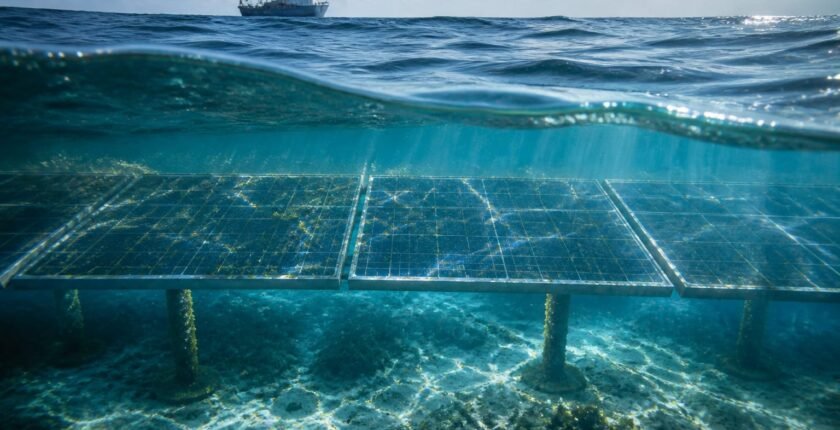
Scientists have demonstrated that perovskite-based underwater solar panels can produce electricity at a depth of 10 meters, according to a study published in Joule. The test, conducted near Weizhou Island off China’s southwestern coast and reported via EuroNews, ran for two hours and generated 324 milliwatt-hours. Measured peak power conversion efficiency reached nearly 35 percent under the study’s simulated conditions, close to the Shockley-Queisser limit of about 33 percent. Yunnan University materials scientist Wen-Hua Zhang says the experiment validates submerged operation down to about 10 meters and widens possible marine applications, though the authors note commercial deployment remains distant. The two-hour run powered a small LED for a few hours, the paper reports.
“this work presents the first functional validation of submerged solar cells practically operating at a water depth of up to about 10 meters, greatly broadening their application scope.”
Wen-Hua Zhang
Key takeaways
- Near Weizhou Island, sunlight was converted into electrical power at a depth of 10 meters.
- The simulated two-hour run yielded 324 milliwatt-hours and powered a small LED for several hours.
- Measured peak power conversion efficiency reached nearly 35 percent in simulation, close to the Shockley-Queisser limit of about 33 percent.
- Wen-Hua Zhang of Yunnan University described the test as a first functional validation of submerged solar cells at around 10 meters.
Table of contents
How the experiment worked
Researchers used perovskite-based cells tailored to absorb blue and green wavelengths that penetrate seawater. The team tested a module at 10 meters depth — nearly 33 feet — under controlled light conditions and recorded a peak conversion efficiency of nearly 35 percent in simulation. The test ran for two hours and produced 324 milliwatt-hours, about 162 milliwatts average output, the paper shows.
Those figures come from a laboratory setup reported in Joule rather than an open-ocean deployment. Field factors remain untested.
Why perovskites matter for submerged PV
Perovskite compositions can be tuned to match the spectral window available under water, which is why the authors chose them instead of conventional silicon. That spectral match is central to approaching the Shockley-Queisser limit, the paper argues, and the reported near-35 percent peak efficiency reflects that design choice.
The study notes the result was achieved under simulation; durability, salt corrosion and long-term degradation in seawater were not resolved by the two-hour test. Scaling from a lab module to ocean arrays poses engineering and maintenance challenges.
Potential marine uses and limits
The authors suggest submerged panels could serve low-traffic marine infrastructure, scientific sensors or local devices where surface panels are impractical. The test's 10 meters depth establishes a proof of concept for 'rarely traveled portions of the world's oceans,' the paper says, but it stops short of commercial feasibility.
Practical deployment would require solving mechanical anchoring, biofouling, and maintenance under corrosive seawater — issues the two-hour, 324 milliwatt-hour test could not address. Researchers call for longer open-water trials.
How this could progress
The case for
- Perovskite tuning lets submerged cells target blue-green wavelengths, which enabled the study's near-35 percent simulated peak efficiency.
- A laboratory proof of concept at 10 meters opens research paths for powering sensors and local marine devices where surface arrays are impractical.
The case against
- The result comes from a simulated, two-hour test; long-duration performance and materials stability in seawater remain unproven.
- Engineering challenges such as anchoring, biofouling and repair logistics could substantially raise costs and limit viable locations.
What to be careful about
- The experiment ran only two hours, so short-duration performance may not represent daily or seasonal outputs.
- Results are from simulated light and a laboratory setup, not open-ocean trials subject to waves, turbidity and weather.
- Perovskite materials can be sensitive to moisture and salts; the study did not provide long-term corrosion or degradation data.
The bottom line
Submerged perovskite photovoltaics demonstrably convert sunlight to electricity at 10 meters depth in a laboratory-simulated test, but the study's brief, two-hour run and simulated light leave key questions open. Peak efficiency near 35 percent and the 324 milliwatt-hours output show technical potential, and Wen-Hua Zhang at Yunnan University frames the result as a first functional validation. Still, moving beyond proof of concept will require extended field tests, independent efficiency verification, materials stability data in seawater and solutions for anchoring and biofouling. Until those steps are reported, underwater solar remains an intriguing laboratory advance rather than a deployable technology.
What to watch
- Watch for longer open-water trials of submerged perovskite modules; no date has been set.
- Watch for independent verification of the reported near-35 percent efficiency; no date has been set.
Frequently asked questions
How deep were the panels tested?
The researchers tested a module at 10 meters depth, which the paper notes is nearly 33 feet, during a laboratory-simulated experiment near Weizhou Island.
How much power did the experiment produce?
The two-hour run produced 324 milliwatt-hours, equivalent to about 162 milliwatts average output, and it powered a small LED for a few hours according to the paper.
Is this technology ready for commercial use?
No. The study and Wen-Hua Zhang of Yunnan University describe the result as a first functional validation; commercial deployment is distant because durability and scaling were not demonstrated in the two-hour test.
Related reading