
Blog
Gobi Solar Arrays Could Cut Spring Dust by Nearly 14%
Estimated reading time: 5 minutes · Last updated:
A paper in Geophysical Research Letters, whose lead author is based at a prominent Chinese university, reports that extensive PV arrays across the Gobi modify near-surface winds and raise soil moisture downwind enough to reduce dust entrainment. The authors estimate existing arrays prevent roughly 352,400 metric tons of dust from entering the atmosphere each spring month, and model scenarios tied to a complete buildout consistent with China’s 2060 target project an average springtime particulate concentration decline across northern China of nearly 14 percent. The effect combines a modest windbreak from panel rows with shading and lower evaporation that increase soil moisture and keep fine particles bound.
Key takeaways
- Measured dust suppression by existing arrays: Arrays already in place suppress about 352,400 metric tons of spring dust per month.
- Projected regional air-quality benefit: A full buildout modelled around China’s 2060 target could lower average springtime particulate concentrations across northern China by nearly 14 percent.
- Scale of desert installations cited: The Tengger Desert Solar Park covers 43 square kilometers, and China is targeting 455 GW of solar and wind in desertified regions by 2030.
- Operational trade-off for panels: Soiling reduces panel output by 15 to 25 percent without regular cleaning, while some installations keep losses below 5 percent using nano coatings or automated robots.
Table of contents
- Key takeaways
- How arrays make a desert less dusty
- What was measured and what was modelled
- The operational feedback: soiling cuts output even as panels cut dust
- Policy and valuation: when a power plant is also a public-good asset
- Case for and against counting dust suppression in project value
- What to be careful about
- Frequently asked questions
How arrays make a desert less dusty
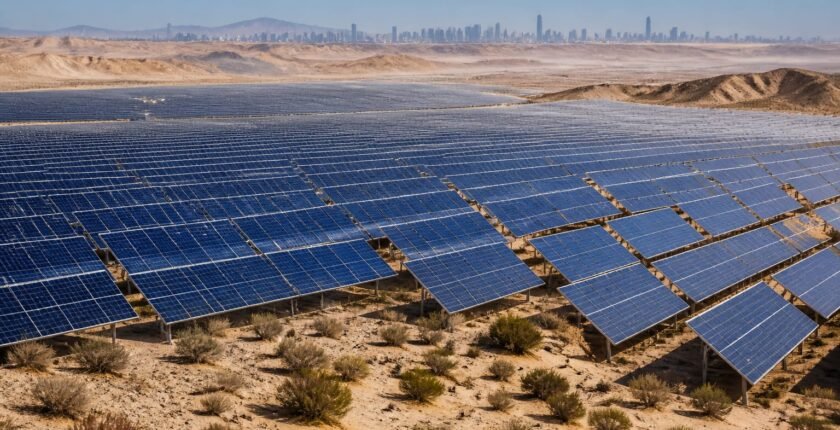
Rows of photovoltaic panels alter the local fluid mechanics of wind over a desert surface. Each row acts as a low windbreak, reducing gust speed at the ground; slower gusts lack the uplift necessary to mobilise fine particles. The study’s modelling couples that wind reduction with changes in surface energy balance: panels cast shade and lower direct evaporation, which raises near-surface soil moisture compared with bare sand.
Moist soil binds dust more effectively than dry soil, so reduced near-surface wind stress together with increased soil moisture cut emissions. To separate mechanical and microclimatic effects of arrays, the authors merged measurements from multiple satellite platforms with a regional model that links climate and atmospheric chemistry and incorporated a solar-farm parameterisation into the dust-emission scheme.
What was measured and what was modelled
The team report two separate results: a measured quantity tied to existing arrays and a projection from scenario modelling. Satellite-constrained analysis and the model together indicate arrays already standing suppress about 352,400 metric tons of dust each spring month. That figure is presented as a measured outcome of the arrays now in place, not as a future projection.
Separately, the regional model ran a full buildout scenario aligned with China’s longer-term planning and found that, by 2060 under that deployment, average springtime particulate concentrations across northern China could fall by nearly 14 percent. The paper stresses that the 14 percent number is a modelled projection linked to the assumed 2060 buildout rather than a direct, contemporaneous city-level measurement.
The operational feedback: soiling cuts output even as panels cut dust
The same dust the arrays suppress is the dust that lands on their glass and reduces generation. The paper cites industry estimates that sand and particulate accumulation can cut panel efficiency by 15 to 25 percent where regular cleaning is impractical. That loss creates a direct operational cost and a water demand problem where freshwater is scarce.
Manufacturers and some new projects mitigate that loss: nano self-cleaning coatings and automated robotic cleaning systems are reported to keep soiling losses below 5 percent at some Gobi installations. Those technologies narrow the trade-off between electricity yield and regional air-quality co-benefit, but they also raise capital and maintenance expenditures that influence project economics and siting decisions.
Policy and valuation: when a power plant is also a public-good asset
Permits and project valuations currently focus on megawatt-hours produced, while dust suppression falls under public-health and environmental budgets as well as energy accounting. The paper's authors say the co-benefits of solar farms in arid regions are "largely overlooked" when returns are assessed solely on energy generation, and formal recognition could shift how desert land and capital are allocated.
China’s planning context matters: the Tengger Desert Solar Park is cited at 43 square kilometers as an example of existing scale, and Chinese planners have set a target to deploy 455 GW of combined solar and wind capacity in desertified regions by 2030. If policymakers include reductions in airborne particulates when they calculate project benefits, proposals sited near dust-generating landscapes could be favoured—altering bidding processes, compensation and environmental mitigation for large desert PV developments.
Case for and against counting dust suppression in project value
The case for
- Panels physically reduce near-surface wind stress and raise soil moisture, mechanisms that are real-world and detectable in satellite observations and regional modelling.
- Technology options—nano coatings and robotic cleaning—can keep soiling losses below 5 percent at some sites, reducing the operational cost of harvesting the co-benefit.
The case against
- The headline 14 percent figure is a projection tied to a 2060 full-buildout scenario and depends on the model’s deployment and climate assumptions.
- Soiling imposes a direct penalty on generation (15 to 25 percent without cleaning) that raises water and capital requirements in arid regions and could offset economic incentives to pursue dual benefits.
What to be careful about
- The 14 percent reduction is a model projection for a 2060 buildout and may not materialise if deployment, climate trends or regional winds diverge from the scenario.
- Panel soiling reduces electricity yield by 15 to 25 percent where cleaning is limited, creating a resource and cost exposure for desert projects that claim air-quality co-benefits.
- Policy frameworks that value only energy output may fail to internalise particulate-suppression benefits, limiting any reallocation of land or capital toward sites with dust-control value.
The bottom line
The Geophysical Research Letters study presents a clear physical pathway by which large PV fields in the Gobi both generate electricity and suppress spring dust: reduced near-surface winds and slightly moister soils keep fine particles grounded. The finding separates a measured outcome—352,400 metric tons of spring dust kept down by existing arrays—from a modelled policy-scale projection that a 2060-aligned buildout could cut regional spring particulates by nearly 14 percent. Turning that secondary benefit into policy or financial value will require named data: researcher-level attribution, city sensor corroboration and clearer cost estimates for cleaning technologies that manage the soiling penalty.
What to watch
- Watch progress toward China’s 2030 target to build 455 GW of solar and wind capacity in the Gobi and other desertified regions; the material names that 2030 target.
- Watch policy or permitting discussions that reference China’s 2060 carbon neutrality planning; the study’s nearly 14 percent projection is modelled around a 2060 buildout.
Frequently asked questions
How much dust do current Gobi arrays keep from the air each spring month?
The paper reports that arrays already standing suppress about 352,400 metric tons of dust per month during spring.
What is the 14 percent figure based on?
The nearly 14 percent reduction in average springtime particulate concentrations across northern China is a modelled projection tied to a full buildout scenario aligned with China’s 2060 target; it is not a contemporaneous urban measurement.
Don’t panels get fouled by the very dust they stop?
Yes. The study cites soiling losses of 15 to 25 percent without regular cleaning, while some newer installations using nano coatings and automated robots report keeping losses below 5 percent.
Related reading