
Blog
Utah GeoBlock Sent 33 MW From 2-mile Well in 23 Months
Estimated reading time: 5 minutes · Last updated:
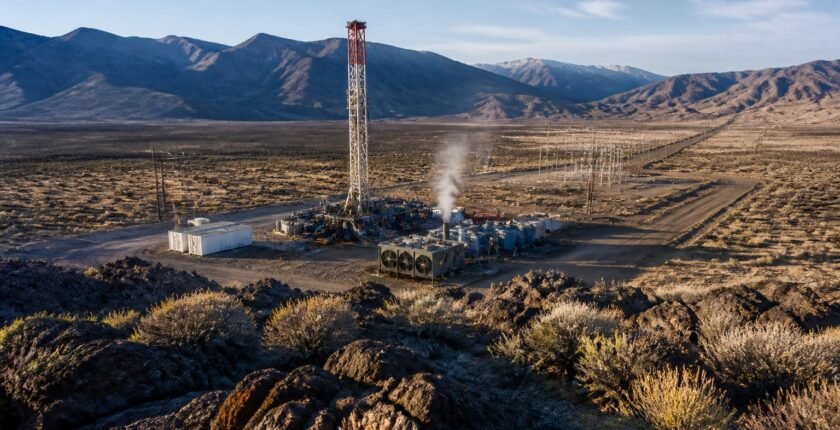
As first reported by Energies Media, Fervo Energy’s Cape Station in Beaver County, Utah, put a single GeoBlock onto the grid at 33 megawatts after a 23‑month build and commissioning cycle. The unit draws heat from fractured granite created by horizontal drilling and high‑pressure stimulation, circulates water through paired wells and flashes that heat at surface to drive a turbine. The milestone — grid connection on September 24 and commercial operations beginning September 30 — is the first time this drill‑and‑fracture approach has produced steady, contractual output at this scale.
a defining moment at Fervo and it’s one we’re proud to deliver ahead of schedule.
David Ulrey, Fervo CFO
Key takeaways
- A Fervo GeoBlock at Cape Station sent 33 megawatts to the grid on September 24 and began commercial operations on September 30.
- Fervo says it built and commissioned the GeoBlock in 23 months.
- Phase I comprises approximately 100 MW across three 33‑megawatt GeoBlocks, with the other two blocks expected to reach contractual commercial operation by January 1, 2027.
- Fervo secured 421 million dollars in non‑recourse debt and Phase II, an additional 400 MW, is under construction with an expected commercial operation date in 2028.
Table of contents
- Key takeaways
- How engineers made dry granite behave like a reservoir
- What a GeoBlock is and what Cape Station proved
- Finance, schedule and the open economics
- What the milestone proves — and what it does not
- How the case for and against rapid scale-up stacks up
- What to be careful about
- Frequently asked questions
How engineers made dry granite behave like a reservoir
Conventional geothermal relies on heat plus natural permeability; granite supplies heat but not the plumbing. Fervo’s team drilled vertically to roughly a mile and a half, then steered the hole horizontally for thousands of feet in hot granite and used high‑pressure injections to open networks of hairline fissures. Those induced fractures form an artificial reservoir: a maze of narrow flow channels more than a mile underground through which water circulates.
In operation, cold water is pumped down one well, moves through the fractured zone where it picks up heat, and returns scalding through a paired production well. At surface a working fluid or direct flash stage converts that heat into vapor that spins a turbine generator set; the cooled water is then reinjected to repeat the cycle. The engineering challenge is repeatable stimulation and enough connected surface area to sustain continuous commercial flow rates.
What a GeoBlock is and what Cape Station proved
A GeoBlock is a compact, modular cluster that combines paired wells and surface equipment sized to produce about 33 megawatts. Cape Station’s Phase I is made of three of those GeoBlocks, giving the site roughly 100 MW of nominal capacity once all blocks are online. The first block’s output fed the Milford Substation about six miles away, and Shell Energy is the named buyer for the electricity that will ultimately be resold into California’s market.
The practical significance is not just peak output but continuous baseload delivery: unlike solar or wind, the unit produces steady power day and night. That steadiness is what utilities prize when they procure carbon‑free capacity that can backstop variable renewables, so a single 33 MW GeoBlock running under a commercial contract is a different validation from a short research pilot.
Finance, schedule and the open economics
The project’s financing shows there is market appetite but also exposure: Fervo has secured 421 million dollars in non‑recourse debt for Cape Station. The company says disclosed construction costs remain higher than conventional gas generation, a gap that must narrow through drilling‑cost reductions if the model is to scale competitively.
Fervo also framed speed as a deliverable: the firm built and commissioned the first GeoBlock in 23 months and says it aims to compress future GeoBlock builds to 18 months. That target matters because faster cycles reduce financing and schedule risk, but it rests on repeating a complex drilling and stimulation sequence that crews have so far completed at this scale only once.
What the milestone proves — and what it does not
This event demonstrates that a horizontal, fractured well pair can deliver commercial scale power for months rather than days: a practical, contract‑backed proof of concept at 33 MW. It is narrower than some headlines suggest; the test is a single GeoBlock operating under specific geology in Beaver County, where temperatures rise quickly with depth.
Key uncertainties remain. The long‑term behaviour of the induced fracture network under years of thermal cycling is unproven, economics at larger build‑outs have not been disclosed in full, and scaling will depend on reducing drilling costs and repeating the construction sequence reliably. The other two GeoBlocks in Phase I are in commissioning and expected to reach contractual commercial operation by January 1, 2027, while Phase II (400 MW) is targeted for 2028.
| Item | Capacity | Status | Target commercial operation |
|---|---|---|---|
| Single GeoBlock (first unit) | 33 MW | Connected and in commercial operation | September 24 (grid), September 30 (commercial) |
| Phase I (three GeoBlocks) | ≈100 MW | Two blocks in commissioning | Contractual commercial operation expected by January 1, 2027 |
| Phase II | 400 MW | Under construction | Expected commercial operation in 2028 |
How the case for and against rapid scale-up stacks up
The case for
- A single GeoBlock proved the technical chain end‑to‑end at commercial output, showing induced fractures can sustain steady power delivery rather than a short pilot burst.
- A 23‑month build gives a reference schedule that, if improved toward the stated 18‑month target, would shorten project finance cycles and lower capital carrying costs.
- A signed buyer (Shell Energy) and a grid tie to Milford Substation demonstrate practical market access for output destined for California.
The case against
- Disclosed construction costs remain above conventional gas generation and the project carries 421 million dollars of non‑recourse debt, leaving profitability sensitive to future drilling cost reductions.
- Geological conditions in Beaver County are favourable; sites without rapid temperature gradients will need deeper, more expensive wells and may not replicate these timelines.
- Long‑term reservoir behaviour under multi‑year thermal cycling has not been observed at scale and could reduce sustainable output or require remediation that raises operating costs.
What to be careful about
- Higher capital cost versus conventional gas plants, with disclosed construction costs still above gas generation and $421 million in project debt.
- Geological variability: the fracturing method depends on rock that breaks predictably; different basins may need deeper, costlier wells.
- Operational risk from long‑term thermal cycling may degrade fracture connectivity and reduce flow rates over years, affecting output and revenues.
- Execution risk if crews cannot reproduce the 23‑month sequence reliably; missing the 18‑month target would raise financing and schedule exposure.
The bottom line
The Cape Station GeoBlock is a practical demonstration that enhanced geothermal, built with oil‑field drilling techniques, can produce contract‑backed electricity at commercial scale. The 33 MW output and the 23‑month build establish a reference point for speed and capability, but scaling that result into hundreds of megawatts depends on drilling costs, repeatable stimulation performance and the geological suitability of other sites. The next milestones — the remaining Phase I blocks due by January 1, 2027, and Phase II in 2028 — will show whether this approach is a one‑off fit for favourable Utah geology or the start of a wider geothermal deployment model.
What to watch
- Watch for the other two Phase I GeoBlocks to reach contractual commercial operation by January 1, 2027.
- Watch for the planned Phase II, an additional 400 MW, to reach its expected commercial operation date in 2028.
Frequently asked questions
What is a GeoBlock?
A GeoBlock is a compact cluster of paired wells and surface equipment designed to produce about 33 megawatts; Cape Station’s Phase I is three GeoBlocks totaling roughly 100 MW.
How long did it take to build the first unit?
Fervo says it built and commissioned the first GeoBlock in 23 months and aims to reach an 18‑month construction timeline for future GeoBlocks.
What are the main economic uncertainties?
Disclosed construction costs remain above conventional gas generation and the project has 421 million dollars in non‑recourse debt, making further drilling‑cost reductions critical to competitiveness.
Related reading