
Blog
Floating Wind Faces a Cost and Policy Test
Estimated reading time: 6 minutes · Last updated:
Floating wind turbines — tall, grid‑connected turbines mounted on buoyant platforms — have moved from demonstrations into pilot projects in Europe, Asia and a single U.S. site in Maine. The technology promises access to stronger winds farther offshore, and a U.S. goal aims to reach 15 GW of floating wind by 2035. This account synthesizes field reporting, interviews and data as first reported by Inside Climate News and traces why the engineering, port and finance challenges that remain now matter as much as the turbines themselves. The primary question is whether collaboration and targeted support can bring costs down and projects to commercial scale.
“That’s when the governor came to our lab, and said, ‘What do we do?’”
Habib Dagher
Key takeaways
- U.S. target: The Biden Administration set a national goal of installing 15 GW of floating wind turbines by 2035.
- Maine demonstration: The University of Maine’s quarter‑scale platform supports a 108‑foot tall turbine and was towed into place in May 2025.
- Planned research array: State planners signed a lease for a proposed research array of 10–12 full‑sized platforms; developer negotiations were suspended last March.
- Cost gap: When WindShot began the levelized cost of electricity for floating projects was about double fixed‑bottom wind, as much as three times a combined‑cycle gas plant, and roughly equivalent to a new nuclear plant.
Table of contents
- Key takeaways
- How floating wind turbines are built and where they fit
- Maine’s demonstration and the stalled research array
- Costs, technical gaps and the port problem
- Policy swings, finance risk and the role of collaboration
- How floating wind could reach scale — and what stops it
- What to be careful about
- Frequently asked questions
How floating wind turbines are built and where they fit
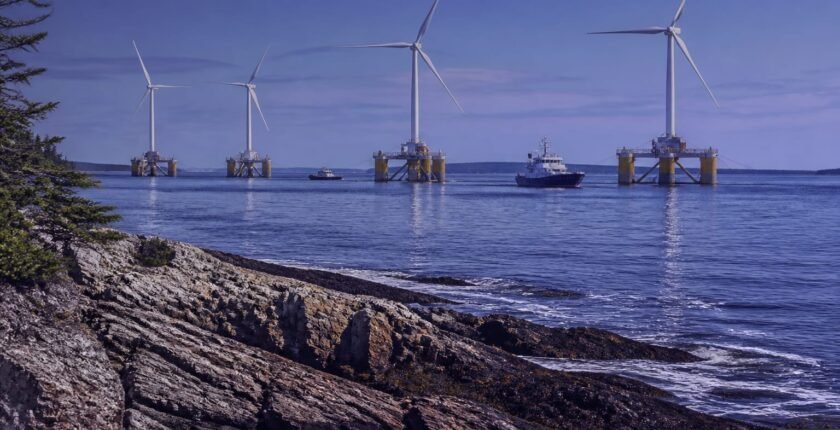
Floating wind turbines sit on buoyant platforms — triangular, plus‑sign or cylindrical designs — anchored to the seabed with mooring lines and connected to shore by power cables. The platforms can be the size of a baseball field and carry turbines taller than city landmarks; developers test smaller, quarter‑scale models before scaling to full size.
The main selling point is access: floating systems operate in deeper water farther from shore, where wind speeds are higher and fixed‑bottom foundations are impractical. That is why areas such as the Gulf of Maine and much of the U.S. West Coast view floating wind as the only viable offshore option for their steep coastal shelves.
Technically the programme spans many specialties: platform hydrodynamics; turbine loads; dynamic export cables that must flex and survive in a moving environment; and offshore substations. Each of those elements adds engineering complexity and cost compared with mature fixed‑bottom projects.
Maine’s demonstration and the stalled research array
Maine’s Advanced Structures and Composites Center developed a quarter‑scale plus‑sign concrete platform that now supports a 108‑foot turbine off Castine. The platform was towed into place in May 2025 and is being used to test loads, mooring systems and components such as a shock‑absorbing device supplied by Dublin Offshore.
The center traces its work to the 2008 energy shock — when heating fuel rose above $4 a gallon — and a 2010 bond measure, approved by nearly 60 percent of voters, that helped fund early research. That local mandate, center leaders say, underpinned a multiyear programme of testing and open technical sharing.
The next step envisioned a research array of 10–12 full‑sized platforms on a lease signed with the Bureau of Ocean Energy Management in 2024. Those commercial steps slowed when the developer suspended contract negotiations last March, leaving the planned array in limbo while the center continues component testing and collaboration.
Costs, technical gaps and the port problem
Cost remains the single largest barrier. At the time the U.S. Floating WindShot was announced, analyses from Lazard and the Department of Energy showed the levelized cost of electricity from floating projects was about double that of fixed‑bottom wind, as much as three times a combined‑cycle gas plant and roughly equivalent to a new nuclear plant.
Some technical problems remain unresolved at commercial scale: dynamic export cables and offshore substations that can withstand platform motion; and validated operations and maintenance practices for fleets in deeper water. Bloomberg NEF analysts flagged these dynamic cables and substations as key outstanding items.
Support infrastructure multiplies the bill. Studies under the WindShot priced new and upgraded ports required for staging floating platforms at upwards of $1 billion each, because platforms need large laydown areas immediately adjacent to deep water. That port bill, plus supply‑chain buildout and transmission upgrades, helps explain the persistent price gap.
Policy swings, finance risk and the role of collaboration
Policy and market confidence have shifted the landscape. The U.S. got a jolt in 2022 from the Floating WindShot, which funded research, convenings and ports. By the end of the Biden presidency, the Bureau of Ocean Energy Management had auctioned commercial‑scale floating lease sites in the Gulf of Maine and off California.
Since then, administrative actions have introduced headwinds. Last December the Trump administration sought to halt five under‑construction fixed offshore wind projects; courts rejected those stop‑work orders but developers lost money during delays. The administration has also paused further offshore leasing and negotiated buybacks of some leases, prompting lawsuits by several states.
Despite those setbacks, collaborative networks persist. Researchers, firms and trade groups share designs and testing data; universities are opening specifications for wider use; and European and Canadian programmes — including a Nova Scotia solicitation for 5 GW launched last year — are keeping commercial pipelines moving across the Atlantic.
| Technology | Reported relationship to floating LCOE |
|---|---|
| Floating wind | About double fixed‑bottom; as much as three times combined‑cycle gas; roughly equivalent to a new nuclear plant |
| Fixed‑bottom wind | Floating projects reported at about double the LCOE of fixed‑bottom wind |
| Combined‑cycle gas | Floating projects reported as much as three times the LCOE of combined‑cycle gas |
| New nuclear | Floating projects reported roughly equivalent to a new nuclear plant in LCOE comparisons |
How floating wind could reach scale — and what stops it
The case for
- Shared R&D and open technical specifications are lowering barriers and accelerating solutions to platform design and mooring questions.
- Public programmes such as the U.S. Floating WindShot and research prizes directed to university and private teams have funded port upgrades, testing facilities and early commercial leases.
- Transatlantic partnerships and ongoing contracts in Europe provide operators, manufacturers and supply chains opportunities to scale operations and spread cost reductions.
The case against
- High levelized costs relative to fixed‑bottom wind and gas, coupled with port and transmission bills (ports priced upwards of $1 billion each), keep projects financially marginal.
- Policy reversals and lease buybacks in the United States have eroded investor confidence and prompted litigation and project delays.
- Key components — notably dynamic export cables and offshore substations — remain engineering challenges at commercial scale and threaten schedule and cost certainty.
What to be careful about
- Political and policy risk: U.S. lease buybacks, an effective pause on new leasing and cancelled grant support have reduced investor appetite for U.S. projects.
- Financial exposure for developers and contractors from multi‑month delays and halted work — developers reported losing millions per day during stop‑work periods.
- Infrastructure shortfall: ports suitable for floating wind were priced at upwards of $1 billion each in WindShot studies, creating a capital barrier to deployment.
- Unresolved technical reliability of dynamic cables and offshore substations could raise operations costs or force redesigns at scale.
The bottom line
Floating wind turbines have moved beyond laboratory prototypes to win demonstrator miles and pilot sites, and they offer a practical route to harness deep‑water wind resources. But the path to commercial fleets depends on resolving engineering items such as dynamic export cables, building expensive port and transmission infrastructure, and restoring market confidence after recent policy reversals. Success will hinge on continued technical collaboration, targeted public support for ports and transmission, and stable policy signals that convince financiers to underwrite the capital‑intensive steps from quarter‑scale rigs to strings of full‑sized platforms.
What to watch
- Monitor U.S. progress toward the national goal of installing 15 GW of floating wind by 2035.
- Watch the outcome of Nova Scotia’s solicitation for 5 GW of offshore wind capacity; no date has been set for award or contracts.
- Watch whether contract negotiations for Maine’s proposed research array of 10–12 full‑sized platforms resume; no date has been set.
Frequently asked questions
What is a floating wind turbine?
A floating wind turbine is a utility‑scale wind turbine mounted on a buoyant platform anchored to the seabed and connected to shore by power cables. Demonstrations include quarter‑scale platforms that carry a 108‑foot turbine and full projects planned as 10–12 platform research arrays.
Why is floating wind more expensive than fixed‑bottom offshore wind?
Analyses cited by U.S. programmes show floating projects had a levelized cost of electricity about double that of fixed‑bottom wind, as much as three times a combined‑cycle gas plant and roughly equivalent to a new nuclear plant; required new ports were priced at upwards of $1 billion each in WindShot studies.
What policy or market actions have hurt U.S. floating wind momentum?
The U.S. received a policy boost from the 2022 Floating WindShot and lease auctions by BOEM, but actions last December to halt projects and subsequent lease buybacks, plus cancelled grant funding for ports, have prompted lawsuits and investor caution.
Related reading