
Blog
Malaysia Data Centres Line Up 500 MW Solar and 1 GWh Battery
Estimated reading time: 7 minutes · Last updated:
IOI Corporation Berhad and Tenaga Nasional Berhad (TNB) plan to build a 500 MWac solar farm with a 250 MW/1,000 MWh battery energy storage system at Bahau, Negeri Sembilan, to supply DayOne's Malaysia data centres. The power will move under the Corporate Renewable Energy Supply Scheme (CRESS), which lets corporate buyers source renewable electricity from independent developers over the national grid. TNB holds a 21-year offtake deal with DayOne Data Centres Limited, a Singapore-headquartered operator, for up to 500MWac. At full output the battery can run for about four hours. The plan follows Malaysia's September 2026 decision to fix grid access charges for firm renewable supply, a change aimed at the financing doubts that have shadowed corporate clean power deals as data centre demand rises.
The project will be supported by TNB's long-term renewable energy offtake agreement with DayOne Data Centres Limited, a leading global digital infrastructure platform headquartered in Singapore.
IOI Corporation Berhad, in a statement
Key takeaways
- The project: IOI Corporation Berhad and TNB plan a 500 MWac solar farm and a 250 MW/1,000 MWh battery on about 1,300 acres at Bahau, Negeri Sembilan.
- The buyer: DayOne Data Centres Limited is expected to take up to 500MWac over 21 years through an offtake deal with TNB first announced on 11 June 2025.
- The rule change: Malaysia's September 2026 CRESS revision introduced a fixed MYR 0.14 ($0.03)/kWh access charge for qualifying firm renewable supply and a 10-year minimum contract.
- The deadline: The reduced CRESS charge requires commercial operation by the end of 2028, when about 3.15 GW from 11 developers and eight consumers was already registered.
Table of contents
- Key takeaways
- A 1,300-Acre Site Pairing Solar With Four Hours of Storage
- Why a 21-Year DayOne Contract Carries the Project
- What Malaysia Changed in CRESS in September 2026
- Data Centre Growth Is Straining Malaysia's Grid
- What could help or hold back the Bahau project
- What to be careful about
- Frequently asked questions
A 1,300-Acre Site Pairing Solar With Four Hours of Storage
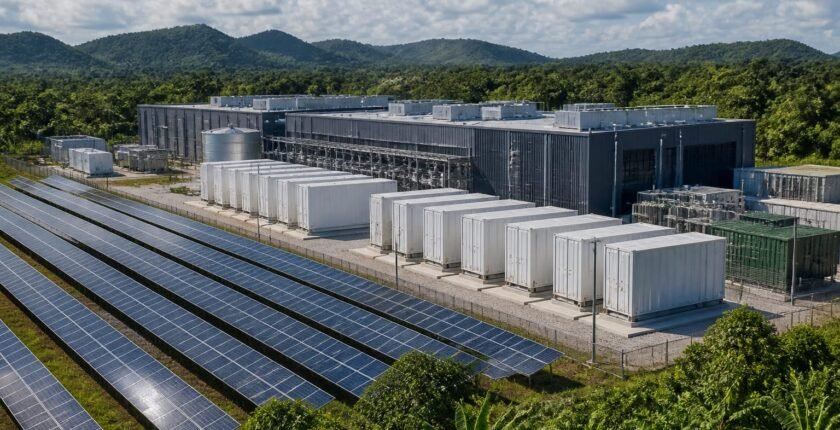
The plan places a 500 MWac photovoltaic plant on about 1,300 acres at Bahau, in the Malaysian state of Negeri Sembilan. MWac measures alternating-current output, the power a plant can deliver to the grid once inverters have converted the panels' direct current. Next to the panels sits a battery energy storage system rated at 250 MW and 1,000 MWh.
Those two ratings describe different things. The 250 MW figure is how fast the battery can charge or discharge, while 1,000 MWh is how much energy it holds, so it can run at full power for roughly four hours. Its power rating is half that of the solar plant, which means it can take in at most half of the farm's peak output at any moment.
IOI, an integrated palm oil producer, is developing the project with TNB and a consortium of small and medium-sized enterprises. None of those smaller firms has been named. No budget or construction schedule has been made public alongside the plan, which leaves the most practical questions about delivery unanswered for now.
Why a 21-Year DayOne Contract Carries the Project
An offtake agreement is a long-term contract in which a buyer commits to take a project's output, and it is usually the first thing lenders examine. The buyer here is DayOne Data Centres Limited, which is headquartered in Singapore and runs data centre operations in Malaysia. The agreement sits with TNB rather than directly with IOI.
IOI said in a statement that TNB's offtake deal with DayOne would support the Bahau project. Under that deal, according to IOI, DayOne is expected to buy up to 500MWac of renewable energy across 21 years. The parties first announced the arrangement on 11 June 2025, so the customer was secured before the generating site was named publicly.
Two details deserve caution. The 500MWac figure is a ceiling rather than a guaranteed volume, and IOI's own wording is that DayOne is expected to procure it, not that it is obliged to. The offtake cap matches the plant's rating exactly, which suggests the farm was sized to the contract, though no party has said so.
What Malaysia Changed in CRESS in September 2026
CRESS, the Corporate Renewable Energy Supply Scheme, lets companies that consume electricity buy renewable power straight from independent developers, with the national grid carrying it between them. The scheme is designed to draw private money into clean generation and to help energy-hungry industries cut emissions.
Malaysia revised the scheme in September 2026 to make projects easier to finance. Qualifying firm renewable supply projects now pay a fixed system access charge of MYR 0.14 ($0.03) per kWh, and contracts between developers and corporate buyers must run for at least 10 years. To secure the lower charge, a project has to reach commercial operation before the end of 2028.
The fixed charge is reserved for firm supply, and pairing panels with storage is one way to make solar output steadier. Whether the Bahau project will count as firm, and whether it can be running by the 2028 cut-off, has not been stated. When the revision was announced, 11 developers and eight corporate consumers had registered roughly 3.15 GW of projects under the scheme.
Data Centre Growth Is Straining Malaysia's Grid
Malaysia's data centre expansion has raised questions about electricity supply, grid capacity and water. An analysis published by pv magazine in March 2026 pointed to the difficulty of meeting new demand while keeping the grid stable and holding enough dispatchable generation, meaning plants that can be ramped up on request. It also flagged uncertainty over grid access charges as a threat to the economics of corporate renewable deals, the gap the September revision set out to close.
IOI and TNB are not the only developers chasing this demand. Gentari, a clean energy company, teamed up with the engineering group Gamuda in August 2025 on a joint plan for 1.5 GW of solar, paired with batteries, aimed at hyperscale data centres using CRESS. That pipeline is about three times the Bahau solar capacity.
Volta Foundation sees speed to power and cheaper electricity as the main strengths of batteries for data centre operators, and long-duration storage and continuous supply as their weak points. It also observes hyperscalers increasingly choosing to own storage themselves. A four-hour system fits the first description well; it does not answer the second.
| Project | Developers | Solar | Storage | Buyer |
|---|---|---|---|---|
| Bahau, Negeri Sembilan | IOI, TNB, SME consortium | 500 MWac | 250 MW/1,000 MWh | DayOne, up to 500MWac over 21 years |
| Gentari-Gamuda (announced August 2025) | Gentari, Gamuda | 1.5 GW | Battery storage, size not given | Hyperscale data centres |
What could help or hold back the Bahau project
The case for
- A 21-year offtake through TNB gives the project a named long-term buyer before construction.
- The September 2026 CRESS revision fixes the access charge at MYR 0.14 ($0.03) per kWh for qualifying firm supply, removing a pricing unknown.
- A 1,000 MWh battery lets the plant shift part of its solar output away from midday.
The case against
- The reduced charge depends on commercial operation by the end of 2028, and no build schedule has been published.
- DayOne's volume is a ceiling of up to 500MWac, not a fixed commitment.
- Four hours of storage cannot provide the continuous supply data centres need through a full night.
What to be careful about
- The project may miss the end-2028 commercial operation deadline and lose access to the fixed MYR 0.14 per kWh charge.
- It is not yet clear whether the Bahau plant will qualify as firm renewable supply under the revised CRESS rules.
- The unnamed SME consortium partners leave part of the ownership and funding structure undisclosed.
The bottom line
The Bahau project tests whether CRESS, as revised in September 2026, can turn a signed corporate customer into a built power plant. On paper the parts are there: a 500 MWac solar farm, a 250 MW/1,000 MWh battery, a 21-year offtake through TNB and a fixed MYR 0.14 per kWh access charge for qualifying firm supply. The open question is timing. The cheaper charge depends on commercial operation by the end of 2028, and no construction schedule has been published. For DayOne, four hours of storage smooths solar output but will not carry its data centres through a full night, so the grid still has to fill that gap. How fast IOI and TNB move will show whether the revised scheme works.
What to watch
- The end of 2028 is the cut-off for commercial operation under the revised CRESS terms, so watch whether the Bahau plant is on course to qualify for the MYR 0.14 per kWh charge before then.
- Watch for the names of the small and medium-sized enterprises in the IOI and TNB consortium and for a construction start; no date has been set for either.
- Watch for updated CRESS registration figures beyond the roughly 3.15 GW recorded at the September 2026 revision; no date for the next update has been given.
Frequently asked questions
How long can the Bahau battery supply power?
With 1,000 MWh of energy and a 250 MW power rating, the battery can discharge at full output for about four hours. Volta Foundation counts long-duration storage and continuous supply among batteries' weak points for data centres.
Will the IOI and TNB project get the fixed CRESS grid charge?
The MYR 0.14 ($0.03) per kWh charge applies to qualifying firm renewable supply projects that start commercial operation by the end of 2028. Neither the project's firm-supply status nor its schedule has been made public.
How much capacity is registered under Malaysia's CRESS scheme?
When the scheme was revised in September 2026, 11 developers and eight corporate consumers had registered about 3.15 GW of projects. Separately, Gentari and Gamuda announced a 1.5 GW solar-plus-storage plan for data centres in August 2025.
Related reading