
Blog
Harbinger Raises $240M to Push EV Platform Beyond Trucks
Estimated reading time: 7 minutes · Last updated:
Harbinger, the Garden Grove, California, maker of electric medium-duty truck chassis, has raised $240 million in a Series D round. It plans to carry its EV technology into four newer markets: energy storage, power generation, autonomy and defense. It is doing so while it scales the factory that must deliver 2,000 trucks to FedEx by the end of 2027. Ridgeline, Tiger Global and Capricorn's Technology Impact Fund led the round jointly, and Harbinger announced it Thursday. The Harbinger $240 million raise lifts its total funding past $650 million since the company was founded in 2021. The open question is output. In September the company reported building its 1,000th vehicle, half the size of the FedEx order.
Harbinger's role is not simply to give customers another option. It is to reset expectations for what critical systems should deliver.
John Harris, co-founder and CEO, Harbinger
Key takeaways
- Series D: Harbinger raised $240 million in a Series D co-led by Ridgeline, Tiger Global and Capricorn's Technology Impact Fund, taking total funding above $650 million since 2021.
- FedEx order: Part of the money funds the factory ramp behind a FedEx order for 2,000 medium-duty electric trucks, valued above $300 million and due by the end of 2027.
- Production gap: CEO John Harris told Bloomberg News in September that Harbinger had built its 1,000th vehicle, half the number FedEx alone has ordered.
- New markets: Harbinger's newer lines of business span autonomy, defense, energy storage and power generation. On the defense side, it builds the base of an uncrewed Army supply vehicle for a contract that American Rheinmetall holds.
- Market context: CALSTART counted 12,996 new U.S. zero-emission truck units in the second half of 2025, and cargo vans supplied 12,158 of them.
Table of contents
- Key takeaways
- Why Harbinger Wants to Be More Than a Truck Maker
- Crossover Funds and FedEx Itself Back the Round
- Harbinger's Trucks Already Carry Hardware for Its New Markets
- Cargo Vans, Not Medium-Duty Trucks, Drive Zero-Emission Growth
- Can Harbinger Build 2,000 FedEx Trucks by the End of 2027?
- What could help or hurt Harbinger's expansion
- What to be careful about
- Frequently asked questions
Why Harbinger Wants to Be More Than a Truck Maker
Harbinger now presents itself as "an American industrial technology platform company," and its announcement named five markets the Series D will cover. Commercial vehicles are only one of them. The others are energy storage, power generation, autonomy and defense.
In practice the truck business still comes first. Harbinger said part of the money will keep scaling its medium-duty manufacturing, the capacity it needs to fill the FedEx contract. That order is worth more than $300 million.
John Harris, Harbinger's co-founder and CEO, described the expansion as a single idea applied across sectors. "Electrification is at the core of everything we do, and increasingly, electrification is at the core of industry, defense, mobility, and AI," he said. The company intends to reuse the engineering it developed in-house for its trucks in each new market.
What Harbinger left out matters just as much. It disclosed no valuation and no current production capacity. Nor did it say how the $240 million divides between trucks and the newer lines of business.
Crossover Funds and FedEx Itself Back the Round
Crossover investors Squarepoint Capital, Xantium and Fidelity Management & Research Company joined the three co-leads. A crossover investor is a fund that holds stakes in both private and publicly listed companies. Maniv and Greycroft invested again, and Goldman Sachs and Morgan Stanley acted as placement agents.
Harris told Bloomberg News that Harbinger has deliberately courted backers that are "generally crossover or public markets focused." That points the cap table toward investors used to listed companies.
Customers are investors too. FedEx and THOR Industries came in strategically through TechNexus. FedEx's Paul Melander, its senior vice president for safety and transportation, now sits on Harbinger's board. BuildGroup, which Harbinger called a strategic data center investor, also took part.
Tiger Global tied its bet to artificial intelligence. "Harbinger excels at electrification, and electrification has become one of the most pressing bottlenecks of the AI era," said Griffin Schroeder, a Tiger Global partner. The Series D comes after a $160 million Series C the previous November. FedEx placed its first order at that time, for 53 trucks.
Harbinger's Trucks Already Carry Hardware for Its New Markets
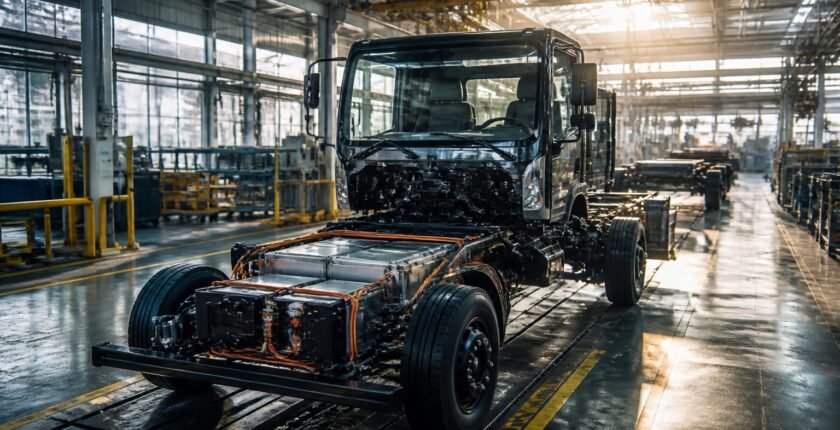
Harbinger makes Class 4 through Class 6 chassis, the medium-duty range used for delivery and work trucks. It offers them in all-electric and plug-in hybrid form. Rather than buying in major systems, it designs the powertrain, battery system, steering and brakes itself.
The HC Series Cab, shown in March, adds a gasoline range extender. Depending on configuration, it reaches up to 500 miles and can export up to 15 kilowatts of power. That is enough for a crew to leave a separate generator behind, and it is a small working version of the power-generation pitch.
The other new markets have early footholds. Harbinger bought Phantom AI, a maker of autonomy software. In summer it won its first defense work: American Rheinmetall, which holds an Army contract for an uncrewed supply vehicle, has Harbinger building that vehicle's platform. Bloomberg News reported that Harbinger has begun selling its batteries for energy storage, though the company named no storage or power generation customers.
Cargo Vans, Not Medium-Duty Trucks, Drive Zero-Emission Growth
CALSTART's June 2026 Zeroing in on Zero-Emission Trucks market update found that zero-emission models made up 4.14% of trucks deployed in the U.S. during the latter half of 2025. CALSTART called that share a record. It came as overall truck sales fell 35% from a year earlier.
The growth is narrow. CALSTART counted 12,996 new zero-emission units over that half-year, and cargo vans accounted for 12,158 of them, roughly 94 percent. All remaining segments together, step vans and medium-duty trucks among them, contributed 838.
Harbinger's Class 4 to 6 trucks fall into that smaller group, which shows how thin its segment remains. A single 2,000-truck FedEx order is more than double the 838 non-van units CALSTART counted for the whole half-year. That makes one customer's schedule unusually important to the company's results.
Can Harbinger Build 2,000 FedEx Trucks by the End of 2027?
Production is the constraint. In September, Harris said in comments to Bloomberg News that the company had just built its 1,000th vehicle. The FedEx order on its own requires double that number before the end of 2027.
Harbinger has published no capacity figure, so outsiders cannot judge how fast the plant runs. They also cannot tell how much of the $240 million goes toward closing that gap. Spreading capital across five markets adds execution risk just as the core contract becomes most demanding.
Defense is early too. The Army program sits in a prototype phase that usually involves three to 10 units, as first reported by FreightWaves, and no contract value has been made public.
Harris framed the strategy ambitiously, saying Harbinger exists to reset what customers expect from critical systems. The FedEx delivery schedule will be the first hard test of that ambition.
| Market | Current activity | Customers disclosed | Value disclosed |
|---|---|---|---|
| Commercial vehicles | Class 4-6 electric and plug-in hybrid chassis | FedEx, 2,000 trucks | More than $300 million |
| Defense | Platform for uncrewed Army supply vehicle | American Rheinmetall contract | No |
| Energy storage | Battery sales, per Bloomberg News | None named | No |
| Power generation | Up to 15 kW exportable power on HC Series Cab | None named | No |
| Autonomy | Acquired Phantom AI software | None named | No |
What could help or hurt Harbinger's expansion
The case for
- $240 million in new capital on top of more than $650 million raised since 2021 gives room to fund both the factory and new lines.
- FedEx is customer, investor and board member, which aligns its interest with Harbinger's delivery success.
- In-house powertrain, battery, steering and brake design can be reused across storage, power and defense products.
- An existing defense foothold through the American Rheinmetall contract gives a route into military programs.
The case against
- Output reached 1,000 vehicles by September, while the FedEx order alone calls for 2,000 by the end of 2027.
- No valuation, capacity figure or split of funds between trucks and new businesses has been disclosed.
- Non-van zero-emission trucks totalled only 838 units in the second half of 2025, per CALSTART, a thin market beyond FedEx.
- The Army work is at prototype scale with no contract value made public.
What to be careful about
- Delivery risk on the FedEx contract: the company must double its cumulative vehicle count by the end of 2027.
- Capital dilution: money spread across five markets may leave less for the medium-duty ramp than the FedEx schedule needs.
- Customer concentration: one buyer's order exceeds the entire non-van zero-emission truck volume CALSTART recorded for a half-year.
- Unproven new lines: no energy storage or power generation customers have been named.
The bottom line
Harbinger has the backing a medium-duty electric truck maker needs. It has $240 million in new capital and more than $650 million raised in total. Its investors range from Fidelity and Tiger Global to its biggest customer, FedEx. What it has not yet shown is output at the scale its contract demands. Its next milestone is a delivery count, not a new market. If the plant moves from 1,000 vehicles toward the 2,000 FedEx trucks due by the end of 2027 while storage, autonomy and defense grow alongside, the platform case gains weight. If truck output slips, the expansion will look premature. Until Harbinger publishes capacity figures, the FedEx deliveries are the clearest measure available.
What to watch
- Watch FedEx delivery progress against the 2,000-truck order, which is due by the end of 2027.
- Watch whether the uncrewed Army supply vehicle moves past its prototype phase and whether a contract value is disclosed; no date has been set.
- Watch for Harbinger to name its first energy storage or power generation customers; it has given no timetable.
Frequently asked questions
How much money has Harbinger raised in total?
Harbinger says it has raised more than $650 million since it was founded in 2021. That includes the $240 million Series D and a $160 million Series C, which came alongside an initial FedEx order for 53 trucks.
What is Harbinger's valuation after the Series D?
Harbinger has not disclosed one. It also withheld its current production capacity and how the $240 million splits between trucks and its newer businesses.
What is Harbinger building for the US Army?
Harbinger's first defense deal came through American Rheinmetall, the holder of an Army contract for a driverless supply vehicle, with Harbinger providing the vehicle's platform. The effort is still at prototype stage, which usually means between three and 10 units, and the contract's value has not been disclosed.
Who is on Harbinger's board from FedEx?
Paul Melander, FedEx's senior vice president for safety and transportation, has joined Harbinger's board. FedEx also invested in the Series D through TechNexus, alongside THOR Industries.
Related reading