
Blog
He Dreiht Offshore Wind Farm Completes 64 Vestas Turbines
Estimated reading time: 7 minutes · Last updated:
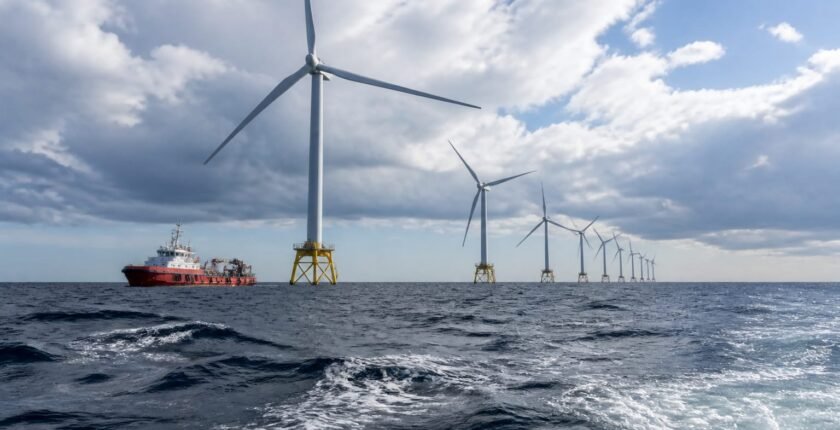
EnBW's He Dreiht offshore wind farm in the German North Sea has all 64 of its turbines in place. It was formally inaugurated on 17 September 2026. Each machine is a Vestas V236-15.0 MW with a rotor 774 feet across, which gives the site 960 MW of installed capacity. EnBW expects the farm to produce 3.6 billion kilowatt-hours a year and says that is enough for 1.1 million households. The last turbine went in on 12 August 2026, roughly 53 miles northwest of Borkum island. Vestas has described the V236-15.0 MW as the first 15-megawatt turbine to reach the market, so He Dreiht is the model's first commercial fleet. Germany granted the project no state funding.
Key takeaways
- Fleet complete: All 64 Vestas V236-15.0 MW turbines stand at EnBW's He Dreiht site. The last was placed on 12 August 2026 and the farm was inaugurated on 17 September 2026.
- Rotor scale: Each turbine's 774-foot rotor sweeps 43,742 square metres. Together the turbines give 960 MW of capacity, which feeds a 900 MW grid connection run by TenneT.
- Expected output: EnBW forecasts annual generation of 3.6 billion kWh, which it equates to supply for 1.1 million households.
- No subsidy: He Dreiht won no state funding entitlement in Germany's 2017 auction. It costs around €2.4 billion, with €600 million of financing from the European Investment Bank and power buyers including Fraport, Bosch, Deutsche Bahn and Google.
Table of contents
- Key takeaways
- How He Dreiht's Power Travels 143 Miles to the Grid
- What a 774-Foot Rotor Buys in Output
- How Vestas Went From One Prototype to a 64-Turbine Fleet
- How a €2.4 Billion Farm Was Financed Without State Support
- The case for and against He Dreiht's model
- What to be careful about
- Frequently asked questions
How He Dreiht's Power Travels 143 Miles to the Grid
He Dreiht is an EnBW project, and building it was a large marine operation. At peak periods, more than 500 people and 60 vessels were working at the site or supporting it. The final turbine was set in place on 12 August 2026, and the formal inauguration followed on 17 September 2026.
TenneT is responsible for bringing the power ashore. The Dutch-German grid operator runs a connection that starts at an offshore converter platform, where the turbines' output is prepared for the onshore network. From the platform, the power travels through 75 miles of subsea cable and another 68 miles of cable on land. That is roughly 143 miles end to end.
The farm's 960 MW of installed capacity sits on a grid connection rated at 900 MW, which leaves a margin of 60 MW. Developers sometimes build more generation than the export cable can carry because a whole fleet rarely runs at full output at the same moment. The extra turbines help keep the cable closer to full use.
What a 774-Foot Rotor Buys in Output
Each of the 64 machines is a Vestas V236-15.0 MW, and its defining feature is the rotor. The blades measure 774 feet from tip to tip, or 9,291 inches. The swept area is the circle the blades trace as they turn. For this turbine it covers 43,742 square metres, about the size of six football fields.
Size matters for a simple reason. The energy a turbine can take from the wind rises with the area its blades sweep. A bigger rotor therefore catches more moving air and can support a higher power rating, which is how a single unit reaches 15 MW.
EnBW says a single turn of one rotor produces enough power for four homes. It expects the full farm to generate 3.6 billion kWh a year, enough for 1.1 million households. Those two figures imply about 3,300 kWh per household annually. Compared with 960 MW running every hour of a year, the forecast also implies a capacity factor of about 43 percent. Capacity factor is the share of a plant's theoretical maximum output that it actually delivers.
How Vestas Went From One Prototype to a 64-Turbine Fleet
The V236-15.0 MW was already being tested before construction began at He Dreiht. Vestas finished installing a prototype in December 2022, and the unit generated its first kilowatt-hour during testing.
The commercial order for all 64 turbines followed in 2023. Alongside the hardware, it included a five-year service agreement and ongoing support for running the fleet. In a September 2023 announcement, Vestas described the V236-15.0 MW as the first 15-megawatt turbine available on the market. On that basis, He Dreiht is the first commercial project to deploy the model.
The timeline was fast. Fewer than four years separate the prototype's first output from the farm's inauguration, so the full fleet has only a short operating record behind it. The five-year service agreement keeps Vestas directly involved through the early years, which is when any problems specific to the model would be most likely to appear.
How a €2.4 Billion Farm Was Financed Without State Support
Germany's 2017 offshore wind auction gave He Dreiht no entitlement to state funding. The project's income therefore depends on selling its electricity, not on a guaranteed support payment.
The project costs about €2.4 billion. The European Investment Bank has provided €600 million of long-term financing, roughly a quarter of that total.
Much of the commercial case rests on long-term supply contracts with large electricity users. These deals are often called power purchase agreements, meaning a customer commits to buying a project's output over many years. He Dreiht's buyers include Fraport, Bosch, Deutsche Bahn and Google.
This is the part of the project with the widest relevance. A bid with no subsidy works only if the cost of each unit of power comes down, and fewer, larger turbines are one way to achieve that. Whether the economics hold depends on the farm delivering close to EnBW's 3.6 billion kWh forecast.
| Milestone | Date | Detail |
|---|---|---|
| Offshore wind auction | 2017 | No entitlement to state funding |
| Vestas prototype installed | December 2022 | Produced its first kilowatt-hour in testing |
| Turbine order | 2023 | 64 turbines plus a five-year service agreement |
| Vestas announcement | September 2023 | Called V236-15.0 MW the first 15 MW turbine on the market |
| Final turbine installed | 12 August 2026 | All 64 turbines in place |
| Inauguration | 17 September 2026 | 960 MW farm formally opened |
The case for and against He Dreiht's model
The case for
- A 774-foot rotor sweeping 43,742 square metres lets each unit reach a 15 MW rating, so fewer foundations and turbines are needed for 960 MW.
- Long-term supply contracts with Fraport, Bosch, Deutsche Bahn and Google give the project revenue without state support.
- €600 million of European Investment Bank financing covers roughly a quarter of the €2.4 billion cost.
- The 60 MW margin above the 900 MW connection helps keep the export cable well used.
The case against
- The V236-15.0 MW fleet has a short operating record, with its prototype's first output dating only to December 2022.
- Without state funding, any shortfall against the 3.6 billion kWh forecast falls directly on project revenue.
- Output above 900 MW cannot reach the grid, so the extra 60 MW is only useful when part of the fleet is running below full output.
What to be careful about
- Annual generation could fall short of EnBW's 3.6 billion kWh forecast, and no subsidy exists to cushion the revenue gap.
- He Dreiht is the first commercial fleet of the V236-15.0 MW, so problems specific to the model would surface here first.
- The 900 MW TenneT connection caps exports below the 960 MW installed capacity.
- Revenue depends on a small group of large buyers, including Fraport, Bosch, Deutsche Bahn and Google.
The bottom line
He Dreiht tests scale on two fronts. On the technical side, it is the first commercial fleet of a model that Vestas says was the first 15 MW turbine on the market: 64 machines, each with a 774-foot rotor. On the financial side, it carries a build of about €2.4 billion with no state support from Germany's 2017 auction. It relies instead on €600 million from the European Investment Bank and supply contracts with Fraport, Bosch, Deutsche Bahn and Google. The construction phase is finished: every turbine is in place, and the farm was inaugurated in September 2026. Performance is still unproven. The measure to watch is whether annual output gets close to EnBW's forecast of 3.6 billion kWh.
What to watch
- The first full year after the September 2026 inauguration will show whether He Dreiht's output approaches EnBW's 3.6 billion kWh forecast; no date for publishing results has been set.
- Watch for operating data from EnBW or TenneT showing how often the fleet hits its 900 MW export limit; no date has been set.
- Watch for whether Vestas reports any issues specific to the V236-15.0 MW fleet during its five-year service agreement; the start date of that agreement has not been disclosed.
Frequently asked questions
What turbines does the He Dreiht wind farm use?
He Dreiht uses 64 Vestas V236-15.0 MW turbines, each rated at 15 MW, for 960 MW in total. Vestas installed the model's prototype in December 2022 and has described it as the first 15-megawatt turbine on the market.
Did He Dreiht get government subsidies?
No. Germany's 2017 offshore wind auction gave the project no entitlement to state funding. Its roughly €2.4 billion cost is supported by €600 million from the European Investment Bank and by long-term power sales to companies including Google and Deutsche Bahn.
How many homes can He Dreiht power?
EnBW expects about 3.6 billion kWh a year, which it says can supply 1.1 million households. That works out to roughly 3,300 kWh per household annually.
Who connects He Dreiht to the German grid?
TenneT, the Dutch-German grid operator, handles the connection. Power runs from an offshore converter platform through 75 miles of subsea cable and 68 miles of land cable into a 900 MW link.
Related reading