
Blog
PowerBank Camillus Community Solar Cleared to Operate in NY
Estimated reading time: 5 minutes · Last updated:
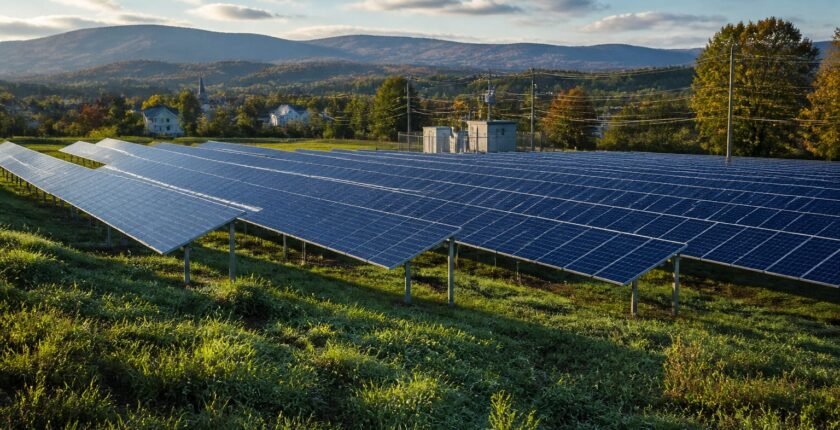
PowerBank Corporation says its Camillus community solar project in New York, a 3.26 MW ground-mounted array on a closed landfill, has received permission to operate. That is the last approval the project needed before it can enter service. PowerBank built Camillus for Solar Advocate Development LLC, which bought it in a deal the company valued at US$7.3 million. The array is meant to serve local households through community solar, a model in which renters and homeowners share in a solar farm's output without fitting panels to their own roofs. In its press release announcing the milestone, PowerBank said Camillus adds to more than 100 MW of completed projects. It also said its development pipeline is approaching 1 GW.
Key takeaways
- Final approval: PowerBank Corporation's 3.26 MW Camillus community solar project in New York has received permission to operate, the step that clears it to enter service.
- Landfill site: Camillus is a ground-mounted array on a closed landfill, a parcel PowerBank has turned into a power source for local households.
- US$7.3 million deal: PowerBank built Camillus for Solar Advocate Development LLC and sold it to that buyer in a transaction valued at US$7.3 million, roughly $2.24 million per megawatt.
- Company scale: PowerBank says it has completed more than 100 MW of projects and has a development pipeline approaching 1 GW.
Table of contents
What Permission to Operate Means for Camillus
Permission to operate is the final approval a solar project needs before it can enter service. Construction can be finished and panels can be wired, but the array cannot start supplying power until that sign-off arrives. PowerBank Corporation described the Camillus approval in exactly those terms: a key step toward bringing the project online.
The project is rated at 3.26 MW and mounted on the ground rather than on rooftops. It is structured as community solar. Under that model, households subscribe to a share of a shared array and receive financial and environmental benefits from its output, even if they rent or cannot host panels themselves.
PowerBank has not published a commercial operation date, a subscriber count or the name of the utility Camillus connects to. Those details decide when local households actually see a benefit, and they remain open.
Why Build a Solar Farm on a Closed Landfill
Camillus sits on a closed landfill. Land like this rarely suits housing or farming once a dump is sealed, so it often sits idle for years. PowerBank's pitch is that its engineers and construction partners converted such a site into a working clean power source for nearby homes.
A ground-mounted array is a sensible fit for that kind of parcel because it puts panels on open land the community cannot easily use any other way. The trade-off is engineering complexity. PowerBank presents its approval on a landfill site as proof of its building experience.
PowerBank has not said which landfill was used, how long it has been closed, or what site preparation the build required. A reader weighing the company's claim about difficult sites would need those details to judge it, and none has been released so far.
How the US$7.3 Million Sale Fits PowerBank's Model
PowerBank did not keep Camillus. The project was built for Solar Advocate Development LLC and sold to it in a transaction valued at US$7.3 million. Spread across 3.26 MW of capacity, that works out to about $2.24 million per megawatt. That figure is a transaction value, not a disclosed construction cost.
PowerBank calls itself an independent North American energy company that is vertically integrated, handling solar and battery storage systems from development and construction through to operation and ownership. It sells to several kinds of customer: the grid itself, commercial and industrial businesses, and municipal and residential off-takers, meaning buyers that sign up to take a project's power.
Camillus shows the develop-and-sell side of that model. Building a project and selling it to another owner lets a developer recycle capital into its next site. The company has not said whether it keeps any operating role at Camillus after the sale.
Reading PowerBank's 100 MW and 1 GW Claims
According to PowerBank, Camillus brings its completed projects to a combined total above 100 MW. The company also puts its development pipeline at close to 1 GW. Both numbers are PowerBank's own, taken from its announcement, and have not been independently tallied.
The gap between those numbers is the real story. A pipeline near 1 GW is roughly ten times the capacity PowerBank says it has finished. Pipelines count projects at every stage, including many that may never be built. The 1 GW figure therefore shows ambition, while the 100 MW figure shows what the company has actually delivered.
PowerBank also argues that AI and digital infrastructure are pushing electricity demand to new levels. It says it can supply power with the speed and scale that newer customers need, without long waits for permits and grid connections. That is a sales argument. A 3.26 MW community array serving households does little to test it.
| Measure | Capacity | Status |
|---|---|---|
| Camillus project | 3.26 MW | Permission to operate received |
| Completed portfolio | More than 100 MW | Completed, per PowerBank |
| Development pipeline | Approaching 1 GW | In development, per PowerBank |
What could help or hold back PowerBank's next projects
The case for
- A completed approval on a closed landfill gives PowerBank a reference project for other hard-to-use sites.
- Selling Camillus to Solar Advocate Development LLC for US$7.3 million frees capital for a pipeline the company says is approaching 1 GW.
The case against
- The 100 MW track record and the near-1 GW pipeline are self-reported, and PowerBank has not broken down how much of the pipeline is close to construction.
- PowerBank has released no commercial operation date or subscriber figures, so the household benefit from Camillus is not yet measurable.
What to be careful about
- Camillus has permission to operate, but no date for full commercial service or household enrolment has been published.
- PowerBank's capacity and pipeline figures come only from the company and have not been independently confirmed.
- Site details for the landfill, including its name and preparation work, have not been disclosed, which limits outside scrutiny of the build.
The bottom line
Camillus is a small project with a clear message. PowerBank Corporation says a 3.26 MW array on a closed New York landfill has cleared its last approval, and Solar Advocate Development LLC now owns it after a US$7.3 million deal. The landfill angle is the most useful part of the story, because it shows idle, compromised land being put to work for local households through community solar. The rest of the announcement is PowerBank selling itself: more than 100 MW completed, a pipeline approaching 1 GW, and a pitch aimed at AI-driven power demand. Those claims are the company's own. The measures that matter for Camillus, its start date and its subscriber count, have not been published yet.
What to watch
- Watch for PowerBank or Solar Advocate Development LLC to announce that Camillus has entered commercial service and begun enrolling households; no date has been set.
- Watch whether PowerBank turns part of its pipeline, which it says is approaching 1 GW, into new completed projects during 2027.
Frequently asked questions
Who owns the Camillus solar project in New York?
Solar Advocate Development LLC owns Camillus. PowerBank Corporation built the 3.26 MW project for that buyer and sold it in a transaction valued at US$7.3 million.
How does community solar work for renters?
Community solar lets renters and homeowners subscribe to a share of a shared array, such as the 3.26 MW Camillus project. Subscribers receive financial and environmental benefits from its output without installing panels on their own homes.
Is the Camillus solar farm producing power yet?
Camillus has received permission to operate, the final approval needed to enter service. PowerBank has not published a commercial operation date or the number of households signed up.
Related reading