
Blog
EIA Says Southwest Hydropower Hit Record Lows in 2026
Estimated reading time: 6 minutes · Last updated:
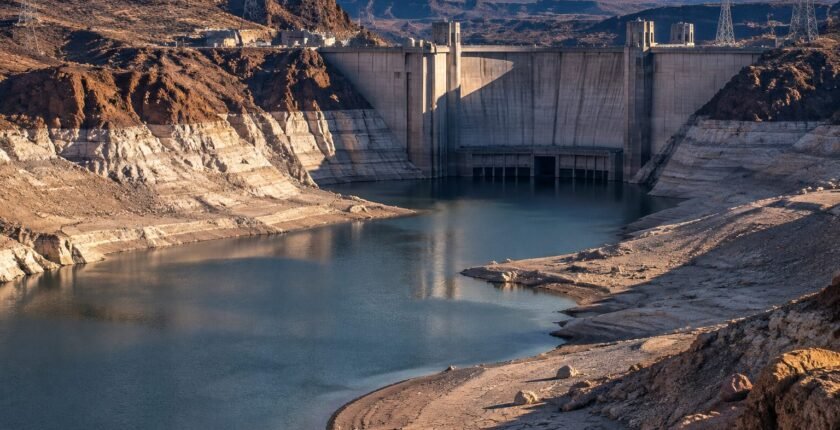
Southwest hydropower output reached record lows in summer 2026, the U.S. Energy Information Administration (EIA) says, because a drought lasting several years in the Colorado River Basin has drained the reservoirs behind the region's dams. EIA's Form EIA-923 survey shows generation from April through August 2026 ran 19% below the same months a year earlier and 28% below the 10-year average. The squeeze is tightest at Glen Canyon Dam, where Lake Powell ended September at 3,518 feet. That is less than 1% above the 3,490-foot level the dam needs to produce power. In its November 2026 Short-Term Energy Outlook, EIA expects Southwest hydropower to total 6.13 billion kilowatthours this year and to edge lower again in 2027.
Key takeaways
- Record summer low: EIA data show Southwest hydropower from April through August 2026 was 19% below the prior year and 28% below the 10-year average.
- Lake Powell near cutoff: Lake Powell stood at 3,518 feet at the end of September, less than 1% above the 3,490-foot minimum power pool for Glen Canyon Dam.
- Interior cuts consumption: The Department of the Interior will reduce combined water use in California, Arizona and Nevada by 1.25 million acre-feet a year for two years to protect Lake Mead.
- No rebound forecast: EIA projects 6.13 BkWh of Southwest hydropower in 2026 and 6.1 BkWh in 2027, a further 0.5% decline.
- Shrinking share: Hydropower is expected to supply about 4% of Southwest generation in 2026, down from a peak of 8% in 2011, according to EIA's STEO.
Table of contents
- Key takeaways
- How Drought Drove Southwest Hydropower to a Record Low
- Why Lake Powell Is Closer to the Edge Than Lake Mead
- Saving Lake Powell Shifts the Strain to Lake Mead
- EIA Forecasts Another Weak Year in 2027
- What could lift or sink Southwest hydropower
- What to be careful about
- Frequently asked questions
How Drought Drove Southwest Hydropower to a Record Low
EIA's Southwestern electricity supply region covers Arizona and New Mexico, along with small parts of Nevada and California. Across that area, hydropower generation over the five months from April through August 2026 came in 19% below the prior year. It was 28% below the 10-year average. EIA describes the result as a record low for the summer.
The figures come from the agency's Form EIA-923 survey, its latest data on power plant output. EIA traces the shortfall to prolonged drought across the Colorado River Basin. The cause is a run of dry years that has built up over time, not one bad season.
The consequences reach well beyond the dams. Seven states depend on the Colorado River for hydropower and for other water needs: Arizona, California, Colorado, Nevada, New Mexico, Utah and Wyoming. The U.S. Bureau of Reclamation manages most of the basin's dams. That makes it the operator deciding how scarce water is divided between electricity and every other use.
Why Lake Powell Is Closer to the Edge Than Lake Mead
A hydropower dam can only generate while its reservoir stays above a set elevation, called the minimum power pool. Below that line, the dam cannot produce electricity. Lake Powell, formed by Glen Canyon Dam, and Lake Mead, formed by Hoover Dam, both reached record low water elevations this year, EIA reports.
Glen Canyon is the tighter case. Its minimum power pool is 3,490 feet. Lake Powell measured 3,518 feet at the end of September, less than 1% above that floor, which leaves about 28 feet of headroom before the dam's turbines would have to stop.
Hoover Dam needs Lake Mead at 950 feet or higher. At the end of September, Mead was at 1,038 feet, roughly 88 feet or 9% above its minimum power pool. That cushion is wider than Powell's. The two lakes sit on the same river, however, so protecting the upstream reservoir draws on the downstream one.
Saving Lake Powell Shifts the Strain to Lake Mead
Federal operators have taken two steps to keep Lake Powell above the 3,490-foot threshold. Water was released from Flaming Gorge, a reservoir in the Upper Colorado River Basin, to add flow headed toward Powell. Outflows from Lake Powell were also reduced so the lake would stay at 3,510 feet or above under the most probable inflow scenario.
Holding water in Powell has a cost downstream. Smaller releases from Powell mean less water reaching Lake Mead, which could lower Mead's elevation and cut generation at Hoover Dam. EIA identifies this knock-on risk directly.
The Department of the Interior has turned to demand to offset it. Under its decision, the three states together must use 1.25 million acre-feet less from the river in each of the next two years, with California, Arizona and Nevada sharing the cut. Shrinking what those three states take from the river is meant to keep more water behind Hoover Dam while Powell's outflows stay restrained.
EIA Forecasts Another Weak Year in 2027
In its November 2026 Short-Term Energy Outlook (STEO), EIA projects Southwest hydropower will total 6.13 billion kilowatthours (BkWh) for 2026. That is 9% below the prior year and 24% below the 10-year average. The full-year gap is smaller than the 28% summer shortfall, but it is still steep.
The 2027 forecast shows no recovery. EIA expects 6.1 BkWh, 0.5% less than this year. The main upside is this year's El Niño, which could deliver more precipitation than normal and ease the drought somewhat. EIA cautions that one wet year probably will not erase the effects of several years of water scarcity.
Hydropower is also a shrinking part of the region's power supply. The STEO puts its 2026 share of Southwest generation at about 4%, half its 2011 peak of 8%. Lindsay Aramayo is listed as principal contributor to EIA's analysis.
| Dam | Reservoir | Minimum power pool | End-September elevation | Margin |
|---|---|---|---|---|
| Glen Canyon Dam | Lake Powell | 3,490 feet | 3,518 feet | Less than 1% (about 28 feet) |
| Hoover Dam | Lake Mead | 950 feet | 1,038 feet | 9% (about 88 feet) |
What could lift or sink Southwest hydropower
The case for
- El Niño could bring above-normal precipitation this winter and raise reservoir inflows, which EIA says may improve its regional hydropower forecast.
- Interior's 1.25 million acre-foot annual cut in California, Arizona and Nevada consumption is designed to support Lake Mead's elevation and Hoover Dam output.
The case against
- Reduced releases from Lake Powell, needed to hold it at 3,510 feet or more, send less water downstream to Lake Mead.
- EIA expects one good water year to fall short of reversing several years of scarcity, and it already forecasts a further 0.5% decline in 2027.
What to be careful about
- If Lake Powell falls below its 3,490-foot minimum power pool, Glen Canyon Dam cannot generate hydropower; it ended September only about 28 feet above that level.
- Holding water in Lake Powell could lower Lake Mead and reduce generation at Hoover Dam.
- Hydropower's share of Southwest generation has already halved from 8% in 2011 to about 4% expected in 2026, leaving the region more reliant on other sources.
The bottom line
The Southwest's hydropower problem has become a question of how to divide a shrinking river. EIA data put summer 2026 generation at a record low, and Lake Powell ended September about 28 feet above the point where Glen Canyon Dam stops producing power. Operators have bought time by releasing water from Flaming Gorge and holding back Powell's outflows. That moves the strain onto Lake Mead and Hoover Dam, which is why Interior is cutting use in California, Arizona and Nevada by 1.25 million acre-feet a year. EIA's 6.1 BkWh forecast for 2027 assumes no quick recovery. El Niño may help, but nothing in EIA's numbers points to hydropower regaining the 8% share it held in 2011.
What to watch
- Whether Lake Powell stays at or above the 3,510-foot level its reduced releases are meant to protect through the 2026-27 winter; EIA gave no date for the next elevation reading.
- Whether El Niño precipitation lifts EIA's 2027 Southwest hydropower forecast above 6.1 BkWh in later editions of the Short-Term Energy Outlook; no release date was stated.
- How Lake Mead and Hoover Dam output respond in 2027 as Interior's 1.25 million acre-foot annual consumption cut for California, Arizona and Nevada runs over the next two years.
Frequently asked questions
What is the minimum power pool at Lake Powell?
It is the lowest water elevation at which Glen Canyon Dam can generate hydropower, set at 3,490 feet. Lake Powell was at 3,518 feet at the end of September 2026, less than 1% above it.
Which states are affected by low Colorado River hydropower?
Arizona and New Mexico make up EIA's Southwestern supply region, which also takes in slivers of California and Nevada. Seven states rely on the Colorado River for hydropower and water: Arizona, California, Colorado, Nevada, New Mexico, Utah and Wyoming.
Will El Niño end the Southwest hydropower slump?
EIA says this year's El Niño could bring above-normal precipitation and some drought relief. It also says one good water year is unlikely to undo several years of scarcity, and it forecasts 6.1 BkWh for 2027.
Related reading