
Blog
Green Volt Reserves 28 Siemens Gamesa 15 MW Turbines
Estimated reading time: 4 minutes · Last updated:
The Green Volt floating wind farm off north-east Scotland has secured its turbine supply. On 24 November, the Green Volt joint venture said it had signed a capacity reservation agreement for 28 Siemens Gamesa machines, each able to produce more than 15 MW. The developer described the deal as worth millions of pounds. Taken together, the order implies more than about 420 MW of capacity. The choice is a change of course, since Green Volt had first looked at turbines from Mingyang. Alongside the order, the developer agreed a Letter of Intent with the Port of Aberdeen covering anchor and mooring work.
Scotland has the skills, industrial heritage and proven track record of delivering major energy projects to lead this industry.
Matt Green, Green Volt Project Director
Key takeaways
- Turbine order: Green Volt reserved production capacity for 28 Siemens Gamesa turbines rated above 15 MW each, announced on 24 November.
- Supplier switch: Mingyang had earlier been under consideration as turbine supplier for the Green Volt project.
- Aberdeen port role: A Letter of Intent with the Port of Aberdeen is expected to support GBP 15 million (around EUR 17.9 million) of spending tied to Aberdeen South Harbour.
- Project status: Green Volt, owned by Flotation Energy and Vårgrønn and sited about 80 kilometres off Peterhead, gained onshore and offshore consent in April 2024.
Table of contents
Why the Siemens Gamesa Order Moves Green Volt Forward
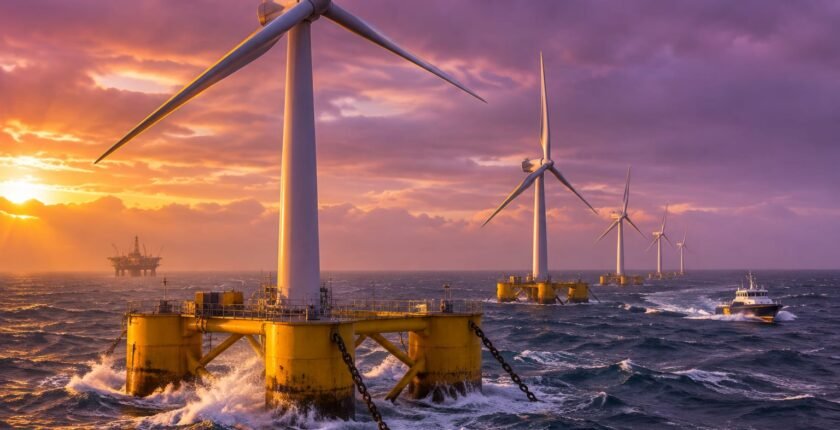
Green Volt is a joint venture between Flotation Energy and Vårgrønn. Its site lies about 80 kilometres off Peterhead. The partners say it will be the world's largest commercial-scale floating wind farm at sea. That ranking is their own claim, made for a project not yet built.
A floating wind farm mounts turbines on buoyant platforms held by anchors and mooring lines, rather than on foundations fixed to the seabed. Green Volt won consent for its offshore and onshore elements in April 2024. In August 2025, OWC won a contract to engineer the project's offshore and onshore cables.
A capacity reservation holds space on a manufacturer's production line. No further terms of the Siemens Gamesa agreement were published.
How the Port of Aberdeen Deal Spreads the Work
The second agreement points part of the supply chain at Aberdeen. Under the Letter of Intent, the Port of Aberdeen expects to marshal anchors and moorings at Aberdeen South Harbour, meaning it would stage and prepare that equipment before it heads offshore.
The arrangement should underpin GBP 15 million (around EUR 17.9 million) of spending on port facilities, infrastructure and supply chain work. Bob Sanguinetti, chief executive of Port of Aberdeen, said the sector offered Scotland and the UK an economic opening of the kind that comes once in a generation, and that the work would bring fresh openings to North East suppliers.
Matt Green, Green Volt project director, argued that Scotland's skills and record on big energy schemes equip it to lead floating wind. A Letter of Intent signals a plan rather than a binding contract, so the GBP 15 million remains an expectation.
| Party | Agreement | Date | Scope |
|---|---|---|---|
| Siemens Gamesa | Capacity reservation | Announced 24 November | 28 turbines, each above 15 MW |
| Port of Aberdeen | Letter of Intent | Announced 24 November | Anchor and mooring marshalling, GBP 15 million expected |
| OWC | Engineering contract | August 2025 | Offshore and onshore cables |
What could help or hold back Green Volt
The case for
- Reserving Siemens Gamesa production capacity gives the project a defined turbine supplier for 28 machines.
- Consent for both onshore and offshore elements has been in place since April 2024.
- Cable engineering has been contracted to OWC since August 2025, so another workstream is already underway.
The case against
- A capacity reservation is not a published supply contract, and its terms remain undisclosed.
- The Port of Aberdeen arrangement is a Letter of Intent, so the GBP 15 million of spending is expected rather than committed.
- The developer has not explained the move away from Mingyang turbines.
What to be careful about
- The Siemens Gamesa reservation could fall short of a firm turbine supply agreement if later terms are not concluded.
- The Aberdeen South Harbour marshalling work depends on the Letter of Intent becoming a binding contract.
- The world's-largest claim made by the joint venture depends on the project being built at its planned scale.
The bottom line
The turbine reservation and the port agreement settle two practical questions for Green Volt: which machines it will use, and where its mooring hardware will be prepared. Both remain early commitments. The Siemens Gamesa deal reserves output without published contract terms, and the Aberdeen arrangement states an intention rather than a signed obligation. The developer has also given no reason for dropping Mingyang. What the evidence supports is a project moving from consent, granted in April 2024, into procurement. Whether it earns the world's-largest label its owners claim depends on construction milestones the partners have yet to set out publicly.
What to watch
- Watch for a firm turbine supply contract with Siemens Gamesa that follows the capacity reservation; no date has been set.
- Watch for the Port of Aberdeen Letter of Intent to become a binding agreement for anchor and mooring marshalling at Aberdeen South Harbour; no date has been set.
Frequently asked questions
Who owns the Green Volt floating wind farm?
Green Volt is a joint venture between Flotation Energy and Vårgrønn. The project sits about 80 kilometres off Peterhead in Scotland.
Did Green Volt pick Mingyang turbines?
Green Volt first considered Mingyang turbines for the project. It has since reserved capacity for 28 Siemens Gamesa turbines instead.
What will the Port of Aberdeen do for Green Volt?
Under a Letter of Intent, the Port of Aberdeen would handle future anchor and mooring marshalling at Aberdeen South Harbour. The arrangement is expected to support GBP 15 million (around EUR 17.9 million) of spending.
Related reading