
Blog
Closed-Loop Geothermal Could Gain 27% From Groundwater Flow
Estimated reading time: 7 minutes · Last updated:
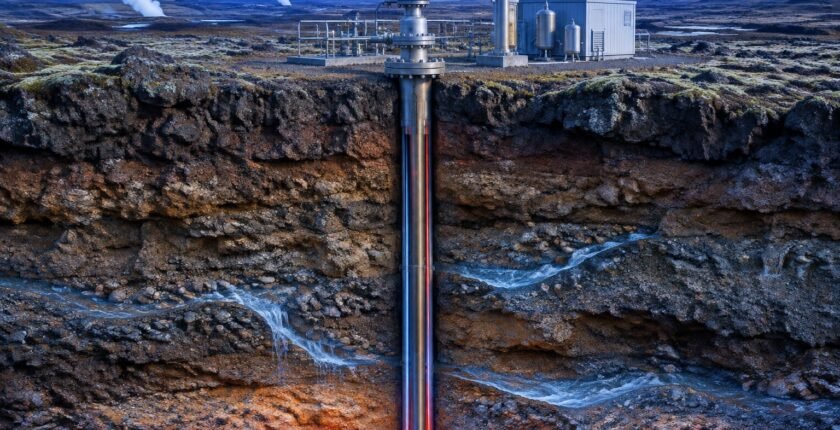
Groundwater moving slowly through deep sedimentary rock could raise the energy a closed-loop geothermal well delivers over 40 years by up to 27 percent, compared with a well that depends on heat conduction alone. That is the central result of a three-dimensional finite-element study by O. Alobaid, C. J. Ezekiel, A. Daniilidis, T. Finkbeiner and P. M. Mai in the journal Geothermal Energy. Flowing water sweeps cooled water away from the buried pipe and brings warmer water in from upstream, so the rock around the well does not chill as fast. The team modelled a U-shaped loop in the Midyan basin, part of the Red Sea Rift. The gain is simulated, not measured, and the authors flag assumptions that may flatter it.
Key takeaways
- The headline gain: In the Alobaid team's model, groundwater moving at 20 metres per year raised 40-year cumulative net heat from a closed loop by 27 percent over a conduction-only case.
- Baseline output: The simulated U-shaped well in the Midyan basin started at 6.3 megawatts of thermal power, settled near 3.6 megawatts within a year, and delivered 4.5 billion megajoules over 40 years.
- Orientation matters: Laying the 2000-metre horizontal lateral perpendicular to groundwater flow gave the highest heat transfer, while parallel layouts let a cold plume build along the casing.
- Design levers: Raising cement thermal conductivity from 0.2 to 0.8 watts per metre-kelvin lifted net thermal output by roughly 90 percent, and a 3000-metre lateral reached 4.0 megawatts.
- Untested assumptions: The authors note that direct hydrological data from the Midyan basin are limited and that the model ignores faults, so porosity and permeability at 5000 metres may be overstated.
Table of contents
- Key takeaways
- Why Sealed Geothermal Loops Run Short of Heat
- How the Midyan Basin Model Was Built
- What Moving Groundwater Adds Over 40 Years
- Which Design Choices Raise Net Power
- Where the Simulation Could Overstate the Gain
- The case for and against groundwater-assisted closed loops
- What to be careful about
- Frequently asked questions
Why Sealed Geothermal Loops Run Short of Heat
Geothermal power has mostly come from two routes. Conventional hydrothermal plants pull hot brine straight out of the ground. Enhanced geothermal systems crack tight rock with pressurised fluid to open a circulation path, and pumping fluid into crystalline basement rock has in the past set off earthquakes.
A closed-loop design, also called an advanced geothermal system, sidesteps both problems. A working fluid travels inside sealed pipes and never mixes with the water in the formation. That cuts the risks of corrosion, mineral scaling and contamination.
The price is output. In dry rock, heat reaches the pipe only by conduction, which is slow, so the rock beside the wellbore cools quickly and power sags. The Alobaid team asked whether advection, the transport of heat by moving fluid, could refill that lost heat in a formation where groundwater naturally flows.
How the Midyan Basin Model Was Built
The researchers picked the Midyan basin because it runs hot. Regional heat flow there is 70 to 90 milliwatts per square metre, and temperature climbs 30 to 40 degrees Celsius per kilometre of depth. Their target was the Oligocene Al Wajh formation, a thick sedimentary layer 4000 to 5000 metres down.
Low-permeability evaporite, shale and salt cap that layer, and impermeable crystalline basement lies beneath it. Boxed in this way, groundwater can only move sideways. The model applied a 1.5-megapascal pore-pressure difference across the reservoir to push water at Darcy velocities, the effective speed of water through rock, between 0 and 20 metres per year.
The simulated block measured 5000 by 1000 metres across and 5600 metres deep. The well drops 5000 metres, runs a 2000-metre lateral through the aquifer, then rises 5000 metres, about 12,000 metres of pipe in all, with insulation on the top 1000 metres of the return leg. In the base case, water enters at 30 kilograms per second and 25 degrees Celsius. Mesh tests at 2.5 elements per metre kept numerical error under 5 percent over 40 years.
What Moving Groundwater Adds Over 40 Years
In the baseline run, the loop opened at 6.3 megawatts of thermal power and settled in less than 12 months to a steady average of 3.6 megawatts. Net heat over 40 years totalled 4.5 billion megajoules. Most warming happened on the way down the injection leg, the lateral added more gradually, and the insulated return held temperature to the surface.
With no groundwater movement, the Péclet number, a ratio of heat carried by flowing water to heat spread by conduction, was zero. A symmetric cold zone formed tightly around the lateral and throttled output. At 20 metres per year the number reached 0.18, chilled water drifted downstream, warmer water arrived from upstream, and cumulative net energy after 40 years rose 27 percent.
Direction mattered as much as speed. A lateral set perpendicular to the flow gave the best heat transfer and peak power, because water crossing the pipe kept delivering undisturbed heat along its whole span. A parallel lateral, running either way, let the cold plume stretch along the casing and weakened the temperature contrast between rock and borehole wall.
Which Design Choices Raise Net Power
Pumping harder does not always pay. Across circulation rates from 10 to 100 kilograms per second, net thermal power peaked at 30. Faster flow captured slightly more raw heat, but the fluid spent less time in the hot lateral, the gap between injection and production temperatures shrank, and parasitic pumping, the energy spent moving the fluid, ate into the return.
Geometry gave clearer gains. Widening the lateral from 0.114 to 0.245 metres in diameter put more casing against rock and raised net power from 3.1 to 3.7 megawatts. Stretching it from 500 to 3000 metres lifted sustained net power from 2.5 to 4.0 megawatts.
The cement around the pipe proved a strong lever. Raising its thermal conductivity from 0.2 to 0.8 watts per metre-kelvin cut resistance across the well wall and boosted net thermal output by roughly 90 percent. Even so, the local sensitivity analysis ranked the geothermal gradient and reservoir depth as the strongest influences on total yield, so site selection still comes first.
Where the Simulation Could Overstate the Gain
The authors say the result needs field checks before commercial use. Measured hydrological data from the Midyan basin are scarce, so the model relied on baseline porosity and permeability. At 5000 metres, heavy overburden stress and compaction often squeeze both properties below shallow estimates, which would mean slower groundwater than the model assumed.
The model also treats the reservoir as uniform porous rock with no explicit faults or fracture networks. Real faults can funnel water into narrow channels and leave stretches of a lateral with little flow. Both caveats point the same way: 27 percent is the best case within the modelled range, under favourable rock assumptions, not a forecast for a working plant.
| Parameter | Range tested | Result |
|---|---|---|
| Groundwater Darcy velocity | 0 to 20 m per year | 27% more 40-year net energy at 20 m/yr |
| Circulation rate | 10 to 100 kg/s | Net thermal power peaked at 30 kg/s |
| Lateral diameter | 0.114 to 0.245 m | Net power 3.1 to 3.7 MW |
| Lateral length | 500 to 3000 m | Net power 2.5 to 4.0 MW |
| Cement conductivity | 0.2 to 0.8 W/m-K | About 90% more net thermal output |
| Lateral orientation | Parallel, reverse, perpendicular | Perpendicular gave highest power |
The case for and against groundwater-assisted closed loops
The case for
- Moving groundwater replenished heat around the lateral and added 27 percent to 40-year energy in the model at 20 metres per year.
- The sealed loop avoids producing brine and avoids hydraulic stimulation, the step linked to induced seismicity in enhanced geothermal systems.
- Simple design choices, a perpendicular lateral, wider bore, longer lateral and more conductive cement, each raised net power in the simulation.
The case against
- Porosity and permeability at 5000 metres may be lower than the baseline values used, reducing groundwater flow.
- Faults and fractures, absent from the model, could channel water away from parts of the lateral.
- Without flow, the model shows a tight cold zone forming around the well and limiting long-term output.
What to be careful about
- The 27 percent gain rests on groundwater velocities that have not been measured in the Al Wajh formation at depth.
- Compaction under high stress at 5000 metres could cut permeability below the model's assumptions.
- Uniform-rock modelling omits faults that could concentrate flow in narrow conduits.
- Output is most sensitive to geothermal gradient and reservoir depth, so results may not carry over to other basins.
The bottom line
The study hands closed-loop geothermal developers one design rule and one site test. The rule is to lay the horizontal leg across the direction of groundwater flow, not along it, and to pair that with a long, wide lateral and conductive cement. The test is to find a deep sedimentary layer where water actually moves, because at 20 metres per year it added 27 percent to 40-year energy in the Midyan model. Sealed loops have struggled because the rock around them runs cold. Moving groundwater offers a way past that limit without fracturing rock or producing brine. Whether the Al Wajh formation flows as freely at 5000 metres as the model assumed is the open question, and only data gathered at depth can settle it.
What to watch
- Watch for direct hydrological measurements from the Midyan basin that show whether groundwater in the Al Wajh formation moves as fast as the model assumed; no date has been set.
- Watch for follow-up modelling that adds faults and fracture networks to test whether channelled flow erodes the 27 percent gain; no date has been set.
Frequently asked questions
Where was the closed-loop groundwater study published?
It appeared in Geothermal Energy, volume 13, issue 1, as article 40 in 2025, under the DOI 10.1186/s40517-025-00363-4. The authors are O. Alobaid, C. J. Ezekiel, A. Daniilidis, T. Finkbeiner and P. M. Mai.
Has the 27 percent gain been proven in a real well?
No. The figure comes from a finite-element simulation of the Midyan basin, and the authors say empirical validation is needed before commercial execution. Hydrological data from the basin are limited.
Does closed-loop geothermal cause earthquakes?
Closed loops circulate fluid in sealed pipes rather than injecting it into rock, which is the step that has historically triggered seismicity in enhanced geothermal systems. The Alobaid model required no hydraulic stimulation.
What does a Péclet number of 0.18 mean for a geothermal well?
It means conduction still dominates but moving water carries a meaningful share of the heat. In the model, reaching 0.18 at 20 metres per year was enough to add 27 percent to 40-year energy.
Related reading