
Blog
German Battery Storage Developer Return Raises €835 Million
Estimated reading time: 5 minutes · Last updated:
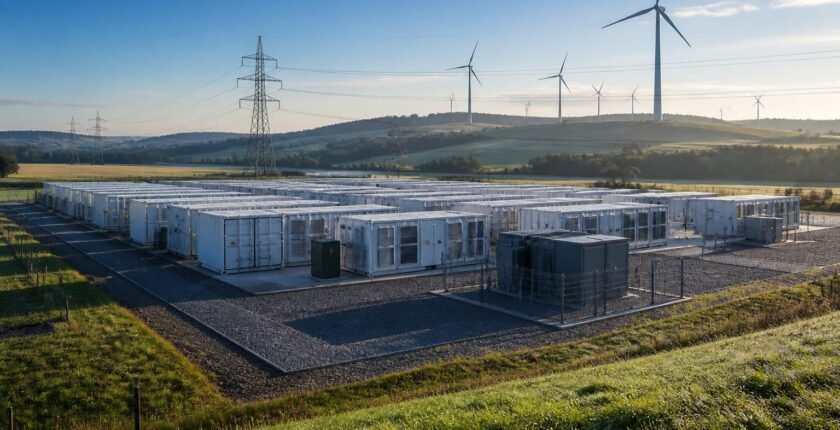
Amsterdam-based storage company Return has raised €835 million (USD$936 million) in portfolio financing, underwritten by Deutsche Bank and Rabobank, to grow its battery fleet in Germany. The money first funds three German battery storage projects now under construction, totalling 117 MW. The framework is built so more sites can join through 2027 as each reaches financial close. Return was founded in 2021. A larger ambition sits behind the deal. From 2027, Return says it wants to install at least 1 GW of storage in Germany every year, backed by annual spending of €750 million to €1.2 billion. The company itself ties that pace to market conditions.
As demand for energy flexibility grows, we need to scale not just our battery storage capacity, but also the way we finance it.
Daniel Witvoet, CFO, Return
Key takeaways
- The deal: Deutsche Bank and Rabobank underwrote €835 million (USD$936 million) of portfolio financing for Return's German battery storage build-out.
- First projects: Three German battery sites under construction, with a combined 117 MW, are the first projects inside Return's new financing framework.
- Household equivalent: Return estimates the three sites could supply a year's electricity use for roughly 100,000 German households, assuming four-hour batteries cycling twice daily.
- Annual target: From 2027, Return plans at least 1 GW of new German battery capacity each year, with investment of €750 million to €1.2 billion annually.
Table of contents
What the €835 Million Actually Pays For
Portfolio financing is a single lending framework that covers a group of projects rather than one site at a time. Return's version, underwritten by Deutsche Bank and Rabobank, currently holds three German battery sites, all still being built, which together add up to 117 MW of capacity. More projects are meant to join through 2027 as they reach financial close, the point at which a project's funding is fully committed.
Return frames the scale in household terms. If each battery holds four hours of output and completes two full charge-and-discharge cycles daily, the company calculates the three sites could deliver in a year about what 100,000 German homes consume. On that same four-hour assumption, 117 MW equates to about 468 MWh of storage.
Real cycling will depend on prices and grid needs, so the household comparison illustrates potential rather than measured output.
Why Germany Needs Batteries That Can Shift Power
Return links its expansion to Germany's growing dependence on wind and solar, whose output rises and falls with the weather. That swing pushes energy companies to become more flexible in matching supply with demand. A battery energy storage system, or BESS, is a bank of batteries that charges when power is plentiful and releases it when the grid runs short.
Dominik Thumfart, Head of Infrastructure & Energy Origination at Deutsche Bank, said battery storage plays a "crucial role" in the transition, helping intermittent generators earn more from their output and keeping the grid stable. He said the bank designed the structure to scale with the capital spending needs of Return's German pipeline.
Return describes its own system as linking storage sites across countries and giving real-time visibility of where energy is available and where it is needed, which it says helps relieve congestion.
Can Return Reach 1 GW a Year From 2027?
The target dwarfs the deal's starting point. Return aims to install at least 1 GW of battery capacity in Germany each year from 2027, with planned annual investment of €750 million to €1.2 billion depending on market conditions. The three financed projects total 117 MW, a little over a tenth of a single year's goal.
Daniel Witvoet, Return's chief financial officer, argues that growth requires changing how storage is funded, not only how much is built. He said pairing finance for physical assets with the company's virtual flexibility model would let Return expand more efficiently and respond to shifting customer needs. How that virtual model works in detail, and how much of the target it would carry, has not been spelled out.
The investment range itself signals the uncertainty. The gap between its low and high ends is about €450 million a year, and Return ties the outcome to markets it does not control.
| Item | Size | Timing | Status |
|---|---|---|---|
| Current financed projects | 117 MW across three sites | Under way | Under construction |
| Further framework additions | Not disclosed | Through 2027 | Pending financial close |
| Annual installation target | At least 1 GW per year | From 2027 | Planned |
| Annual investment | €750 million to €1.2 billion | From 2027 | Depends on market conditions |
What could speed or slow Return's German build-out
The case for
- The framework is designed to absorb additional projects through 2027 without negotiating a fresh loan for each site.
- Deutsche Bank's Thumfart said the structure was built to scale with Return's German capital spending needs.
- Germany's rising share of wind and solar increases the need for flexible capacity that batteries provide.
The case against
- Return's annual investment plan spans €750 million to €1.2 billion, a range the company links to market conditions.
- The 117 MW now financed is a little over a tenth of the 1 GW annual target, leaving most of the planned capacity still to fund.
- The household estimate depends on two full cycles a day, which actual market operation may not deliver.
What to be careful about
- Further projects join the framework only as they reach financial close, so the size of the pipeline beyond 117 MW is not yet fixed.
- Return's 1 GW annual target and its spending plan are explicitly conditional on market conditions.
- Construction of the three financed projects is still under way, and no completion dates have been given.
The bottom line
The financing gives Return a funded start, not a finished build-out. Three projects totalling 117 MW are under construction with backing from Deutsche Bank and Rabobank, and the framework can take on more sites through 2027. The harder test comes afterwards, when Return wants to add at least 1 GW in Germany every year. Hitting that would mean spending in the €750 million to €1.2 billion range Return has outlined, inside a market that keeps rewarding flexible capacity as wind and solar grow. The evidence so far supports the first step. The annual target remains a plan whose pace Return itself ties to market conditions.
What to watch
- Watch for further German projects joining Return's financing framework as they reach financial close; the company expects additions through 2027.
- Watch whether Return starts installing at its target pace of at least 1 GW a year in Germany once 2027 begins.
- Watch for the three 117 MW projects to finish construction and start operating; no completion date has been given.
Frequently asked questions
Who is Return, the battery storage company?
Return is an Amsterdam-based energy storage company founded in 2021. It builds, owns and operates large battery storage systems and says its platform links sites across countries to ease grid congestion.
How many homes could Return's German batteries power?
Return estimates its three financed German projects, totalling 117 MW, could discharge enough electricity in a year to match the use of roughly 100,000 households. That assumes four-hour batteries completing two full cycles a day.
How much will Return invest in German battery storage each year?
Return plans annual investment of €750 million to €1.2 billion from 2027, tied to a goal of at least 1 GW of new capacity per year. The company says the final figure depends on market conditions.
Related reading