
Blog
Green Hydrogen Replaces Diesel at Festivals
Estimated reading time: 5 minutes · Last updated:
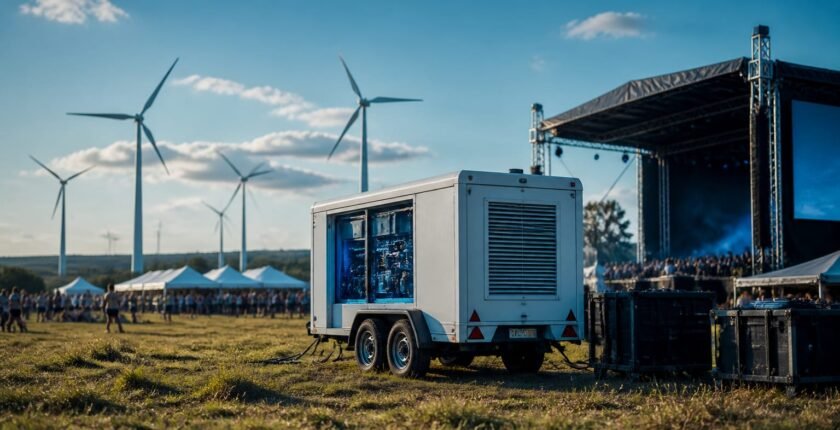
Green hydrogen is appearing on festival power bills in place of diesel. Hypebot’s Jeremy Young reported on 17 September 2026 that fuel-cell systems ran Boomtown’s 20,000-capacity HYDRO XL stage in August 2026 and that FORWARDS Festival trialled hydrogen for its main stage. Green hydrogen is produced when renewable electricity drives electrolysis to split water; the resulting gas is shipped to a site and fed to a fuel cell that makes electricity, emitting water and heat at the point of use. Pilots dating back to 2021 and examples from 2022, 2024 and 2025 show organisers testing where hydrogen replaces diesel reliably.
Key takeaways
- Large-stage trial: At Boomtown in August 2026 a hydrogen fuel-cell system powered the HYDRO XL stage rated for 20,000 capacity.
- Festival clean-power trial: FORWARDS Festival used green hydrogen for its main stage in 2026 during a clean-power trial backed by public funding, as first reported by Hypebot.
- Measured emissions reduction: Supplier GeoPura estimated that a 2024 main-stage switch to green hydrogen avoided approximately 5.7 metric tons of CO2.
- Earlier pilots: HebCelt ran a locally produced green-hydrogen Islands Stage for three days in 2022, supporting 12 acts, and Rock for People began experimenting with hydrogen in 2021.
Table of contents
What green hydrogen does on a festival site
Green hydrogen functions as a portable energy carrier that festival organisers can use when a permanent grid connection is impractical. In practice, renewable electricity is fed to an electrolyser that splits water into hydrogen and oxygen; the hydrogen can then be stored or trucked to the event and reconverted into electricity in a fuel cell. At the point of use the fuel cell emits mainly water and heat instead of carbon dioxide, nitrogen oxides or particulates, and it operates much more quietly than a diesel generator.
The trade-off is efficiency: converting electricity to hydrogen and back wastes energy compared with direct battery storage. That loss can be acceptable for multi-day events that need continuous, high-capacity power in remote locations because a hydrogen system can keep running as long as fuel is delivered. For shorter or highly predictable loads, batteries typically give higher round-trip efficiency and lower logistical complexity.
Pilots and the early evidence base
Festival trials now span several years and scales. Rock for People began experimenting with hydrogen in 2021; HebCelt used locally produced green hydrogen for an Islands Stage for three days in 2022 and supported 12 acts; a smaller hydrogen stage appeared at Boomtown in 2025 and the site expanded the experiment to a 20,000-capacity HYDRO XL stage in August 2026. FORWARDS Festival also ran its main stage on hydrogen in 2026 while using renewable-charged mobile batteries for other site loads.
Commercial suppliers are already putting figures on the benefits. GeoPura, the supplier cited from a 2024 deployment, estimated that replacing diesel at a main stage prevented roughly 5.7 metric tons of CO2. Those headline numbers matter for publicity, but organisers say the pilots are primarily about understanding fuel volumes, refuelling logistics and which elements of production can be moved off diesel without risking power continuity.
Where hydrogen makes sense and where it does not
Hydrogen becomes attractive when a festival needs uninterrupted high-power delivery at a temporary, off-grid location. Unlike a battery pack, a hydrogen system is not limited to a fixed stored energy amount; it can run for days as long as refuelling continues. That makes hydrogen a candidate for powering production hubs, headline stages and critical backstage infrastructure.
Conversely, when a site can access a renewable grid or when loads are short and predictable, batteries usually win on efficiency and simplicity. Promoters are therefore building hybrid mixes: a grid connection when possible, batteries for predictable loads and hydrogen for specific, continuous high-capacity needs. The practical decision is increasingly a matter of logistics—fuel supply chains, on-site storage, safety arrangements and cost—rather than pure emissions arithmetic.
Logistics, costs and the next steps for promoters
For promoters the immediate work is measurement and planning. Pilots show that oversized diesel gensets often idle below capacity and burn fuel inefficiently; measuring an event’s actual load profile is the first, low-cost emission reduction step. After that comes equipment choice: mobile batteries for predictable daytime loads, hydrogen fuel cells for continuous off-grid supply, and local renewables where practical.
The industry now needs transparent supplier data and post-pilot evaluations. Suppliers such as GeoPura have published case figures tied to single festivals; wider adoption will depend on clearer cost comparisons to diesel, firm delivery logistics and evidence that hydrogen systems can meet show-critical reliability standards. With trials reported from 2021 through 2026, the sector is moving from isolated demos toward repeatable deployments—if supply, cost and regulatory hurdles are solved.
| Application | Typical solution | When hydrogen is preferable | Example festival & year |
|---|---|---|---|
| Headline stage | Hydrogen fuel cell or large diesel genset | When continuous, multi-day, high-capacity off-grid power is required | Boomtown HYDRO XL stage — August 2026 |
| Medical / welfare | Batteries or small gensets | When loads are predictable and intermittent | Latitude — 2024 |
| Catering / crew villages | Batteries or small diesel units | When short-duration or lower-power loads dominate | Isle of Wight — 2024 |
The case for and against wider roll-out
The case for
- Hydrogen removes onsite NOx and particulate emissions and is much quieter than diesel, improving backstage conditions and public-facing sustainability claims.
- Mobile green-hydrogen systems can supply continuous power for multi-day events where batteries cannot practically be recharged on site.
- Pilots from 2021–2026 have produced operational learning that suppliers and promoters can refine into repeatable deployment processes.
The case against
- Conversion and transport losses mean hydrogen is less energy-efficient than direct renewable connections or batteries, raising lifecycle emissions unless the hydrogen is demonstrably green.
- Higher logistics and fuel costs compared with diesel or batteries could restrain adoption until supply chains scale or policy reduces price gaps.
- Safety, storage rules and local permitting for high-pressure or cryogenic hydrogen add lead time and complexity for festival planners.
What to be careful about
- Supply-chain emissions: if the hydrogen is not produced from renewables, lifecycle CO2 savings can evaporate.
- Cost and logistics: higher fuel and transport costs could make hydrogen deployments uneconomic for many promoters.
- Operational reliability: inadequate refuelling plans risk a headline-stage blackout during a set.
The bottom line
The festival sector is moving cautiously from small demonstrations to larger hydrogen trials. Deployments reported between 2021 and August 2026 show organisers testing hydrogen on stages and critical support services to remove noisy, polluting diesel from artist-facing infrastructure. The technology is not a universal replacement: batteries and grid connections remain better where efficiency or cost dominate. For hydrogen to scale the industry will need transparent supplier data, reliable refuelling logistics and clearer cost comparisons against diesel and battery options.
What to watch
- Watch for post-pilot evaluation reports from Boomtown and FORWARDS; no date has been set.
- Watch for supplier case studies from GeoPura or other vendors with detailed fuel-use and emissions data; no date has been set.
- Watch the 2027 festival season for any wider roll-outs of hydrogen-powered stages in the UK and Europe.
Frequently asked questions
How does green hydrogen power a festival stage?
Organisers use renewable electricity to run an electrolyser that splits water into hydrogen and oxygen; the hydrogen is transported to site and fed into a fuel cell that generates electricity, with water and heat as onsite emissions rather than CO2 or NOx.
How much CO2 can a hydrogen switch avoid at a festival?
Supplier GeoPura estimated that a 2024 main-stage deployment avoided about 5.7 metric tons of CO2; the exact figure depends on the diesel baseline and the source of the hydrogen.
When is hydrogen a better choice than batteries?
Hydrogen is preferable for continuous, high-capacity off-grid needs where the event runs for many days; batteries generally outperform hydrogen for short, predictable loads because of higher round-trip efficiency.
Related reading