
Blog
NYC Hydrogen Ferry Clears Coast Guard Design Basis Step
Estimated reading time: 7 minutes · Last updated:
Incat Crowther and SWITCH Maritime have secured a Design Basis Agreement from the United States Coast Guard for the SWITCH-150, a proposed NYC hydrogen ferry built to carry 150 passengers at 25 knots. The agreement sets the safety framework the vessel must meet. SWITCH says that framework will guide its construction, commissioning and operation. It was needed because the Coast Guard's small passenger vessel rules say nothing specific about fuel cells or onboard hydrogen. The team therefore had to prove equivalent safety directly to regulators. The first vessel would be based at the Brooklyn Navy Yard. The New York State Energy Research and Development Authority (NYSERDA) is backing the project with a $2 million grant. The companies describe the agreement as a significant regulatory milestone.
With the DBA in hand, Switch, our project team, and the USCG have a clear and defined framework that will inform vessel construction, commissioning, and ultimately operation.
Francisco Planells, Director of the Newbuild Program, SWITCH Maritime
Key takeaways
- Regulatory approval: The US Coast Guard granted Incat Crowther and SWITCH Maritime a Design Basis Agreement for the SWITCH-150, a hydrogen fuel cell-electric fast ferry planned for New York City.
- Vessel specification: The SWITCH-150 is a 28-meter (92-foot) aluminum catamaran designed for 150 passengers at 25 knots, with 1576 kWh of batteries and 720 kilograms of compressed hydrogen.
- Rules gap: Subchapter T has no hydrogen-specific provisions, so the team relied on the IMO's interim hydrogen safety guidelines approved in May 2026 to build an equivalency case.
- Precedent and funding: The design follows Sea Change, which won its agreement in 2020 and entered San Francisco Bay service in July 2024, and is supported by a $2 million NYSERDA grant.
Table of contents
Why a Hydrogen Ferry Needed Its Own Rulebook
The Coast Guard's Subchapter T governs how small passenger vessels are designed, built and run. The companies describe these as vessels carrying fewer than 150 people. The rules contain nothing written for fuel cell-electric propulsion or for storing hydrogen on board. That gap left SWITCH, Incat Crowther and their wider project team to work directly with the Coast Guard. Together they built a framework showing the vessel reaches existing safety and risk standards by equivalent means.
International guidance helped close the gap. In May 2026 the International Maritime Organization (IMO) approved interim guidelines on the safety of ships that burn hydrogen as fuel. The companies say those guidelines gave the agreement process more structure. They also say the guidelines cut the time needed to reach approval.
Francisco Planells, director of the newbuild program at SWITCH Maritime, said the signed agreement sets out a framework that the company, its project team and the Coast Guard can all rely on. He said that framework will guide how the vessel is built and commissioned, and later how it runs in service. That is the practical value of the document. It fixes the safety case before money is committed to the hull.
What the SWITCH-150 Is Designed to Do
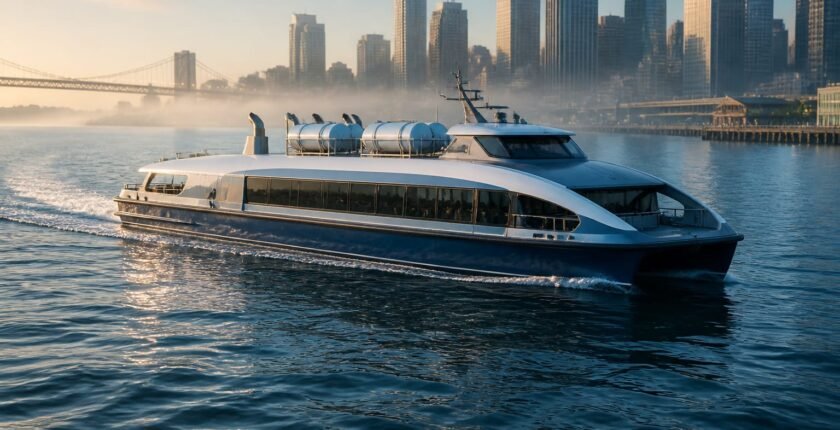
The vessel is planned at 28 meters (92 feet). It would use an aluminum catamaran hull drawn from Incat Crowther's designs. It would carry 150 passengers at a 25-knot cruising speed. Power would come from 1576 kWh of batteries working alongside 720 kilograms of compressed hydrogen stored on board. SWITCH says that hydrogen load is enough for a full day of operation across a range of New York ferry routes.
On the main deck, the plan calls for 150 seats, luggage space, a kiosk and large windows. It also includes three restrooms, one of them wheelchair accessible.
Dan Mace, technical manager at Incat Crowther, said the agreement validates the engineering and safety thinking behind the design. He said it should reassure operators that the propulsion system can work on a fast ferry of this size. With it secured, he said, the firm turns to detailed development, aiming to produce a full set of digital shipbuilding information from which a yard can start building. No construction date has been given.
How Sea Change Set the Template in San Francisco
The SWITCH-150 builds on Sea Change, SWITCH's first vessel. Sea Change is a 70-foot ferry that holds up to 75 passengers, and Incat Crowther designed it too. SWITCH describes it as the first US ferry to run on hydrogen fuel cell-electric propulsion. The new design reuses its technical, regulatory and operating groundwork.
Sea Change's paperwork shows how long the process can take. It received its Design Basis Agreement in 2020. Its Certificate of Inspection, the document that clears a vessel to carry passengers, followed in 2024. Passenger service on San Francisco Bay began in July 2024.
That gap of about four years between agreement and certificate is a useful benchmark for New York, but it is not a forecast. The newer vessel has twice Sea Change's passenger capacity. SWITCH says the IMO guidelines now available shortened approval this time. Whether that speed carries through to inspection and commissioning is still an open question.
SWITCH's Case Against Battery-Electric Ferries
SWITCH argues the SWITCH-150 will perform the way diesel boats do. The company says the ferry can run frequent, demanding service at matching speeds and refuel once a day. It also says dwell times at the dock will not grow, because the vessel does not have to stop and charge.
Fuel would arrive through mobile hydrogen refueling equipment rather than fixed shore chargers. SWITCH says this sidesteps expensive charging installations and upgrades to the power grid. It also says the vessel can drop into an existing timetable. By the company's account, a battery-electric ferry with similar specifications would force schedule changes or a broader rework of the service.
These are the developer's own claims, and no ferry operator has yet spoken publicly about them. They also leave out supply. A daily bunkering routine at the Brooklyn Navy Yard depends on a reliable flow of hydrogen. Neither company has said where that hydrogen will come from or what it will cost.
| Vessel | Length | Passengers | Design Basis Agreement | Status |
|---|---|---|---|---|
| Sea Change | 70 feet | Up to 75 | 2020 | In service on San Francisco Bay since July 2024 |
| SWITCH-150 | 28 meters (92 feet) | 150 | Granted, announced November 2026 | Moving to detailed design; to be based at Brooklyn Navy Yard |
What could help or hold back the SWITCH-150
The case for
- A signed Design Basis Agreement fixes the safety framework before construction, which reduces regulatory uncertainty later in the build.
- The IMO interim hydrogen guidelines approved in May 2026 give the Coast Guard and designers a shared reference point that Sea Change did not have.
- Mobile refueling avoids the shoreside charging and grid upgrades that SWITCH says a comparable battery ferry would need.
- Sea Change has carried passengers since July 2024, so the propulsion concept has already been through Coast Guard inspection once.
The case against
- Sea Change took about four years to move from its agreement to its Certificate of Inspection, and the larger vessel still needs both detailed design and inspection.
- Daily operation depends on a steady hydrogen supply to the Brooklyn Navy Yard, and no supplier or cost has been disclosed.
- Claims of diesel-equivalent performance come from SWITCH itself and have not yet been tested in New York service.
What to be careful about
- Hydrogen supply: daily bunkering requires a reliable source of compressed hydrogen in Brooklyn, and none has been named.
- Schedule: no construction date, shipyard or operator has been announced, so the timeline to passenger service is undefined.
- Unproven claims: the argument that the vessel can join an existing timetable without changes rests on SWITCH's own projections.
The bottom line
The Design Basis Agreement settles how the SWITCH-150 must be built to satisfy the Coast Guard. It does not build the boat. The steps Dan Mace described, detailed design and a construction-ready digital package, come before any yard work. The Certificate of Inspection that would allow paying passengers sits further out still. Sea Change has shown the model can reach service, though its journey ran from 2020 to July 2024. New York's version doubles the passenger count and has $2 million from NYSERDA behind it. The open questions are now commercial and logistical. Who will operate the ferry, and where will its 720 kilograms of hydrogen storage be filled each day? Can SWITCH's promise of no schedule changes hold up on a real New York timetable?
What to watch
- Watch for Incat Crowther to finish detailed design and deliver the construction-ready digital shipbuilding package; no date has been set.
- Watch for SWITCH to name a shipyard, a ferry operator and a hydrogen supplier for the Brooklyn Navy Yard base; none has been announced and no timing has been given.
- Watch for the SWITCH-150 to apply for its Coast Guard Certificate of Inspection, the step that would allow passenger service; no date has been set.
Frequently asked questions
How will the NYC hydrogen ferry be refueled?
SWITCH says the SWITCH-150 will take on hydrogen from mobile refueling equipment on a daily schedule, rather than from fixed shoreside chargers. The company argues this avoids costly charging infrastructure and grid upgrades at the Brooklyn Navy Yard.
Who is paying for New York's hydrogen ferry?
The New York State Energy Research and Development Authority (NYSERDA) is supporting the project with a $2 million grant. Other funding sources and the vessel's total cost have not been disclosed.
When will the SWITCH-150 carry passengers?
No date has been given. The vessel still needs detailed design, construction and a Coast Guard Certificate of Inspection. Its predecessor Sea Change took from its 2020 agreement until July 2024 to enter service.
What is a Design Basis Agreement for a ship?
It is an agreement between a vessel's designers and the US Coast Guard on the safety framework the design must meet. SWITCH's Francisco Planells said it will inform construction, commissioning and operation of the SWITCH-150.
Related reading