
Blog
Standardization Could Cut North Sea Offshore Wind Costs 28%
Estimated reading time: 5 minutes · Last updated:
DNV led a joint industry project that found standardisation and large-scale manufacture can materially reduce costs for North Sea offshore wind. The analysis estimates that, under a highest-volume pathway, steady project pipelines and longer production runs for existing turbine platforms could reduce levelized cost of electricity (LCoE) by as much as 28% by 2050, with about a 19% reduction by 2035. For modelling purposes DNV used a roughly 15 MW turbine on a monopile foundation as the comparative reference and ran three scenarios for 2025 to 2050 to assess how market expansion and production-run length influence costs.
Suppliers invest against projects and firm capacity commitments. Europe’s offshore wind targets show the scale of long-term demand, but the industry also needs visible, investable project pipelines.
Ditlev Engel, CEO, Energy Systems at DNV
Key takeaways
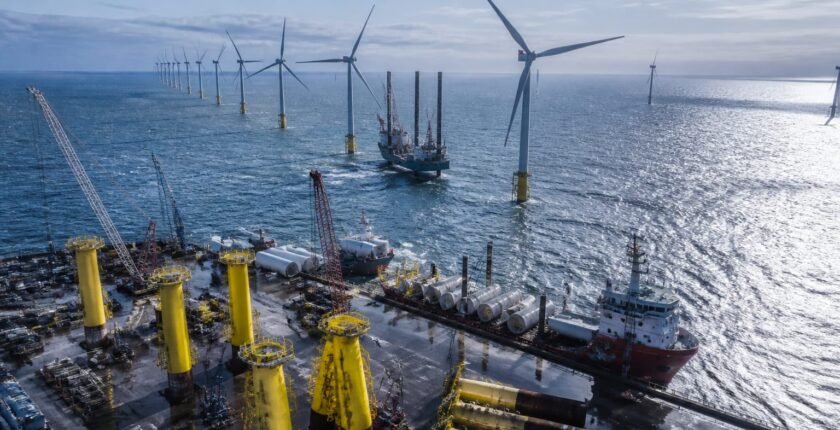
- Top-line saving: The joint industry project by DNV estimates that average lifetime LCoE for North Sea offshore wind could fall by as much as 28% by 2050 under the highest-volume scenario. Credit: Offshore Wind
- Near-term outcomes: Under a longer production-run scenario, DNV finds about a 14% LCoE reduction by 2035 and about 25% by 2050.
- Reference platform: The study models turbines around 15 MW on monopile foundations as the reference platform.
- Bottlenecks identified: DNV warns that ports and installation capacity become constraints in the high-volume scenario and that irregular project flow risks underuse of existing capacity.
Table of contents
How DNV modelled the potential savings
DNV led a joint industry project with eight supply-chain partners to estimate LCoE for North Sea offshore wind between 2025 and 2050. It compared three cases: business-as-usual with modest growth and short production runs; a case with extended production runs but similar market growth; and a highest-volume case featuring sustained deployment. For comparison DNV selected a reference platform of roughly 15 MW on a monopile foundation, stressing that this choice serves purely for modelling and is not a forecast of the ideal turbine size.
Results are reported as percentage reductions in average lifetime LCoE versus the baseline. The business-as-usual case yields roughly a 5% LCoE reduction by 2035; the longer-production-run case yields about 14% by 2035 and around 25% by 2050; and the highest-volume case yields about 19% by 2035 and up to 28% by 2050. The study draws on DNV's Energy Transition Outlook 2025, data from its North Sea Forecast and project pipelines, and the deployment ambitions set out in the Ostend and Hamburg declarations.
Where the savings come from and the role of industrialisation
DNV finds most of the modelled reduction stems from lower capital expenditure, driven by turbine and project-development costs, with further savings from installation and substructure costs. The study shows that steadier demand and longer production runs allow suppliers to spread fixed development and tooling costs over larger volumes, reducing per-unit capex.
Beyond cost accounting, stable platforms and standardised interfaces can raise reliability, boost energy yield and shorten delivery schedules so projects start generating sooner. Ditlev Engel, CEO of Energy Systems at DNV, said visible, investable project pipelines are the key performance indicator for drawing supplier investment. Peter Constantin Brun, DNV's global segment leader for offshore wind, said the joint-industry partners entrusted DNV with commercially sensitive data to quantify the economic effect of industrialisation and standardisation.
Barriers, constraints and what needs to change
The study flags immediate risks from underuse: irregular project flow weakens the business case for supplier investment and limits the industry’s ability to respond when demand rises. DNV’s modelling indicates that existing European turbine capacity can broadly meet near-term demand for turbines around 15 MW, but in the high-volume scenario ports become a constraint and installation capacity approaches its limit, requiring selected upgrades and expansion.
To capture the full saving potential, DNV calls on policymakers to turn deployment targets into visible project pipelines and predictable auction timetables; it asks developers and turbine manufacturers to agree earlier on design envelopes and interfaces; and it urges suppliers to invest in specific bottlenecks before wider capacity build-out. DNV also says standardised designs and processes can lower waste, rework, transport and energy use, producing environmental benefits alongside cost savings.
| Scenario | 2035 LCoE reduction | 2050 LCoE reduction | Notes |
|---|---|---|---|
| Business as usual | about 5% | Moderate growth, short production run for current platform | |
| Longer production runs | about 14% | about 25% | Same market growth, extended runs of current turbine platforms |
| Highest-volume scenario | about 19% | about 28% | Sustained deployment and long production runs |
How the picture could evolve
The case for
- If governments provide consistent auction schedules and visible pipelines, suppliers can justify investments that lower turbine and project-development capex and unlock the study’s full savings.
- Early alignment on design envelopes and interfaces between developers and manufacturers would allow longer production runs of stable platforms, supporting the 14–28% LCoE reductions modelled through 2050.
The case against
- If project flow remains irregular, suppliers may underuse capacity and defer investment, preventing the economies of scale the study assumes and limiting savings to the business-as-usual path (about 5% by 2035).
- If ports and installation capacity are not upgraded, high-volume deployment will face bottlenecks that reduce the achievable cost savings and could raise project timelines.
What to be careful about
- Underuse risk: irregular pipelines could leave existing turbine capacity idle and deter supplier investment.
- Port and installation constraints: high-volume deployment approaches current installation limits and would require selected port expansion and upgrades.
- Policy uncertainty: inconsistent auction schedules or shifting deployment targets would undermine the steady demand the model requires.
The bottom line
DNV’s joint industry project quantifies an economic case for industrialisation and standardization across the North Sea supply chain: steady pipelines and longer production runs for reference platforms around 15 MW can unlock substantial LCoE reductions. Realising the headline 28% saving by 2050 depends on coordinated action: policymakers must translate targets into visible pipelines and consistent auctions, ports and installation capacity must be upgraded where the study shows constraints, and developers must align earlier with manufacturers on design envelopes. Without those changes, the industry risks underuse of capacity and far smaller cost improvements.
What to watch
- Watch for national governments to publish consistent auction schedules and visible project pipelines; no date has been set.
- Watch for announcements of port expansion plans or installation-capacity upgrades to relieve constraints identified in the high-volume scenario; no date has been set.
- Watch for turbine manufacturers or major developers to publish commitments to longer production runs for existing platforms; no date has been set.
Frequently asked questions
How much could costs fall and by when?
DNV’s joint industry project projects up to a 28% reduction in average lifetime LCoE by 2050 in its highest-volume scenario, with about 19% reduction by 2035 in that same scenario.
What technical platform did the study use as a reference?
For its reference case the modelling assumes approximately 15 MW turbines on monopile foundations; DNV notes this is a comparative assumption rather than a cap on future turbine size.
What are the main sources of the savings?
Most modelled savings come from lower capital expenditure—chiefly turbine and project-development costs—followed by installation and substructure savings, according to DNV.
Related reading