
Blog
Ten Years of Princess Amalia Wind Farm SCADA Data Go Open
Estimated reading time: 6 minutes · Last updated:
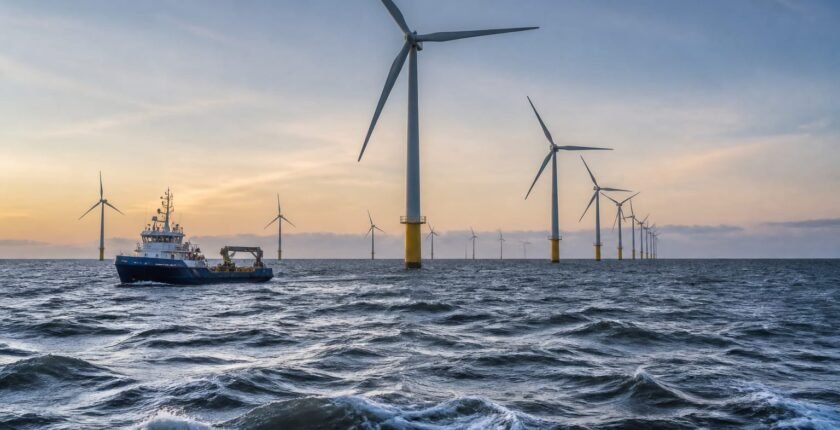
Ten years of operating records from all 60 turbines at the Princess Amalia offshore wind farm can now be downloaded free. René Bos and Rody Kemp, researchers at Eneco, have released the Supervisory Control and Data Acquisition records for 2008 through 2017, and TNO hosts the files under a Creative Commons Attribution 4.0 International licence. The Princess Amalia wind farm SCADA data cover weather readings, power output and turbine control signals for the 120-megawatt site. Bos and Kemp set out the release in a preprint now being reviewed for Wind Energy Science. Their goal is practical. They want wake modellers, control researchers and students to have a long, unbroken record of the kind that commercial confidentiality usually keeps private.
Key takeaways
- Who released it: Eneco researchers René Bos and Rody Kemp have published SCADA records from the Princess Amalia offshore wind farm covering 2008 through 2017.
- Scope: The data include all 60 turbines of the 120-megawatt farm, with meteorological, power production and turbine control variables.
- Access: TNO hosts the dataset free of charge under a Creative Commons Attribution 4.0 International licence.
- Peer review: The data description paper, DOI 10.5194/wes-2026-193, was received by Copernicus Publications on 15 October 2026 and opened for public discussion on 4 November 2026.
- Intended uses: Bos and Kemp name wake model validation, wind farm control, operational performance and turbine reliability as the main research targets.
Table of contents
- Key takeaways
- What a Decade of Princess Amalia SCADA Records Holds
- Why the Site Context Matters as Much as the Turbine Logs
- How Bos and Kemp Want the Open Dataset to Be Used
- Where the Data Description Paper Stands in Review
- What the release does and does not offer
- What to be careful about
- Frequently asked questions
What a Decade of Princess Amalia SCADA Records Holds
SCADA stands for Supervisory Control and Data Acquisition. In a wind farm it is the system that logs how each turbine is behaving and lets operators supervise it. Those logs are usually treated as commercially sensitive, which is why a full-farm release over a long period draws attention from researchers.
The Princess Amalia release covers every turbine at the site, 60 in all, across a farm rated at 120 megawatts in total. That works out to about 2 megawatts per turbine on average. Bos and Kemp group the recorded variables into three families: meteorological conditions, power production and turbine control.
The time window is the other headline feature. The records begin in 2008 and run through 2017, giving ten calendar years of operation from a single offshore site. A study that needs to compare one winter with another, or follow a component across many years, needs exactly this kind of unbroken span. It is something short measurement campaigns cannot supply.
Why the Site Context Matters as Much as the Turbine Logs
Bos and Kemp did not stop at the turbine variables. Their data description paper adds background on the facility itself: the site coordinates, details of wind farms nearby, and documentation of metocean and environmental measurement campaigns carried out in the area. Metocean is shorthand for the combined meteorological and oceanographic conditions at an offshore site.
This context is what turns raw logs into something a modeller can test against. A wake model predicts how the slower, more turbulent air behind one turbine affects the turbines downwind of it. To check such a model against real output, a researcher needs to know where the turbines sit and what else in the neighbourhood could be shaping the incoming wind.
Independent metocean measurements serve a similar purpose. They give researchers a reference for the conditions the farm was actually facing, separate from what the turbines' own sensors recorded. Without that reference, it is hard to tell whether a gap between model and measurement comes from the model or from the inputs.
How Bos and Kemp Want the Open Dataset to Be Used
The authors designed the release to serve a wide range of offshore wind work. They list four main applications: validating turbine wake models, studying wind farm control strategies, analysing operational performance, and research into wind turbine reliability.
Access terms are deliberately loose. TNO, the research organisation hosting the files, makes them available to the public at no cost under a Creative Commons Attribution 4.0 International licence. The dataset is catalogued as "Offshore wind measurements – Princess Amalia offshore wind farm", and the compilation carries an Author(s) 2026 copyright notice, while the underlying data are distributed under the Creative Commons terms.
Bos and Kemp give three reasons for opening the data. They want to encourage exploratory research. They want to support studies that depend on long continuous measurement periods. And they want to help academic and student projects that cannot get at confidential commercial data, a barrier that often leaves university work relying on simulations alone.
Where the Data Description Paper Stands in Review
A companion paper describes a decade of SCADA records gathered at the Princess Amalia offshore wind farm and explains how researchers can obtain them. Copernicus Publications registered it under DOI 10.5194/wes-2026-193 and lists 15 October 2026 as the date it received the manuscript, with the public discussion phase opening on 4 November 2026. The preprint can be downloaded as a 1419-kilobyte PDF.
That status matters. The paper is a preprint under review for Wind Energy Science, not an accepted publication. Reviewers and discussion participants may still ask the authors to clarify or change how the dataset is described before any final version appears.
Copernicus Publications attached a standard publisher note to the discussion paper. It says the publisher stays neutral on jurisdictional claims, published maps, institutional affiliations and other geographical representations in the text, and that final responsibility for place names rests with the authors. The note also says the views in the manuscript belong to Bos and Kemp alone, not to Copernicus Publications.
| Component | What it covers | Where it sits |
|---|---|---|
| Turbine SCADA records | All 60 turbines, 2008 to 2017; meteorological, power and control variables | TNO, free, CC BY 4.0 |
| Site context | Coordinates, neighbouring wind farms, metocean and environmental campaigns | Data description paper |
| Data description paper | Dataset description and access details | Copernicus Publications, DOI 10.5194/wes-2026-193 |
| Review status | Received 15 October 2026; public discussion from 4 November 2026 | Preprint for Wind Energy Science |
What the release does and does not offer
The case for
- Records from all 60 turbines over ten years give researchers a continuous full-farm record rather than a sample.
- Free access under a Creative Commons Attribution 4.0 International licence removes the confidentiality barrier that blocks many student and academic projects.
- Site coordinates, neighbouring-farm details and metocean campaign documentation give wake modellers the context needed to test predictions against real output.
The case against
- The newest records date from 2017, so the dataset cannot describe how the farm has operated since then.
- The data description paper is still a preprint under review and may change before any final publication.
- All records come from a single 120-megawatt site, so findings drawn from it may not carry over to farms of different size or layout.
What to be careful about
- The dataset description could be revised during peer review at Wind Energy Science, so studies built on the preprint version may need to check for changes.
- With records ending in 2017, conclusions about current turbine performance or reliability drawn from this data would rest on an older operating period.
- Copernicus Publications has stated it takes no responsibility for maps, place names or jurisdictional claims in the manuscript, leaving those details to the authors.
The bottom line
The Princess Amalia release is valuable mainly because of its scale. It covers every turbine at a 120-megawatt offshore farm over ten straight years, and it includes the site context a modeller needs. That combination is rare in a field where operators guard their SCADA logs closely. It also comes with limits that users should keep in view. The records end in 2017. They describe one farm. And the paper explaining them is still moving through review at Wind Energy Science. For researchers testing wake models or control strategies, and for students who have had no real data to work with, those limits are a fair price for open access.
What to watch
- Watch for the close of the public discussion phase on the Bos and Kemp paper at Wind Energy Science; no closing date has been given.
- Watch for the journal's final decision on the data description paper, which would settle how the dataset is formally described; no date has been set.
- Watch for the first published wake model validation or wind farm control studies built on the Princess Amalia records; none has been announced.
Frequently asked questions
Where can I download the Princess Amalia offshore wind farm data?
TNO hosts the files, catalogued as "Offshore wind measurements – Princess Amalia offshore wind farm". They are free to the public under a Creative Commons Attribution 4.0 International licence.
Who are René Bos and Rody Kemp?
Bos and Kemp are researchers at Eneco and the authors of the data description paper. Copernicus Publications notes that the views in the manuscript are theirs alone, not the publisher's.
Is the Princess Amalia dataset paper peer reviewed yet?
Not yet. The paper, DOI 10.5194/wes-2026-193, is a preprint under review for Wind Energy Science, and its public discussion phase began on 4 November 2026.
Can students use the Princess Amalia SCADA data?
Yes. Bos and Kemp say one aim of the free release is to help academic and student projects that cannot access confidential commercial data. The records cover all 60 turbines from 2008 to 2017.
Related reading