
Blog
Sunpin Japan Shiga Battery Storage Plant Hits the Grid
Estimated reading time: 6 minutes · Last updated:
Sunpin Japan has connected its 45 MW / 180 MWh SP Shiga Otsu Power Storage Station to the grid in Otsu City, Shiga Prefecture. The standalone lithium-ion battery joined the network on 5 November 2026. It is due to start commercial operation in December 2026. At that point E-Flow, a joint venture of Kansai Electric Power and Enewill, begins trading its capacity. The Shiga battery storage project is a four-hour system, which means it can discharge at full output for four hours. Sunpin Japan is the Tokyo subsidiary of Sunpin Solar, a California solar and storage developer. Two things have not been made public: how the plant will earn money and whose batteries sit inside it.
As the EPC contractor, we will continue to prioritize safety and quality as we steadily prepare for the start of commercial operations.
Jitsugetsu Kanemoto, president of Blue Point Power Solutions
Key takeaways
- Grid connection: Sunpin Japan connected the 45 MW / 180 MWh SP Shiga Otsu Power Storage Station in Otsu City to the grid on 5 November 2026, and commercial operation is scheduled for December 2026.
- Market access: E-Flow, the Kansai Electric Power and Enewill joint venture, will act as aggregator and bid the battery into Japan's wholesale and balancing markets.
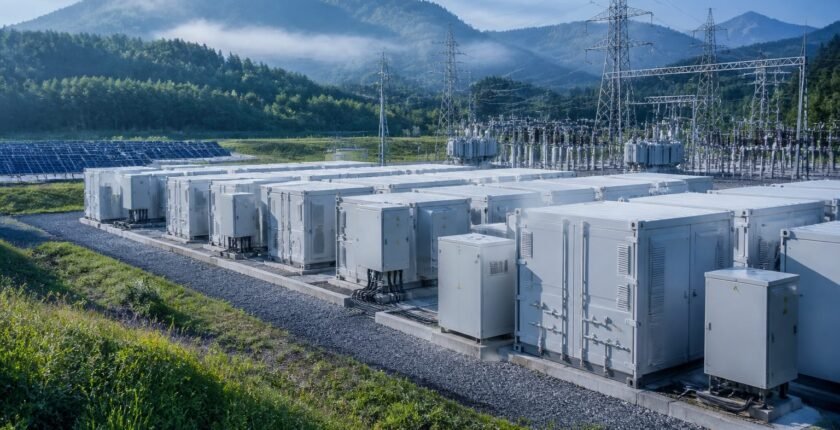
- Supplier unconfirmed: Site photographs show liquid-cooled 20-foot high-cube containers that resemble REPT Battero's Powtrix 2.0 DC Container. A 10 GWh supply agreement between REPT Battero and Sunpin Solar dates from late 2023, but no Japanese link has been confirmed.
- Wider pipeline: Sunpin Japan has outlined 1 GWh of utility-scale storage, split among five projects located in the prefectures of Ibaraki, Shiga, Osaka and Fukushima.
Table of contents
- Key takeaways
- Sunpin Kept the Otsu Build Inside Its Own Group
- How E-Flow Will Turn Four Hours of Storage Into Revenue
- What Sunpin and Its Partners Have Not Disclosed
- Otsu Sits Inside a 1 GWh Plan Across Four Prefectures
- What could help or hinder the Otsu battery
- What to be careful about
- Frequently asked questions
Sunpin Kept the Otsu Build Inside Its Own Group
The Otsu station was built on a greenfield site, and Sunpin Japan did the early development work with its own staff. The company secured the land, obtained the permits and handled the talks with the utility before construction began.
Construction went to a sister company. Blue Point Power Solutions, a Sunpin group affiliate, carried out the engineering, procurement and construction work, a package the industry calls EPC. The same firm will commission the plant and then handle operations and maintenance over the long term.
Jitsugetsu Kanemoto, president of Blue Point Power Solutions, said the contractor will keep safety and quality as its priorities while it prepares the site for commercial service. Keeping development, construction and upkeep within one corporate family gives Sunpin a single line of accountability. It also means the group carries the plant's operating record largely on its own.
How E-Flow Will Turn Four Hours of Storage Into Revenue
An aggregator bundles assets such as batteries and bids them into power markets on the owner's behalf. At Otsu that job belongs to E-Flow, the joint venture formed by Kansai Electric Power and Enewill. Once the plant is in commercial operation, E-Flow will place it in both Japan's wholesale electricity market and its balancing market.
The four-hour design follows a regional pattern. Tristan Rayner, an electrical engineer who covers storage, has written that four-hour systems are gaining favour in Kansai. They let owners capture price spreads on the JEPX wholesale market as caps on the EPRX balancing market tighten. That strategy is arbitrage: charging when power is cheap and selling when prices rise. With 180 MWh in reserve, the Otsu battery can charge over a longer low-price window and discharge through a longer high-price one.
The duration choice suggests Sunpin expects wholesale spreads to be part of the plant's income, not balancing payments alone. The company has not confirmed that.
What Sunpin and Its Partners Have Not Disclosed
The companies have not said how the plant will be paid. One option is merchant operation, where the battery takes whatever market prices it can capture. The other is a tolling agreement, under which a third party pays a fee for the right to use the battery. They have also not named who supplied the battery system or the power conversion system (PCS). The PCS turns the battery's direct current into alternating current the grid can use.
Photographs of the project show liquid-cooled containers in the 20-foot high-cube format, as first reported by ESS News, and the units closely resemble REPT Battero's Powtrix 2.0 DC Container. That match is unconfirmed, and a company representative has been asked to confirm it.
There is a plausible commercial link. Sunpin Solar, the US parent, signed a 10 GWh battery supply agreement with REPT Battero in late 2023. It is not known whether any of that volume applies to Japan.
Otsu Sits Inside a 1 GWh Plan Across Four Prefectures
Sunpin Japan's plans in the country extend beyond Otsu. Earlier in 2026, the company set out a utility-scale storage pipeline totalling 1 GWh, made up of five projects with sites in Ibaraki, Shiga, Osaka and Fukushima. It has not published capacities or timelines for the individual sites.
Sunpin is one of a number of overseas developers growing storage portfolios in Japan. Japanese companies have also won projects in the country's Long-Term Decarbonization Auctions. Sunpin has not said whether any of its pipeline will compete in those auctions.
That makes Otsu a useful test. A smooth move into commercial service in December 2026 would show the company can take a Japanese site from bare land to a trading asset using its own team. It would also give Sunpin and E-Flow a working track record to cite as the rest of the pipeline moves forward.
| Company | Role | Relationship |
|---|---|---|
| Sunpin Japan | Developer and owner | Tokyo subsidiary of Sunpin Solar |
| Sunpin Solar | US parent | California solar and storage developer |
| Blue Point Power Solutions | EPC, commissioning, O&M | Sunpin group affiliate |
| E-Flow | Aggregator and market trader | Kansai Electric Power and Enewill JV |
| REPT Battero | Possible container supplier | Unconfirmed; 10 GWh deal with Sunpin Solar |
What could help or hinder the Otsu battery
The case for
- The four-hour design lets the plant pursue JEPX wholesale price spreads as EPRX balancing caps tighten.
- An established utility partner, Kansai Electric Power, stands behind the aggregator, E-Flow.
- Grid connection is complete, so the remaining step before December 2026 is commissioning.
The case against
- The revenue model, merchant or tolled, has not been disclosed, so the plant's exposure to market prices is unknown.
- Neither the battery system nor the PCS supplier has been named, which leaves equipment performance unverifiable.
- Tighter EPRX balancing caps reduce one of the income streams a battery in Kansai can draw on.
What to be careful about
- Commercial operation could slip past December 2026 if commissioning by Blue Point Power Solutions runs long.
- If the plant runs on a merchant basis, its earnings depend on how wide JEPX price spreads remain.
- Unconfirmed equipment sourcing means the plant's degradation and safety profile cannot be assessed.
The bottom line
The grid connection on 5 November 2026 completes the physical build at Otsu. The commercial questions are still open. December 2026 is the date set for E-Flow to begin trading the 45 MW / 180 MWh station. Until then, neither Sunpin nor its partners have said whether the plant will sell into markets on its own account or under contract. The battery supplier is also unconfirmed. REPT Battero is a candidate only because of how the containers look and because of the parent company's 10 GWh deal from late 2023. The four-hour design points toward wholesale price spreads in Kansai. How well that bet pays off is likely to shape how quickly Sunpin Japan builds out the rest of its 1 GWh pipeline.
What to watch
- Watch for E-Flow to begin trading the Otsu battery in Japan's wholesale and balancing markets when commercial operation starts in December 2026.
- Watch for Sunpin or REPT Battero to confirm whether the Powtrix 2.0 DC Container is installed at Otsu; no date has been set for that confirmation.
- Watch for Sunpin Japan to name sizes and schedules for the other projects in its 1 GWh pipeline; no timetable has been published.
Frequently asked questions
When will the Sunpin Shiga battery start commercial operation?
The SP Shiga Otsu Power Storage Station connected to the grid on 5 November 2026. It is scheduled to begin commercial operation in December 2026, when E-Flow starts trading it.
Who owns Sunpin Japan?
Sunpin Japan is a Tokyo-based subsidiary of Sunpin Solar, a solar and storage developer based in California. A group affiliate, Blue Point Power Solutions, built the Otsu plant and will maintain it.
Does the Otsu battery use REPT Battero equipment?
That has not been confirmed. The containers look closely like REPT Battero's Powtrix 2.0 DC Container. In late 2023, Sunpin Solar and REPT Battero agreed a 10 GWh supply arrangement, but it is not known whether Japan falls under that deal.
Related reading