
Blog
Stella Juva solar ambulance completes 800km test
Estimated reading time: 4 minutes · Last updated:
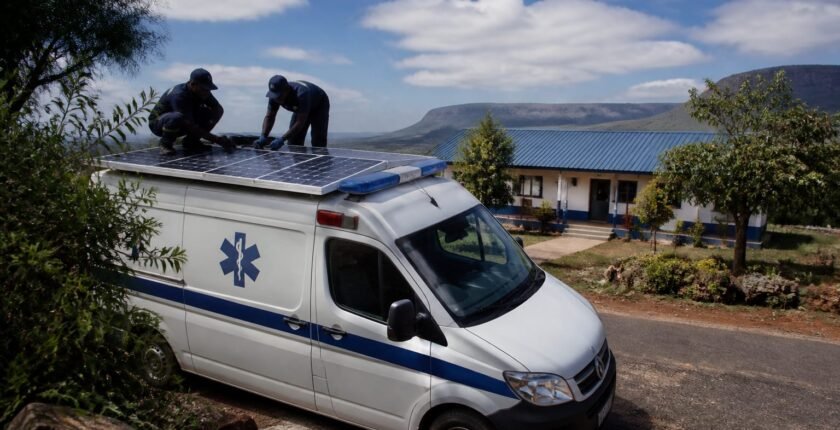
Stella Juva is the world's first road-legal solar-powered ambulance, built by Solar Team Eindhoven at Eindhoven University of Technology. The vehicle is an electric ambulance whose rooftop and side panels feed a 50 kWh battery so it can operate medical devices after dark. The prototype ran field trials in Narok county, Kenya, covering more than 800km in a mix of paved and rough roads and demonstrating standalone power for devices such as X-ray, ultrasound and vaccine refrigeration, as first reported by Euronews.
This helps generate extra energy and provide shade for delivering healthcare. While stationary, the ambulance generates more solar energy than the medical equipment uses. This means that healthcare workers can keep using medical equipment at all times.
Yarno Basten, Solar Team Eindhoven
Key takeaways
- Developer: Stella Juva was developed by Solar Team Eindhoven at Eindhoven University of Technology.
- Energy system: The ambulance stores solar energy in a 50 kWh battery and uses integrated panels to recharge on the move or while parked.
- Field trial: The prototype completed an over 800km practical test in Kenya in collaboration with Amref Health Africa.
- Clinical capacity: A two-day trial suggested the vehicle could serve approximately 200 people and provide ultrasound for up to 40 pregnant women in one outreach.
Table of contents
How Stella Juva powers clinical care
Stella Juva is configured as an electric vehicle with photovoltaic panels integrated into its bodywork and deployable side arrays that expand when the vehicle is stationary. Energy captured by the panels feeds a 50 kWh battery pack; that stored charge both propels the vehicle and runs on-board medical systems when sunlight is unavailable.
The design emphasises continuous operation at outreach sites: while parked the expanded panels generate extra power and provide shaded work space for clinicians. That on‑site generation lets staff run energy-hungry devices — for example an X-ray unit, ultrasound scanner and vaccine refrigeration — without tapping local grid power or fuel generators.
What the Kenya trials revealed about real-world use
Solar Team Eindhoven tested Stella Juva in the Narok region with support from Amref Health Africa, driving more than 800km between field locations and spending extended time off-road. During one approach the team spent about six hours on difficult tracks to reach a remote site; mechanical wear led to a failed steering linkage component that the team replaced in roughly 30 minutes using a designed-for-failure spare.
Across a two-day outreach the ambulance demonstrated clinical throughput equivalent to examining roughly 200 patients and could deliver up to 40 ultrasound scans for pregnant women in a single session. The project managers argue those figures show how a mobile, self-powered clinic can reach communities where long distances and unreliable electricity make conventional outreach costly or impossible.
Clinical equipment, partners and the path to scaling
Stella Juva carries clinical gear that health NGOs commonly request for rural outreach: an X-ray, ultrasound, an Automated External Defibrillator (AED) and vaccine cooling. The ambulance’s ability to sustain those devices while stationary means organisations could diagnose and stabilise patients on site rather than rely solely on transporting them to distant hospitals.
Amref Health Africa participated in the trial and highlighted maternal and child health gains, noting earlier detection of pregnancy complications during outreach would likely reduce preventable deaths. The Eindhoven team says it is open to partners from industry, government and non-profits to test production, logistics and longer deployment schedules that were not part of the initial trial.
| Feature | Stella Juva (prototype) | Typical diesel ambulance |
|---|---|---|
| Primary energy | Integrated solar panels + 50 kWh battery | Diesel fuel |
| On-site power for devices | Yes — demonstrated during trials | Requires generator or external grid |
| Tested range/field mileage | More than 800km in Kenya trial | Varies by tank size and fuel supply |
| Medical kit on board | X-ray, ultrasound, AED, vaccine refrigeration | Basic life support and transport equipment |
Upside and constraints for adoption
The case for
- Deployments in off-grid regions could reduce the need to transport patients long distances by bringing diagnostics and refrigeration to communities.
- Solar charging lowers operational fuel costs and opens opportunities for NGOs and health services with constrained budgets to field mobile clinics.
The case against
- Durability and maintenance in rough terrain remain unresolved at scale; the Kenya trial included a designed-to-fail part that required on-site replacement.
- Performance in prolonged cloudy seasons and the ambulance’s real-world daily range under full equipment load require longer trials before agencies can commit to purchases.
What to be careful about
- Logistics and maintenance: spare-part supply and field reparability will determine uptime after repeated off-road use.
- Operational limits in low-sun periods: battery-only range and recharging cadence during extended cloudy weather are unproven beyond short trials.
- Scaling funding: converting a student-built prototype into a production vehicle requires certification, manufacturing investment and purchaser commitments.
The bottom line
The Stella Juva prototype demonstrates that a purpose-built solar electric ambulance can deliver diagnostics and maintain vaccine cold chains at remote sites without relying on local power or fuel. The Kenya trial underlines both promise and practical questions: teams proved clinical throughput and field reparability, but longer trials are needed to quantify reliability through rainy seasons and to pin down production costs, certification pathways and maintenance models before health services can adopt the concept at scale.
What to watch
- Watch for announcements of formal pilot deployments with health agencies or NGOs; no date has been set.
- Watch for funding or manufacturing partnerships to scale Stella Juva from prototype to small series; no date has been set.
- Watch for published results from longer-duration durability trials beyond the two-day field test; no date has been set.
Frequently asked questions
Who built the Stella Juva solar ambulance?
Stella Juva was developed by students at Solar Team Eindhoven, which is part of Eindhoven University of Technology, in collaboration with partners including Amref Health Africa for field testing.
How much energy does the ambulance store and what did tests show?
The vehicle uses integrated solar panels and stores electricity in a 50 kWh battery; in Kenya it completed more than 800km of driving and a two-day outreach that could have served about 200 people.
What clinical equipment can Stella Juva run?
The prototype carried diagnostic and life‑support items including an X-ray machine, ultrasound scanner, an Automated External Defibrillator (AED) and vaccine cooling, and the team reported panels generated more power than the equipment consumed while parked.
Related reading