
Blog
China Switches On Wind-Powered Underwater Data Center
Estimated reading time: 5 minutes · Last updated:
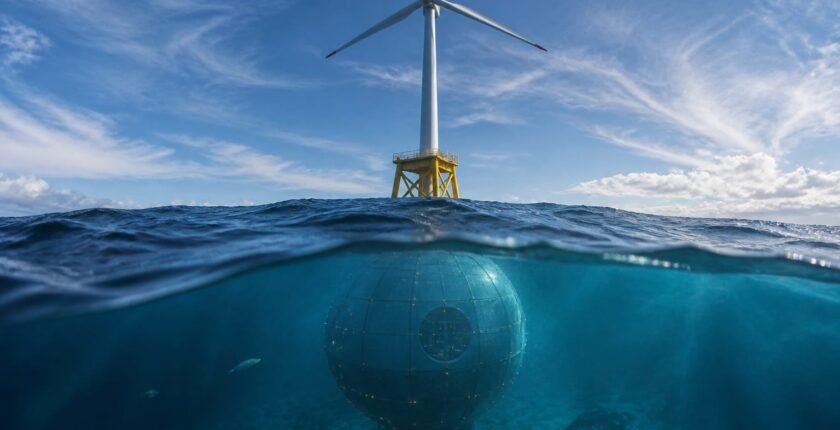
China has activated a wind-powered underwater data center off Shanghai, sinking sealed server modules about 35 metres beneath the surface and targeting up to 24 megawatts of capacity. As first reported by Spherical Insights, the Lin-gang facility pairs seawater-based cooling with nearby offshore wind and aims to draw roughly 95% of its electricity from wind. The project, backed by a state-linked consortium and estimated at $226 million, completed construction by October 2025 and reported a Power Usage Effectiveness below 1.15 in initial operation. The deployment is presented as a way to cut cooling energy, eliminate freshwater use and shrink land needs compared with conventional data centres.
Key takeaways
- Location, scale and backing: The Lin-gang underwater data centre sits about 35 metres below the surface off Shanghai, targets up to 24 MW and is supported by a consortium including Shenergy, China Telecom's Shanghai branch, INESA and CCCC Third Harbor Engineering with an estimated $226 million investment.
- Energy supply: Project specifications report the facility can draw roughly 95% of its electricity from offshore wind while keeping cooling to under 10% of total power use.
- Efficiency gains: The Lin-gang design targets a PUE below 1.15 and is reported to use about 22.8% less electricity than an equivalent land-based centre.
- Water and land impacts: Seawater-based heat rejection removes freshwater cooling needs and the project claims more than 90% lower land requirements versus a comparable conventional data centre.
Table of contents
How seawater replaces mechanical chillers
The Lin-gang installation replaces conventional chiller-driven cooling with a seawater-based thermal-management pathway designed to move heat from servers into the ocean. Inside sealed, pressure-resistant server modules a closed-loop coolant carries heat to a copper heat exchanger, which transfers it directly into surrounding seawater. The material cites copper piping for its high thermal conductivity as a deliberate choice to improve conductive heat transfer.
That architecture reduces or removes the need for refrigeration compressors, cooling towers and large air-handling systems that account for much of a land facility's overhead. Project figures supplied to Spherical Insights estimate an electricity saving of about 22.8% relative to an equivalent land-based site and a target Power Usage Effectiveness below 1.15, meaning roughly 0.15 kWh of supporting infrastructure energy per 1.00 kWh of IT energy.
Engineering, timeline and scale at Lin-gang
Lin-gang moved from partnership to operation quickly by data-centre timescales. The project launched in June 2025 through a cooperation agreement with the Lin-gang administrative committee, reported construction completion by October 2025, and entered initial operation thereafter. The facility's planned top capacity is reported at about 24 MW, while the initial demonstration phase was around 2.3 MW.
State-linked firms supplied the industrial muscle. The project is backed by Shenergy, China Telecom's Shanghai branch, INESA and CCCC Third Harbor Engineering; Wang Shifeng, chairman of CCCC Third Harbor Engineering's division, is recorded as warning the technology remains at an early stage. The consortium set an estimated investment figure of $226 million and describes the deployment as deliberately colocated with offshore wind to shorten transmission and maximise renewable supply.
What the deployment changes for water, land and reliability
The underwater model tackles three common data-centre constraints: grid electricity, cooling-water demand and land use. By rejecting heat to seawater, the facility eliminates freshwater cooling; project specifications state cooling consumes less than 10% of total power and claim more than 90% lower land requirements versus a comparable conventional data centre. The Lin-gang design is presented as a compact way to host high-density GPU clusters for AI workloads while reducing onsite infrastructure.
The environmental payoff depends on power sources and operational durability. China-wide figures in the material show heavy coal reliance—about 60.5% of the national power mix and roughly 70% of electricity in data-centre-heavy eastern regions—so pairing undersea sites with offshore wind is essential to the green case. Microsoft’s Project Natick is cited as a precedent: its module ran underwater for more than two years, held 864 servers across 12 racks and experienced a failure rate one-eighth that of its land-based control group, though Microsoft kept Natick as research rather than a commercial product.
| Project | Location | Deployment/launch | Reported capacity/size | Power source | Notes |
|---|---|---|---|---|---|
| Lin-gang underwater data centre | Off Shanghai, Lin-gang Special Area | Cooperation launched June 2025; construction completed October 2025 | Planned up to 24 MW; initial demonstration ~2.3 MW | Reported ~95% from offshore wind | Estimated $226 million; PUE below 1.15; seawater cooling |
| Lingshui Li facility | Lingshui, Hainan Province | Deployed December 2022 | Commercial underwater data centre (capacity not specified in material) | Not specified in material | Described as the world's first commercial underwater data centre |
| Microsoft Project Natick | Northern Isles (Scotland) | Research deployment (module deployed December 2018 and operated for over two years) | 864 servers across 12 racks | Grid power (research context) | Reported failure rate one-eighth that of land-based control; retained as research |
How this could scale — and what could hold it back
The case for
- If operational metrics hold, the Lin-gang model could be scaled to additional coastal sites and paired with offshore wind to lower net emissions from AI workloads.
- The compact, sealed design and seawater heat rejection could free coastal land for other uses and remove freshwater demand from data-centre cooling operations, easing constraints in densely populated regions.
The case against
- Wang Shifeng has cautioned that underwater data centres remain at an early stage, underlining technical and maintenance uncertainties that could slow commercial rollout.
- China's eastern grid remains carbon-intensive—the material gives roughly 70% coal-based electricity in eastern regions—so the climate benefit depends on reliably sourcing offshore wind rather than grid power.
What to be careful about
- Technical maturity: Wang Shifeng said construction and deployment remain in initial stages, so unforeseen failure modes and maintenance burdens are possible.
- Grid and fuel mix: with the material noting about 60.5% coal in China’s overall power mix and roughly 70% coal in eastern regions, the net emissions benefit is contingent on actually delivering the reported ~95% offshore-wind supply.
- Corrosion and long-term access: sealed subsea modules reduce some exposure but create new repair and replacement logistics that are still unproven at commercial scale.
The bottom line
Lin-gang represents a deliberate step from research projects toward commercial subsea computing by combining sealed server modules, closed-loop seawater heat rejection and nearby offshore wind. The material-backed figures — a reported 24 MW top capacity, an initial 2.3 MW demonstration, a claimed PUE below 1.15 and roughly 95% renewable supply — sketch a credible route to smaller land footprint and near-zero freshwater cooling. The deployment’s long-term climate and commercial value, however, depends on sustained operational performance and on delivering the promised offshore-wind share rather than relying on a coal-heavy grid in eastern China.
What to watch
- Watch for a public release of multi-month operational performance and reliability data from the Lin-gang facility; no date has been set.
- Watch for announcements of further undersea data-centre projects tied to offshore wind by the listed backers or other state-linked firms; no date has been set.
- Watch for any commercial export agreements or technology-transfer contracts that would position the Lin-gang design as an international offering; no date has been set.
Frequently asked questions
How much computing capacity does the Lin-gang underwater site aim to host?
The Lin-gang facility is reported to target up to 24 MW of total capacity, with an initial demonstration phase of approximately 2.3 MW.
How does seawater cooling affect energy efficiency?
Project figures in the material state that the seawater-based design targets a PUE below 1.15 and can reduce electricity consumption by about 22.8% compared with an equivalent land-based data centre.
Who is building the Lin-gang project?
The deployment is backed by a state-linked consortium including Shenergy, China Telecom's Shanghai branch, INESA and CCCC Third Harbor Engineering; Wang Shifeng of CCCC Third Harbor Engineering is named in the material as noting the technology's early stage.
Related reading