
Blog
365m Wind Turbine Could Double German Wind Output
Estimated reading time: 5 minutes · Last updated:
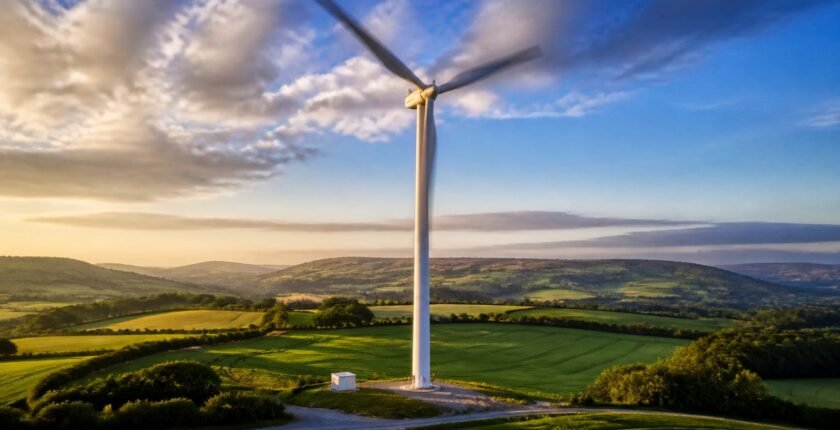
A wind turbine that reaches 365 meters above ground now stands at a wind farm in Schipkau, in the Lusatia region of eastern Germany. Built by Dresden-based engineering firm Gicon, the prototype has a hub height of 300 meters and rotor tips that reach 365 meters, making it taller than the Eiffel Tower at 330 meters; Gicon says winds at 300 meters can produce more than twice the electrical energy of turbines at today's heights. The structure reached full height this week, and internal wiring remains to be installed before a planned inauguration on Nov. 19, 2026, as first reported by AP News.
At 300 meters, we have such constant and strong wind that we can produce more than twice as much electrical energy as with the same facility at today’s heights
Jochen Grossmann, chief executive of Gicon
Key takeaways
- Height: The prototype's rotor tips reach 365 meters (1,197 feet) and its hub height is 300 meters (984 feet).
- Performance claim: Gicon says winds at 300 meters can produce more than twice as much electrical energy as turbines at today’s typical heights.
- Timeline: The turbine reached full height in early October 2026 and Gicon plans to inaugurate it on Nov. 19, 2026.
- Germany context: The Federal Statistical Office reports 59.1% of Germany's energy in the first half of 2026 came from renewables, with wind supplying 29.4%.
Table of contents
Why going higher matters for output
Gicon built the prototype to test a simple aerodynamic premise: winds grow steadier and stronger with altitude, so a greater hub height should raise annual generation. The company gave the turbine a hub height of 300 meters (984 feet) so its rotors can sweep air at levels conventional onshore machines rarely reach. Jochen Grossmann, chief executive of Gicon, framed the expected payoff in direct terms: at 300 meters the site should experience such constant wind that it can produce more than twice the electrical energy of an equivalent facility at today's hub heights.
The prototype's measurements will quantify seasonal availability as well as peak production. Gicon says the test will determine whether taller towers can generate electricity across more months of the year than existing turbines, which would raise capacity factors and alter project economics if those gains prove durable. Gicon has not released the turbine's rated megawatt capacity or detailed yield models; those figures are necessary to translate Grossmann's 'more than twice' claim into expected annual megawatt-hours.
Prototype, site and local context in Lusatia
The tower stands at an existing wind farm near Schipkau in Lusatia, southeast of Berlin, a landscape that shifted from lignite mining to renewables in recent years. The full height was reached this week and the turbine's rotor tips extend to 365 meters (1,197 feet), which Gicon and local accounts note places it taller than Paris's Eiffel Tower at 330 meters (1,083 feet) and just short of Berlin's television tower at 368 meters (1,207 feet).
Work on the prototype is not complete: internal wiring still needs installation before the planned inauguration on Nov. 19, 2026. Gicon says it will use the prototype's data to design a small follow-on wind farm of three to five extra-tall turbines. The company also proposes 'two-story' wind farms that mix shorter, conventional turbines with extra-tall machines to raise yield on limited land, an idea presented as a response to constraints on adding new sites.
What Gicon plans next and what the prototype must prove
Gicon's immediate objective is empirical: validate that taller towers deliver the doubled energy and improved seasonal availability the company expects. Gicon says the prototype will assess how much extra energy can be captured by siting turbines at those elevations and that the findings will inform a design for a small cluster of extra-tall turbines. The company has not provided technical specifications for the blades, generator or control systems, so the prototype's instrumentation and test protocols will determine how persuasive the results are to developers and grid planners.
If the measurements confirm higher capacity factors, Gicon aims to move from a single prototype to three-to-five-turbine projects and to promote taller machines as a way to expand output without needing much more land. Conversely, if the prototype underperforms, Gicon will need to explain whether the shortfall reflects site selection, turbine design, supply-chain limits or other constraints; Gicon has not released contingency plans or cost estimates for scaling up.
How this fits into Germany's wider energy mix
Germany has been expanding renewables for years and the new tower arrives in a policy context encapsulated by three developments: the country shut down its last nuclear plants in 2023, it plans to end coal-fired generation by 2038, and the Federal Statistical Office reports that renewables supplied 59.1% of Germany's electricity production in the first half of 2026, with wind providing 29.4% of the total. Those benchmarks explain why higher-yield wind projects are of interest to planners.
A prototype that raises per-turbine output could ease site-scarcity pressures by making existing wind areas more productive and by enabling denser layouts, as Gicon suggests with its two-story proposal. Gicon has not supplied grid-integration studies or cost-per-megawatt figures, so assessing system-level impact — on curtailment, transmission upgrades or market prices — requires additional data from the company.
Case for and against taller onshore turbines
The case for
- Higher hub heights access steadier, stronger winds: Gicon says 300-meter winds can produce more than twice the electrical energy of turbines at today's heights, which would raise capacity factors if verified.
- Taller turbines could ease land constraints by increasing yield per site and enabling 'two-story' farms that mix conventional and extra-tall machines.
The case against
- The prototype is unfinished: internal wiring must be installed and test results are pending, so claimed performance gains remain unproven until measurement data are published.
- The material provides no rated capacity, cost or grid-integration data, so potential system-level trade-offs, upgrade needs or economics for scaling remain uncertain.
What to be careful about
- Delay or technical issues during final wiring and commissioning could push back the Nov. 19, 2026 inauguration date and postpone data collection.
- The prototype may underdeliver on Gicon's performance claim, in which case projected gains and plans for three-to-five follow-on turbines would need reassessment.
The bottom line
The Schipkau turbine is a test of whether higher towers can materially change onshore wind economics by delivering steadier winds and higher capacity factors. Gicon's claim that 300-meter hub heights can yield more than twice the electrical energy of today's machines is the proposition the prototype must substantiate through measurement after its Nov. 19, 2026 inauguration. If the data confirm significant gains, the company plans a small cluster of extra-tall turbines and the two-story wind-farm concept could ease land constraints; if not, the project will expose what technical or site factors limit the approach.
What to watch
- Watch the turbine’s planned inauguration on Nov. 19, 2026.
- Watch for Gicon's publication of the prototype's measurement results; no date has been set.
Frequently asked questions
How tall is the turbine and what are its hub and tip heights?
The prototype has a hub height of 300 meters (984 feet) and rotor tips that reach 365 meters (1,197 feet), which the developer notes is taller than the Eiffel Tower at 330 meters (1,083 feet).
Who built the turbine and why was this site chosen?
Dresden-based engineering company Gicon built the tower at an existing wind farm near Schipkau in Lusatia; Gicon says the site and the 300m hub height will access stronger, more reliable winds.
When will the prototype begin testing and what remains to be done?
The structure reached full height in early October 2026; internal wiring still needs installation before a planned inauguration on Nov. 19, 2026, after which Gicon will collect measurement data.
How does this prototype relate to Germany's renewable targets?
The Federal Statistical Office reported that renewables accounted for 59.1% of Germany's power output in the first half of 2026, with wind contributing 29.4%; the country plans to end coal generation by 2038.
Related reading