
Blog
95 MW Arkansas solar farm hosts a full food chain
Estimated reading time: 5 minutes · Last updated:
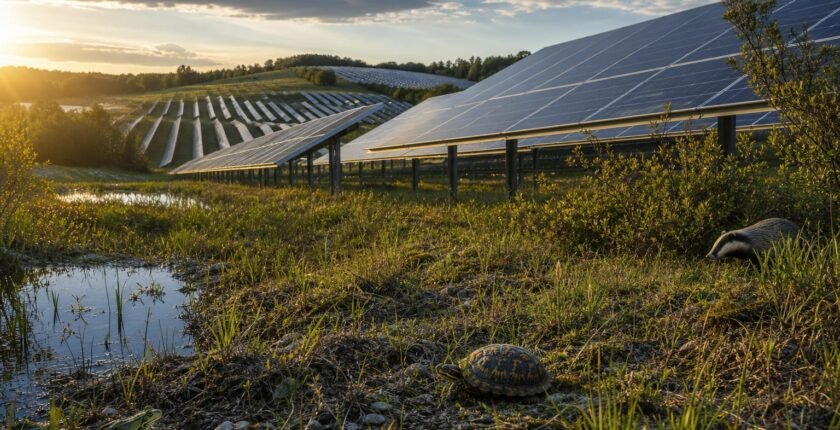
Cameras placed low to the ground at a 95 MW solar facility in Arkansas recorded a linked suite of species — frogs, snakes, glass lizards, ornate box turtles, upland sandpipers, monarch butterflies and an American badger — living under and between raised panels. The panels’ shade and the decision to seed native wildflowers changed the microclimate beneath the array, dropping soil temperatures by several degrees and extending flowering, which increased insect prey. Researchers built the dataset across approximately 90 solar sites in Arkansas and neighbouring states, and the finding was, as first reported by Energies Media, presented alongside a comparison between sites using native seed mixes with active sheep grazing and conventionally mown installations. The result is a demonstration of solar farm biodiversity that emerged without being designed into the plant.
This is the most comprehensive wildlife study ever conducted at solar energy facilities,
the lead researcher
Key takeaways
- Species recorded: Beneath panels at a 95 MW Arkansas solar farm, wildlife cameras captured an ornate box turtle, a slender glass lizard, an American badger and an upland sandpiper, as well as monarch butterfly, frogs and snakes.
- Study scale: Researchers assembled evidence from approximately 90 solar sites in Arkansas and neighbouring states to compare management approaches and species presence.
- Management difference: Sites planted with native seed mixes and managed with seasonal sheep grazing supported substantially richer wildlife assemblages than conventionally mown or gravel-surfaced farms.
- Policy context: The EIA projects almost 70 GW of new US solar capacity in 2026 and 2027, a 49 percent increase compared with the end of 2025.
Table of contents
- Key takeaways
- How panels and grazing changed the ground beneath the array
- What the cameras actually captured and how the evidence was built
- Why habitat connectivity and timing of grazing determine success
- What the Arkansas case means at scale and for developer economics
- Paths for uptake and barriers
- What to be careful about
- Frequently asked questions
How panels and grazing changed the ground beneath the array
The farm’s operators raised panels higher than normal and seeded native wildflowers between rows, then introduced a summer flock of sheep that grazes rather than the site being mechanically mown. Panels intercept direct sun and reduce soil heating; the site team reports that shaded ground runs several degrees cooler and holds moisture longer than adjacent open fields. That cooler, damper layer prolonged flowering in the native seed mix, which in turn kept insect numbers and diversity higher through the season.
Sheep serve two roles that mattered on this site. Their grazing limited tall woody growth while leaving floral species that sustain pollinators, and their hoof action keeps the soil loose in patches — a condition the study identifies as important for burrowing invertebrates and foraging mammals. These paired physical effects — altered microclimate plus a structurally varied understory — created the set of conditions that allowed small amphibians and reptiles to flourish under an active solar installation.
What the cameras actually captured and how the evidence was built
Low-angle motion cameras documented a sequence of species using the panel field as habitat or foraging ground. The list included amphibians and invertebrate prey, small reptiles and birds, predatory snakes, and an American badger — a carnivore the university described as one of the rarer mammals in Arkansas. The presence of multiple trophic levels is what the authors highlight: prey abundance attracts mid-level predators, which in turn support larger carnivores.
The dataset comes from camera surveys and site comparisons across approximately 90 installations in Arkansas and neighbouring states. Sites that combined native seed mixes with managed grazing showed consistently higher species counts than sites described as conventionally mown or gravel-surfaced. The study’s lead researcher told the university’s news service that this multi-site approach is broader than most earlier work, which tended to focus on single species or a handful of locations.
Why habitat connectivity and timing of grazing determine success
The Arkansas examples are not a universal template. The study stresses that habitat connectivity matters: installations that sit next to remnant natural fragments or less-intensively farmed land give animals routes to reach the panels. An array surrounded by roads, dense industrial agriculture or impermeable surfaces is far less likely to recruit the same assemblage, regardless of its seed mix.
Management details also set limits. Introducing too many sheep before the understory is established can remove the floral cover that supports insects and the small fauna they feed on; the paper flags timing and stocking density as actionable variables. In practice, then, developers and land managers need an explicit, staged plan for seeding, establishment and grazing so the ecological benefits accrue rather than being destroyed by short-term overgrazing.
What the Arkansas case means at scale and for developer economics
Scaling the model matters because the EIA expects almost 70 GW of new solar capacity in the United States in 2026 and 2027, a roughly 49 percent jump on the stock at the end of 2025. Even if only a fraction of that new land is managed with native seed mixes and compatible grazing, the cumulative ecological footprint of the buildout shifts: panels can become habitat assets rather than simple land-use liabilities.
There is an economic side. Agrivoltaic-style management generates lease income for landowners while keeping land in agricultural use, which matters where farmland has been declining — the US Department of Agriculture recorded a 2.51 million acre drop in US farmland in 2025. In competitive markets, developers look for ancillary revenue and community support; biodiversity-friendly management can therefore align conservation outcomes with commercial incentives.
| Site type | Management | Typical surface | Wildlife outcome |
|---|---|---|---|
| Arkansas study sites (higher-performing) | Native seed mixes + seasonal sheep grazing | Vegetated understory beneath raised panels | Multiple trophic levels recorded, including badger |
| Conventionally managed sites | Mechanical mowing | Closely cropped grass | Fewer species recorded |
| Gravel-surfaced utility sites | Minimal vegetation | Gravel or hard surfacing | Very low wildlife presence |
Paths for uptake and barriers
The case for
- Economic alignment: lease income from agrivoltaic arrangements and competitive market pressures can push developers toward multiuse sites.
- Replicable management: seeding native wildflowers combined with staged seasonal grazing has a clear, actionable recipe that managers can adopt at new builds.
The case against
- Landscape limits: arrays lacking nearby natural habitat or connectivity will not attract the same assemblage regardless of on-site measures.
- Operational risk: incorrect timing or excessive stocking density can erase understory benefits and harm the developing food web.
What to be careful about
- Not all sites have the habitat connectivity needed to recruit species such as American badger, limiting the approach’s ecological reach.
- Poorly timed or excessive grazing can remove floral resources before they establish, undermining the insect base that sustains higher trophic levels.
- Developers may face higher upfront costs for establishment and monitoring, which could deter adoption without policy incentives or market premiums.
The bottom line
The Arkansas cameras show that a 95 MW solar field can function as more than a generator of kilowatts: with raised panels, native seed mixes and carefully timed sheep grazing the same land can sustain a multilayered food web that reaches up to carnivores such as the American badger. The result depends on landscape context and management details, but it reframes the land‑use calculation around solar buildout: panels need not be a simple trade-off with nature if developers, landowners and regulators treat vegetation and grazing as part of the plant’s operating plan.
What to watch
- Watch for the university’s full study release and peer-reviewed paper; no date has been set.
- Watch for developer guidance or best-practice notes on stocking density and grazing timing for agrivoltaic sites; no date has been set.
Frequently asked questions
How did solar panels create conditions for a food chain?
Panels reduced direct solar heating and kept soil cooler by several degrees beneath the array, which extended flowering in seeded native wildflowers and increased insect prey. That invertebrate base supported frogs and lizards, which in turn attracted snakes and, at this site, an American badger.
Can every solar farm recreate the Arkansas result?
No. The study stresses habitat connectivity and local context: arrays adjacent to remnant natural patches were able to recruit species, whereas arrays surrounded by roads or intensive agriculture were not. Management alone cannot overcome a landscape that is impermeable to wildlife movement.
What management steps made the difference on the higher-performing sites?
Sites that combined native seed mixes with seasonal sheep grazing supported richer wildlife than conventionally mown sites; the researchers compared approximately 90 sites to reach this conclusion and flagged timing and stocking density as crucial variables to get right.
Related reading