
Blog
Eight Automakers Back IONNA to Tackle EV Charging
Estimated reading time: 6 minutes · Last updated:
Eight automakers — Toyota, BMW, General Motors, Honda, Hyundai, Kia, Mercedes‑Benz and Stellantis — are jointly backing IONNA, a Durham‑based public EV charging network meant to make fast charging faster, easier and more reliable. Their support coincided with IONNA earning top marks in J.D. Power’s public charging study, scoring 807 out of 1,000, as U.S. EV sales fell 20.5% year‑over‑year in Q2, according to Cox Automotive. IONNA already operates about 177 locations across 30 states, has more than 1,400 charging bays in service and says it will top 200 locations by the end of 2026, while targeting 30,000 bays across North America by 2030. Several local details and interviews with IONNA CEO Seth Cutler and Toyota’s Thibaut de Barros Conti were as first reported by WRAL.
The question is, how do you build on top of that from an overall experience where I have something to do while I’m there, I feel safe, it’s a place that’s enjoyable?
Seth Cutler, IONNA CEO
Key takeaways
- Eight automakers—Toyota, BMW, General Motors, Honda, Hyundai, Kia, Mercedes‑Benz and Stellantis—own the IONNA network.
- J.D. Power gave IONNA 807 out of 1,000 points in its U.S. public charging study based on 6,594 owner responses.
- IONNA operates about 177 locations in 30 states, with more than 1,400 bays live and 700 under construction.
- U.S. EV retail sales declined 20.5% in Q2 year‑over‑year, and J.D. Power reports the share of station visits where drivers could not charge fell to 12%.
Table of contents
- Key takeaways
- Why automakers say charging must improve before EV sales recover
- What IONNA has built so far and where it is expanding
- How J.D. Power’s study measures charging and why the scores matter
- Limits to the play and how outcomes could still diverge
- How IONNA’s expansion could change the market
- What to be careful about
- Frequently asked questions
Why automakers say charging must improve before EV sales recover
Automakers from several global groups have made an uncommon move: they pooled capital and operating control into a single public charging network to address a common barrier to EV adoption. Public charging remains a major obstacle for buyers, and J.D. Power ranks charging experience as the top reason new‑vehicle shoppers reject EVs. The scale of the problem is framed by sales data: Cox Automotive reports U.S. EV retail purchases declined 20.5% in Q2 versus the same period last year.
Manufacturers describe their choice as defensive and cooperative at once. Thibaut de Barros Conti, vice president of business development at Toyota North America, said automakers see a “long‑term trajectory” for electrified vehicles even as the market slows, and called pooled network investment a customer benefit. The strategy acknowledges that improving availability, reliability and convenience for public fast chargers is a market prerequisite for wider EV uptake.
What IONNA has built so far and where it is expanding
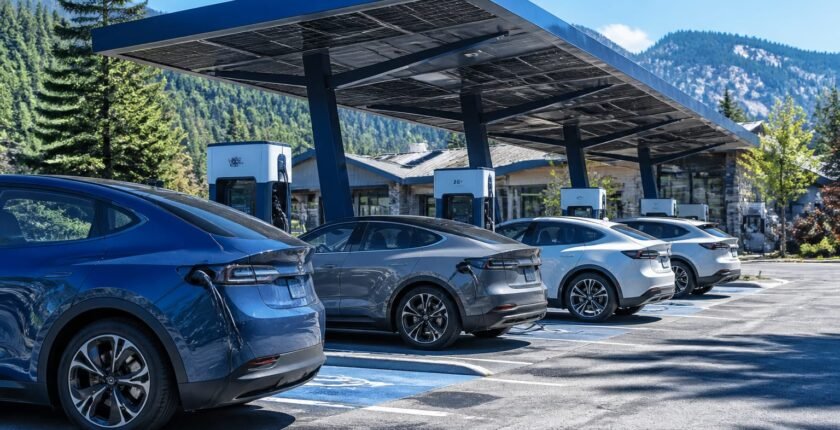
IONNA, headquartered in Durham, operates about 177 locations across 30 states and reports more than 1,400 charging bays in service, with another 700 under construction. The company expects to surpass 200 locations by the end of 2026 and has set an ambitious target of at least 30,000 bays across North America by 2030. Those figures describe a network that mixes fast chargers with amenities: some sites include food, lounges, covered charging and restrooms to improve safety and convenience.
IONNA’s footprint in North Carolina is visible: the company opened more than a dozen locations in the state and transformed a roughly 100‑year‑old gas station in Apex into its first Rechargery, a destination with covered chargers, a 24‑hour lounge and a bakery operated by a local entrepreneur. IONNA also operates a site in Garner and selected Durham for its global headquarters, signalling a local cluster of operations and hiring.
How J.D. Power’s study measures charging and why the scores matter
J.D. Power’s U.S. electric‑vehicle experience study measured public charging from driver experience and gave IONNA 807 out of 1,000 points, placing it ahead of named rivals. The study drew on 6,594 responses from owners of fully electric and plug‑in hybrid vehicles and found that the share of station visits where drivers arrived but could not charge fell to 12%, the lowest rate the study has recorded. Those metrics separate reliability (can the car charge) from service (is the site pleasant to use), and manufacturers are emphasizing both.
For automakers, a high J.D. Power score helps address perceived risk for buyers: if drivers expect a charger will work and the visit will be safe and convenient, the non‑price barriers to purchase shrink. IONNA’s CEO Seth Cutler framed the challenge as a baseline plus experience: drivers first need confidence they can find a working charger; after that, the operator must create a place that is safe and enjoyable.
Limits to the play and how outcomes could still diverge
The automaker consortium does not remove broader market pressures. Several manufacturers have delayed or scaled back EV models since federal consumer tax credits expired, a factor that has clearly contributed to the 20.5% drop in Q2 sales. Toyota is pursuing a multi‑pathway strategy—hybrids, plug‑in hybrids, full BEVs and hydrogen fuel cells—and more than half of Toyota’s current sales are “electrified,” a category that includes conventional hybrids rather than full BEVs.
Affordability, tariffs and slower vehicle rollouts remain concrete headwinds for demand even if charging improves. IONNA’s expansion reduces one barrier, but it cannot by itself lower vehicle sticker prices or restore consumer incentives. Cutler predicted sales could begin growing again next year; whether improved charging and other factors combine to reverse the downturn will depend on vehicle pricing, model availability and policy.
| Network | J.D. Power score | Notes |
|---|---|---|
| IONNA | 807 | About 177 locations; 1,400+ bays in service; 700 under construction; target 30,000 bays by 2030 |
| Mercedes‑Benz Charging Network | not disclosed | Placed behind IONNA in the ranking (score not given in the study excerpt) |
| Rivian Adventure Network | not disclosed | Named as a competitor in the J.D. Power ranking (score not given in the study excerpt) |
How IONNA’s expansion could change the market
The case for
- Improved reliability and convenience could reduce range‑anxiety friction, raising the share of shoppers willing to consider EVs if station uptime and amenities become common.
- A visible, branded network backed by eight automakers may accelerate private investment in complementary services (retail, food, security) at charging sites.
The case against
- Charging availability alone cannot overcome price barriers: manufacturers and consumers both face affordability challenges and tariff pressure that slow new‑vehicle purchases.
- If automakers delay EV model launches or federal incentives remain expired, demand may stay weak despite better charging, leaving sites underused.
What to be careful about
- Continued decline in U.S. EV purchases (20.5% Q2 drop) could leave new charging bays underutilised.
- Dependence on a single consortium model concentrates operational and reputational risk among the owner automakers if reliability problems recur.
- Affordability and tariff pressures noted by Toyota could blunt demand even where charging improves.
The bottom line
Automakers’ backing of IONNA is a pragmatic response to a clear structural problem: public charging reliability and convenience still deter buyers even as vehicle makers adjust their EV plans. IONNA’s J.D. Power score and its current footprint—about 177 locations and 1,400 operational bays—show progress on uptime and experience, but the network cannot solve pricing or incentive shortfalls. Whether improved charging triggers renewed EV growth depends on vehicle affordability, model availability and policy; the milestones to watch are IONNA’s site count by the end of 2026, progress toward 30,000 bays by 2030, and U.S. EV sales performance in 2027.
What to watch
- Watch whether IONNA surpasses 200 locations by the end of 2026, a milestone the company expects to reach.
- Watch progress toward IONNA’s target of at least 30,000 charging bays across North America by 2030.
- Watch U.S. EV retail sales in 2027 to see if the decline that produced a 20.5% drop in Q2 reverses, as IONNA’s CEO predicted.
Frequently asked questions
Who owns IONNA and why does that matter?
IONNA is owned by eight automakers: Toyota, BMW, General Motors, Honda, Hyundai, Kia, Mercedes‑Benz and Stellantis. Shared ownership matters because it aligns manufacturers on a common public charging standard and can smooth cross‑brand access for drivers.
How well did IONNA perform in the J.D. Power study?
J.D. Power gave IONNA 807 out of 1,000 points in its U.S. public charging study, which was based on 6,594 responses from owners of fully electric and plug‑in hybrid vehicles.
How large is IONNA’s network today and what are its expansion goals?
IONNA operates about 177 locations across 30 states with more than 1,400 charging bays live and 700 under construction; the company expects to exceed 200 locations by the end of 2026 and is targeting at least 30,000 bays by 2030.
Related reading