
Blog
Vertical floating solar uses edge-on panels for industry
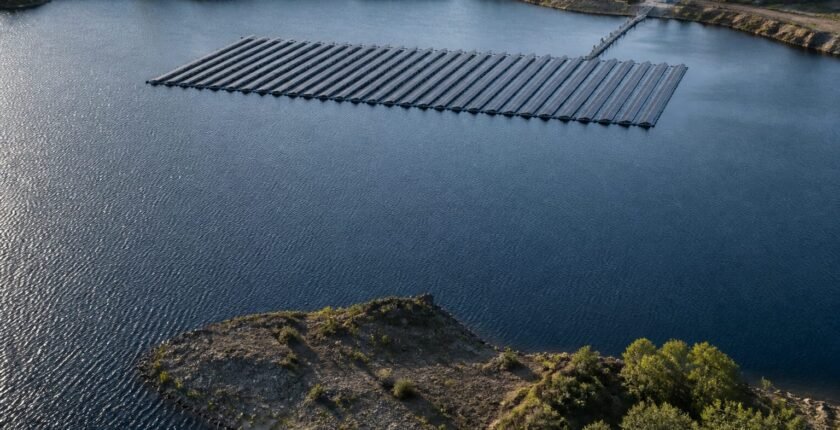
Estimated reading time: 5 minutes · Last updated:
A new floating array on a Bavarian gravel lake deploys 2,600 bifacial modules arranged edge-on to produce 1.87 megawatts while prioritising morning and evening output over midday peak. The layout reduces the array’s footprint to 4.65 percent of the water surface under a 15 percent legal ceiling and is sized to serve a neighbouring gravel works rather than to export broadly. Early operation produced more than 100 megawatt hours in the first three weeks and cut the site’s grid purchases by around 70%, figures the developer provided, as first reported by Energies Media. The primary lesson is economic: vertical geometry shifts revenue timing, not capacity.
Key takeaways
- The Bavarian installation uses 2,600 modules to deliver 1.87 megawatts of capacity; operations began in late August last year and an official opening followed in October.
- The project uses 4.65 percent of the lake surface against a 15 percent cap in German water law; a planned second phase of 1.7 megawatts would keep coverage under 10 percent.
- Early performance: the developer said that during the initial three weeks the array generated more than 100 megawatt-hours and reduced the gravel works' purchases from the grid by around 70 percent.
- The design uses edge-on bifacial modules mounted on keels that reach about five feet below the surface, with gaps of at least 13 feet between sections to leave light and air for the water.
Table of contents
How edge‑on modules change value from midday to shift hours
Traditional tilted arrays maximise total annual kilowatt hours by concentrating output around solar noon. That pattern now coincides with a national supply-wide midday surplus, when wholesale prices fall. The Bavarian plant adopts an alternative: rows of modules mounted vertically and oriented east–west produce two generation peaks, one in the morning and one in the evening, instead of a single midday maximum.
The economic effect is straightforward. Annual yield is lower than a south‑facing tilt, but each kilowatt hour is sold at a higher effective price when used on site during industrial shifts. For this installation the developer and operator configured the layout to serve a heavy, steady daytime load at the adjacent gravel works; shifting output into the facility’s start and end of day raises the value of each MWh and reduces the need for large batteries.
edge-on bifacial modules are central to the approach: because both faces can collect light, a panel standing on edge captures usable irradiance in morning and evening even though it misses noon. The term describes the module arrangement and is the reason the geometry yields two useful humps of production rather than one.
Site engineering: floats, keels and spacing
The array sits on floats anchored in a worked gravel pit whose depth accommodates the project’s keel design. Each float carries a keel that reaches about five feet below the waterline; the keel provides the moment arm that keeps rows upright when wind pushes the panels like sails. That minimum draft excludes very shallow ponds and made a gravel lake a practical choice for this prototype.
Rows are separated by gaps of at least 13 feet so the water beneath is not completely shaded and receives air and light; this spacing also reduces interaction between adjacent rows under wind loads. The site uses bifacial modules because a single‑face, edge‑on panel would forfeit half its potential exposure. Those engineering choices — draft, keel depth and section gaps — define which inland water bodies could accept the design.
The developer provided the module count, the area covered and the early production figures; the plant began operating in late August last year and had a formal opening in October. Those technical constraints together with the depth of the site result in a layout that resembles a fleet of sails rather than a conventional floating field.
Where this model fits, and what remains unproven
This array is not a merchant exporter. Its primary customer is the adjacent crushing and conveying operation, a heavy industrial load that runs through the working day. In guided operating weeks the array cut the site’s grid purchases by around 70 percent and produced more than 100 megawatt hours in its first three weeks — outcomes that make industrial self‑consumption the clear business case rather than wholesale sales.
Despite the promising opening, several long‑term issues remain unresolved. Wind is the largest technical unknown because a vertical panel presents a full sail area to gusts; the structure is designed to move under load rather than rigidly resist it, but there is no long service record for that behaviour on water. Ice is the second key unknown: the lake freezes in winter in Bavaria and the effect of moving ice on keels and anchor lines over multiple winters has not yet been observed.
Other operational risks under monitoring include biofouling on submerged keels and the ecological effect of persistent shading strips on lake oxygen. The developer and independent observers are tracking these points as the installation completes its first annual cycle.
| Item | Value | Source note |
|---|---|---|
| Module count | 2,600 | Developer |
| Installed capacity | 1.87 MW | Developer |
| Legal coverage cap | 15 percent | German water law |
| Project coverage | 4.65 percent | Developer |
| Planned second phase | 1.7 MW | Developer |
| Keel draft | about five feet | Engineering description |
| Section gaps | at least 13 feet | Engineering description |
Outlook: arguments for and against wider adoption
The case for
- Shifting output to mornings and evenings improves the economics of self‑consumption for industrial sites and reduces the scale of storage needed to make production usable.
- The design uses less than a third of the 15 percent surface coverage allowed by German water law (4.65 percent here), so sites with similar depth and loads could be scaled without breaching that ceiling.
The case against
- Wind loads on vertical panels remain unproven over multi‑year service; floating keels must survive repeated gust cycles without excessive maintenance.
- Ice dynamics on frozen pit lakes are unknown and could create anchor or keel failures over successive winters, raising operational and insurance costs.
What to be careful about
- Structural fatigue from wind on vertical panels because a standing panel exposes more sail area than a tilted one.
- Ice-driven mechanical damage to keels and anchors in freezing climates where a lake surface moves against anchored floats.
- Biofouling on submerged keels affecting buoyancy and maintenance intervals.
- Local ecological impacts from persistent shading over parts of the lake, including possible effects on dissolved oxygen.
The bottom line
This Bavarian installation demonstrates a tactical shift: choosing vertical, edge‑on, bifacial modules to match generation to industrial demand rather than to maximise raw annual yield. The approach relies on site depth, keel engineering and spacing rules and currently occupies only 4.65 percent of a lake area allowed up to 15 percent. Early production and a 70 percent reduction in grid purchases at the adjacent gravel works validate the commercial case for self‑consumption, but longer‑term questions about wind fatigue, ice interaction and ecological effects must be resolved before the layout can be widely adopted.
What to watch
- Watch for published results from the first winter season tests of anchors and keels; no date has been set.
- Watch for the developer’s announcement about timing and scope for the planned 1.7 megawatt second phase; no date has been set.
- Watch for any technical papers or engineering reports that quantify wind fatigue on the vertical float concept; no date has been set.
Frequently asked questions
How large is the Bavarian floating array and when did it start operating?
The installation contains 2,600 modules with an installed capacity of 1.87 megawatts; it became operational in late August last year and was formally opened in October.
Does the project run up against the German limit on water coverage?
No; German water law sets a 15 percent cap on shaded water area, the array uses 4.65 percent of the lake, and a proposed 1.7 megawatt second phase would keep total coverage under 10 percent.
Who benefits from the array’s shifted output profile?
The main beneficiary is the adjacent gravel works: the plant produced more than 100 megawatt hours in its first three weeks and cut that operation’s grid purchases by around 70 percent, showing the value of matching output to on‑site load.
Related reading