
Blog
Illinois EPA plan to reach net-zero emissions by 2050
Estimated reading time: 6 minutes · Last updated:
Illinois EPA has issued a Comprehensive Climate Action Plan that sets pathways for the state to achieve net-zero greenhouse gas emissions by 2050. The plan finds current policy will only lower emissions to about 133 million metric tons by 2050 (a 53% cut from 2005) unless Illinois adopts additional measures; the report says a full package of incentives and regulations could cut emissions to 79 million metric tons and deliver $21 billion a year in net benefits by 2050. The Illinois Environmental Protection Agency released the Comprehensive Climate Action Plan this month, as first reported by Capitol News Illinois.
“Illinoisans are seeing the extreme heat and storms climate change has brought to our doorstep this summer.”
JC Kibbey, Illinois Climate Advisor
Key takeaways
- Illinois cut net greenhouse gas emissions 32% from 2005 to 2023, driven in part by a shift to natural gas and renewables including wind and solar.
- Without new policies the plan estimates emissions will fall to 133 million metric tons by 2050, a 53% reduction below 2005 levels.
Table of contents
Where Illinois stands and the shortfall to 2050
Illinois has already cut net greenhouse gas emissions 32% from the 2005 baseline through 2023, a decline the plan attributes mainly to fuel switching in power generation toward natural gas and to growing wind and solar deployment. The plan treats that progress as real but insufficient: under existing policies it projects net emissions of about 133 million metric tons by 2050, which the plan describes as a 53% reduction compared with 2005.
That gap — between a partial transition and the legal and policy objective of net zero by 2050 — is the reason the Illinois Environmental Protection Agency framed a much larger package of actions. The document highlights transportation, buildings, industry, agriculture and waste as sectors that together must change if the state is to close the remaining emissions gap.
How the plan would cut emissions across sectors
The Comprehensive Climate Action Plan combines incentives and new regulations. Measures the plan lists include rebates and incentives to electrify medium- and heavy-duty commercial vehicles, subsidies for residential heat pumps, new all-electric construction codes for new buildings and phasing out gasoline-powered lawn and landscaping equipment by 2035.
On industry, the plan calls for net-zero cement production by 2050 and reductions in emissions intensity for materials used in public construction. For waste, it proposes stronger methane monitoring and abatement at landfills, and for agriculture it proposes incentives for practices that reduce carbon dioxide emissions. The plan describes two scenario pathways: a “moderate efficiency and flexibility” route that assumes full electrification of buildings by 2050 with 32% of households using hybrid heat pumps, and a “high efficiency and flexibility” route that emphasizes reduced energy demand through denser housing and more public transport.
Costs, quantified benefits and health impacts
The report does not downplay costs: it says substantial investment will be needed from state government, private industry and consumers for infrastructure, vehicles, heat pumps and alternative fuels. Those upfront expenditures are presented alongside monetized benefits the plan calculates from avoided fuel use, greater efficiency and health gains.
Specifically, the document estimates the plan’s Increased State Action scenario would deliver $21 billion a year in net benefits by 2050; it also projects 392 to 631 fewer premature deaths each year from improved air quality, which the plan monetizes as $8.8 billion to $13.8 billion in avoided healthcare costs and increased productivity.
What the plan means for power generation and wind
The energy transition underpinning the plan rests on further growth in renewables and electrification of end uses. The report credits earlier emissions declines to growing wind and solar plus increased use of natural gas, and it treats additional renewable capacity and electrified demand as central to reaching the plan’s lower-emissions scenarios.
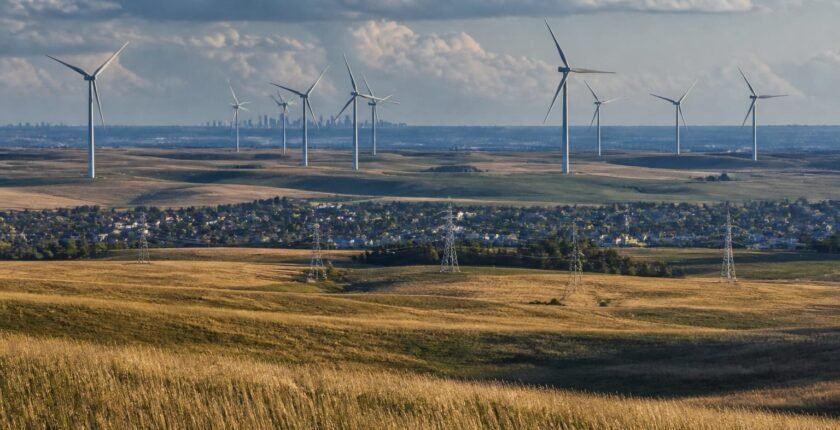
For wind energy specifically, the implication is operational: continued buildout of wind farms and grid upgrades to integrate more variable renewable generation will be required to displace remaining fossil fuels as buildings, industry and transport electrify. The plan links these power-sector changes directly to the statewide targets rather than to a single technology, but it lists renewables — including wind — among the tools that made the 32% decline since 2005 possible.
| Scenario | Household heat pumps by 2050 | Primary emphasis |
|---|---|---|
| Moderate efficiency and flexibility | 32% of households using hybrid heat pumps | Full electrification and rapid EV expansion |
| High efficiency and flexibility | Not specified for hybrid pumps | Reduced energy demand via density and transit |
Case for and against the plan’s feasibility
The case for
- Existing laws and programs provide a foundation: the 2021 Climate and Equitable Jobs Act sets a 2050 phaseout of carbon-emitting power and the EPA awarded Illinois a $430 million Climate Pollution Reduction Grant in 2024 to support initial programs.
- The plan’s modelled benefits are large and concrete: it estimates $21 billion per year in net benefits by 2050 plus 392–631 fewer premature deaths annually from better air quality, which can help justify public investment.
The case against
- Meeting the plan’s scenarios requires major new public and private investment and statutory or regulatory changes across multiple sectors, creating a substantial implementation burden.
- Supply-chain and workforce constraints for heat pumps, EVs and grid upgrades could slow adoption, and the plan warns that current policies alone will leave Illinois at roughly 133 million metric tons in 2050 rather than net zero.
What to be careful about
- Funding shortfalls: the plan requires state and private capital for infrastructure and equipment that the report says will be substantial but does not break down by project.
- Implementation capacity: installers, grid upgrades and manufacturing for heat pumps and EV chargers may lag the deployment pace the plan assumes.
- Regulatory and political pushback: the plan depends on new regulations affecting buildings, industry and land use that could face opposition in rulemaking or the legislature.
The bottom line
The Illinois EPA’s Comprehensive Climate Action Plan lays out a near-term policy menu and two pathways to reach net zero by 2050, but it makes clear that current law and programs alone will not get the state there. The math in the report is stark: a baseline path to about 133 million metric tons in 2050 versus a 79 million metric ton outcome if the plan’s full set of measures is adopted, with the agency estimating $21 billion a year in net benefits under the more aggressive scenario. The work now shifts from modelling to financing, rulemaking and deployment across buildings, transport, industry and waste, where the plan’s targets will be tested in practice.
What to watch
- Watch compliance and milestone reporting tied to the 2035 deadlines, including the plan’s clean heat standard that targets a 22% reduction in natural gas emissions by 2035.
- Watch state and federal funding decisions and rulemakings that would enable industrial emissions requirements and net-zero targets for cement and other construction materials through 2035–2050.
- Watch progress toward the 2050 net-zero target, including published updates on building electrification rates and vehicle fleet electrification through the decade leading to 2050.
Frequently asked questions
How much has Illinois cut emissions so far?
According to the plan, Illinois reduced net greenhouse gas emissions by 32% from 2005 to 2023, a decline the report links to a shift in power generation toward natural gas and renewables such as wind and solar.
What difference would the plan make by 2050?
The report models two outcomes: under current policies it projects about 133 million metric tons of emissions in 2050, a 53% cut from 2005; adopting the full package of measures would lower that to about 79 million metric tons and the report estimates $21 billion a year in net economic benefits by 2050.
Does the plan quantify public-health effects?
Yes; the document estimates improvements in air quality would yield 392 to 631 fewer premature deaths per year and monetizes that as $8.8 billion to $13.8 billion in avoided healthcare costs and increased productivity.
Related reading