
Blog
Residential Geothermal in Littleton Shows Home Energy Future
Estimated reading time: 5 minutes · Last updated:
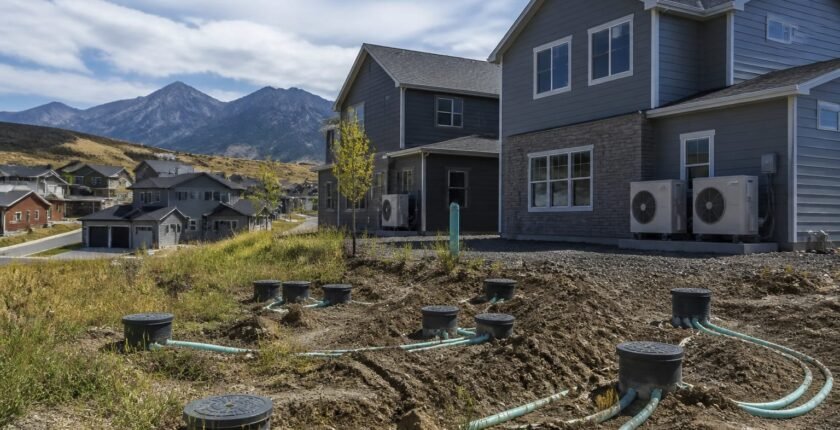
A new Littleton, Colorado neighborhood where nearly 100 homes were built with ground-source heat pumps offers a practical test of residential geothermal at scale. The pilot—a Dandelion Energy installation at Lennar’s Ken Caryl Ranch—uses a single bore between 200 and 500 feet and water that taps roughly 50°F ground temperatures to heat and cool each house. The project aims to cut peak electricity use and avoid new gas-service expansion by electrifying heating. This reporting draws on Inside Climate News.
taking a kind of mass market and maximally efficient lens to what has historically been a bespoke kind of custom, high-end product
Dan Yates, Dandelion Energy CEO and chairman
Key takeaways
- Pilot scale: Dandelion Energy and Lennar completed nearly 100 homes with ground-source heat pumps at Ken Caryl Ranch in Littleton, Colorado.
- Design and drill depth: Each home in the pilot gets a single bore between 200 and 500 feet into ground temperatures of about 50°F.
- Cost and incentives: The Energy Department estimates an average upfront cost of about $25,000 per typical new home and Xcel Energy offers approximately $25,000 per home in rebates for qualifying projects.
- National potential: A 2025 U.S. Department of Energy report says just over 1 million U.S. homes now have ground-source heat pumps and projects the technology could reach 7 million homes by 2035, cutting winter peak demand by more than 40 gigawatts.
Table of contents
- Key takeaways
- How the Littleton pilot installs ground-source heat pumps
- Upfront costs, claimed savings and the incentives that change the math
- What wider adoption would do for grids, builders and climate goals
- Balanced case for scaling residential geothermal
- What to be careful about
- Frequently asked questions
How the Littleton pilot installs ground-source heat pumps
Dandelion Energy and Lennar built almost 100 new homes at Ken Caryl Ranch with ground-source heat pumps, fitting each house with a heat pump in the basement and polyethylene loop piping run down a single bore. The bore depth in the development ranges from 200 to 500 feet, where subsurface temperatures sit around 50 degrees Fahrenheit year-round, so circulating water arrives to the heat pump already warmed in winter and cooled in summer.
The pilot relies on a small, mobile drilling rig Dandelion designed to move quickly between lots and avoid the downtime that would come from transporting a rig to a single retrofit site. That site-to-site efficiency, combined with standardized plans for dozen‑to‑dozen home lots, is the company’s response to the traditional model: bespoke designs and multi-borefield wells that make geothermal a high-end niche.
Upfront costs, claimed savings and the incentives that change the math
Upfront price remains the most visible barrier. The U.S. Department of Energy’s 2025 report puts the typical new‑home upfront cost for a ground‑source heat pump at about $25,000, and independent cost pages cited in the reporting note drilling alone often exceeds $10,000. Dandelion says its approach—lighter rigs, repeatable lot layouts and integrated construction sequencing—can halve installation costs and shave project timelines, though the company’s claim is presented without an independent cost audit in the reporting.
In Littleton, incentives materially change the buyer calculus. Xcel Energy’s efficiency program provides roughly $25,000 per home for qualifying new, high‑efficiency buildings with ground‑source heat pumps, and the Colorado state credit adds $2,000 per installation. The reporting notes that large, contiguous developments can generate seven‑figure rebate totals for builders, making a standardized geothermal package financially attractive to a large homebuilder like Lennar.
What wider adoption would do for grids, builders and climate goals
The Department of Energy models cited in the reporting show a national pathway: moving ground‑source heat pumps from just over 1 million U.S. homes today to 7 million by 2035 would lower winter peak electricity demand by more than 40 gigawatts and yield about $4 billion a year in electric‑grid savings. Those are system‑level numbers that matter to utilities planning winter capacity and to states aiming to cut building emissions.
For builders, the pilot demonstrates a path to electrification without the retrofit penalties that often make geothermal expensive: drilling and loop installation occur before foundations are poured, and standardized plans remove repeated engineering costs. For the grid, the key win is operational: during cold snaps, Dandelion’s CEO says ground-source systems can draw roughly 25% of the electricity consumed by air-source heat pumps, lowering the coincident peak that strains winter supplies.
| Item | Value | Source / note |
|---|---|---|
| Typical upfront install cost (new home) | $25,000 | U.S. Department of Energy, 2025 report |
| Drilling alone (typical) | More than $10,000 | costs cited via geothermalfinder link |
| Xcel Energy rebate (per qualifying home) | Approximately $25,000 | Xcel Energy program, spokesperson statement |
| Colorado state tax credit | $2,000 | Colorado energy office |
Balanced case for scaling residential geothermal
The case for
- Standardised, lot-by-lot drilling and builder partnerships can cut per‑home labour and design costs and make installations repeatable.
- Existing utility rebates and a $2,000 Colorado tax credit can collapse the payback window for buyers and make new subdivisions financially viable for builders.
- System benefits are large: DOE scenarios show more than 40 gigawatts of reduced winter peak demand and roughly $4 billion per year in grid savings if deployment reaches 7 million homes by 2035.
The case against
- Average upfront cost remains roughly $25,000 per home and dependence on large rebates leaves rollout exposed to changing utility programs and budgets.
- Space limits, permitting variability and subsurface geologies complicate urban or retrofit deployments, restricting where the least‑cost model applies.
- Company cost claims (half the cost, twice the speed) are presented without independent, project‑level verification in the reporting.
What to be careful about
- Deployment depends heavily on utility rebate programs such as Xcel Energy’s; changes to those programs would materially alter project economics.
- Permitting rules and local permitting timelines vary across municipalities and can delay drilling or add cost in dense urban settings.
- Subsurface variability can raise drilling costs or reduce loop performance; site geology is a project‑specific risk.
- Builders and homeowners face a high upfront financing need—about $25,000 on average per DOE—that can deter adoption without installation financing or rebates.
The bottom line
The Ken Caryl Ranch pilot shows how residential geothermal can move from niche to mainstream when builder scale, drilling logistics and utility incentives line up. The technology leverages stable subsurface temperatures—about 50°F at 200–500 feet—to cut electricity use in winter peaks and, at large scale, could shave more than 40 gigawatts from winter demand and save roughly $4 billion a year in grid costs per DOE scenarios. That outcome still depends on widespread rebates, standardised construction sequencing and verified cost reductions; absent those, high upfront costs of about $25,000 per home will keep geothermal a selective choice.
What to watch
- completion of Dandelion and Lennar’s 1,500-home Colorado rollout; projected around 2027 based on a 2025 start and a two-year schedule.
- whether Dandelion reaches its target to scale to 10,000 homes per year; no date has been set in the reporting.
- progress toward the DOE projection that ground‑source heat pumps could reach 7 million U.S. homes by 2035.
Frequently asked questions
How much does residential geothermal cost upfront?
The U.S. Department of Energy’s 2025 report puts the typical upfront cost for a new home at about $25,000, with drilling alone often cited as more than $10,000 in the reporting referenced.
How many U.S. homes have ground‑source heat pumps and what is the projected future?
Just over 1 million U.S. homes currently have ground‑source heat pumps and the DOE projects deployment could reach 7 million homes by 2035, according to the 2025 report cited.
Why did Lennar and Dandelion pair up for the Littleton project?
Builder‑scale advantages—standardised site layouts and a mobile drilling rig—let Dandelion install loops before foundations are poured; combined with Xcel Energy rebates of roughly $25,000 per home, that approach aims to make geothermal financially viable for large subdivisions.
Related reading
This article is information, not financial advice. Anyone acting on it should do their own checks.