
Blog
Who benefits from agrivoltaics on farmland
Estimated reading time: 6 minutes · Last updated:
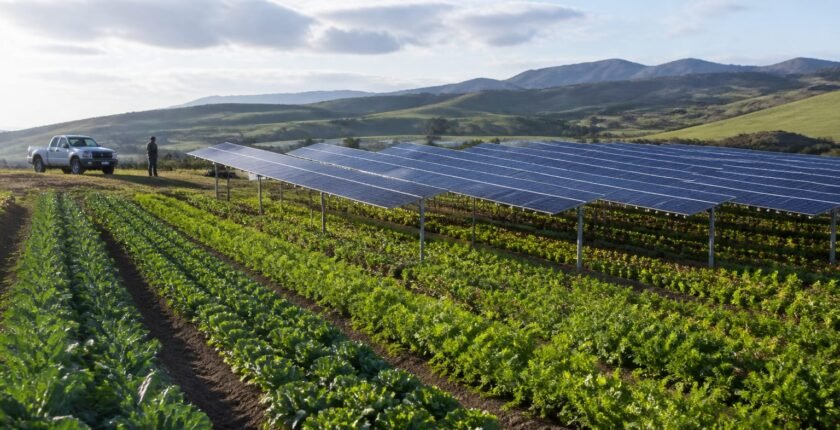
Agrivoltaics — mounting photovoltaic panels above or among crops — can both generate power and give farmers new revenue, but who captures those revenues varies widely. As first reported by Euronews, studies and interviews across Europe show agrivoltaics has technical promise (a 2023 paper estimated Europe could generate about 25 times its current electricity demand via agrivoltaics) while outcomes depend on ownership, contracts and national rules. Large projects already under construction include more than 150 megawatts of capacity in southern Italy whose output has been contracted to Amazon and Apple and is roughly equivalent to the yearly needs of about 100,000 Italian households. The policy design — who keeps rent, who retains land-use rights and what share of area remains active farmland — decides whether farmers gain or are sidelined.
Agrivoltaics is the integration of food production with renewable energy production.
Silvia Tomasi, Senior Researcher, Eurac Research
Key takeaways
- Scale potential: A 2023 study estimated agrivoltaics could generate about 25 times Europe’s current electricity demand.
- Corporate PPAs: Over 150 megawatts of agrivoltaic capacity in southern Italy has been contracted to Amazon and Apple, covering roughly 100,000 households' annual needs.
- Public support: The EU-funded AGRISOL programme plans €1.9 million in agrivoltaics projects, while Italy has allocated €1.7 billion in state aid.
- Distribution of funds: A 2025 review cited by Italian media found about 86% of roughly €775 million in government agrivoltaic funding went to large-scale projects.
Table of contents
- Key takeaways
- What agrivoltaics is and the scale it could reach
- How agrivoltaics can help farmers — and when it does not
- Who captures the profits: evidence of uneven gains
- Policy levers to redistribute gains and protect farmland
- How agrivoltaics could play out
- What to be careful about
- Frequently asked questions
What agrivoltaics is and the scale it could reach
Agrivoltaics pairs photovoltaic (PV) arrays with food production by placing panels above fields, between crop rows or along field margins so land yields both electricity and crops. The setup can include elevated trackers, shaded rows or systems integrated with trees and vines; the configuration is chosen to balance light for plants and energy yield for panels.
The technology’s theoretical reach is large: one 2023 study cited in regional research estimated agrivoltaic layouts could supply roughly 25 times Europe’s current electricity demand if widely deployed. That figure is a potential upper bound; it assumes extensive use of available cropland and implementation across multiple climates and crop systems. The same research underlines that practical deployment depends on grid access, financing and agricultural compatibility at each site.
Key trade-offs are clear at this scale: more panels raise electricity output but change the light, humidity and microclimate experienced by crops. Successful projects therefore treat PV layout, crop choice and irrigation as a single design problem rather than two separate uses of the same land.
How agrivoltaics can help farmers — and when it does not
Farm-level benefits recorded in field studies include reduced evaporation, lower heat stress and protection from hail, which can translate into higher yields or lower input costs for some crops. In Murcia, Spain, researchers reported water-stressed bell peppers performed better under panels than under full sun; on other sites, benefits depend on crop type, panel height and spacing.
Income streams take several forms: farmers can use the electricity on-site, sell surplus to the grid, rent their land or receive royalties from project operators. National rules already push installations to preserve agriculture: France requires projects to maintain at least 90% of reference crop production, while Italian rules set a threshold that at least 70% of the area remains dedicated to agriculture. Those rules aim to keep farming as the principal land use, but implementation and enforcement vary.
Pilar Flores of the Murcian Institute for Agricultural and Environmental Research and Development (IMIDA) warns that benefits are not automatic: system choice and site-specific analysis determine whether a given farm sees yield gains or merely loses arable area to panel infrastructure.
Who captures the profits: evidence of uneven gains
Multiple sources cited in the coverage show a pattern: large developers, landowners and corporate buyers often take the lion’s share of financial gains. In southern Italy, agrivoltaic parks totalling over 150 megawatts have signed power-purchase agreements with Amazon and Apple; that combined capacity is presented in the coverage as enough for roughly 100,000 households a year. Large projects are easier to finance and to queue for grid connection, which concentrates activity among better-capitalised players.
A 2025 review reported by an Italian outlet found about 86% of roughly €775 million in public agrivoltaic funding went to large-scale projects, including foreign-owned ones. The same academic work and interviews with regional stakeholders flagged risks that rental income will subsidise conventional, intensive farming rather than agroecological transitions that some researchers favour.
Farmers’ unions and local campaigners say startups and data-centre developers are actively seeking land leases and that contractual terms can leave smallholders with limited bargaining power. Fabrizio Garbarino of the Associazione Rurale Italiana frames agrivoltaics as a partial response to farming-sector distress that risks becoming a shortcut rather than a structural fix.
Policy levers to redistribute gains and protect farmland
Policymakers and funders can change outcomes by tying support to clear obligations: minimum shares of agricultural output retained, mandatory community consultation, limits on the proportion of land convertible to PV and requirements that rental income fund agroecological practices. Silvia Tomasi of Eurac Research stresses that classification systems should put agriculture first and that regulations must specify how much production is preserved rather than relying on vague labels.
Grant and connection-priority rules can favour smallholders: one concrete option is offering simplified grid access and dedicated grant windows for farmer-led projects rather than large corporate parks. Public procurement and PPA templates can also include clauses that favour local sourcing of electricity or direct revenue-sharing with neighbouring communities.
Without such levers, the positive environmental and social claims attached to agrivoltaics risk being captured by outside investors who supply corporate buyers with contracted power while local communities gain only limited rent or short-term employment.
| Jurisdiction | Requirement or fund | Figure or detail | Source |
|---|---|---|---|
| France | Crop production threshold | Maintain at least 90% of reference crop production | national rule cited |
| Italy | Agricultural area threshold | At least 70% of area must remain dedicated to agriculture | national rule cited |
| EU / Italy | Public funding | AGRISOL €1.9 million; Italy €1.7 billion in state aid | programme and national allocation cited |
How agrivoltaics could play out
The case for
- Wider adoption could deliver both on-farm resilience and additional renewable generation if projects are designed for local crop needs and water savings.
- Targeted public funding and priority grid access for farmer-led projects could shift benefits toward smallholders and local communities, avoiding concentration among large investors.
The case against
- If financing and grid queues continue to favour large developers, agrivoltaics may accelerate corporate control of rural land and direct most revenues away from smaller farmers.
- Poorly framed rental income could subsidise intensive farming models rather than supporting agroecological transitions, undermining the environmental gains agrivoltaics promise.
What to be careful about
- Concentration risk: large-scale projects capture most public grants and grid slots, marginalising smallholders.
- Land-use dilution: weak safeguards could reduce active cropland below national thresholds in practice, harming local food production.
- Greenwashing: companies may rely on PPAs to claim decarbonisation while local communities receive little benefit or control.
- Contract terms: short or restrictive land leases can lock farmers into low rents and remove long-term land stewardship incentives.
The bottom line
Agrivoltaics can deliver a rare double dividend: extra renewable electricity and a new income stream for farms. But the coverage shows that technical potential alone does not guarantee fair outcomes. Where national rules, grant windows and grid access favour large projects, revenues concentrate with investors and corporate buyers; where policy prioritises farmer-led schemes, local benefit is likelier. The choice is not only technical — it is contractual and political. To realise agrivoltaics’ promise for farming, regulators must write the distributional rules into permits and funding terms so that panels on fields do not become panels for outsiders.
What to watch
- Watch for national updates to agrivoltaic classification and permitting in Italy and France; no date has been set.
- Watch for final decisions or contractual disclosures related to the Israeli-backed agrivoltaics project in Tuscany; no date has been set.
- Watch for AGRISOL-funded pilot results from projects in Italy and Spain; no date has been set.
Frequently asked questions
What exactly is agrivoltaics?
Agrivoltaics is the practice of combining photovoltaic panels with crop production by placing panels above, between or at field margins; Silvia Tomasi of Eurac Research describes it as the integration of food and renewable energy production. A 2023 study cited in the coverage estimated agrivoltaics could theoretically generate about 25 times Europe’s current electricity demand if broadly deployed.
Who is currently benefiting financially from agrivoltaic projects?
Coverage and a 2025 review show that large landowners, investors and corporate buyers often capture most revenues: more than 150 megawatts of agrivoltaic capacity in southern Italy has PPAs with Amazon and Apple, and an Italian analysis found roughly 86% of about €775 million in public funding went to large-scale projects.
Can agrivoltaics improve crop outcomes?
Yes in specific cases: field research described in the coverage found water-stressed bell peppers in Murcia grew better under panels than under full sun, and panels can reduce evaporation and shield crops from hail; success depends on panel height, spacing and crop choice.
Related reading