
Blog
Beaver Water District solar park to produce 12,300 MWh
Estimated reading time: 5 minutes · Last updated:
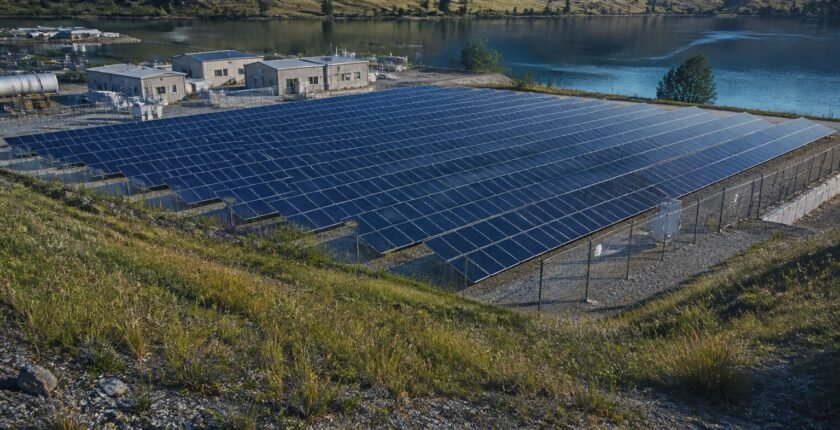
Beaver Water District has completed a 7.224 MW DC (5 MW AC) solar park in Lowell, Arkansas; the utility estimates the array will produce approximately 12,300 MWh each year. The facility is projected to meet about 15 to 20 percent of the district’s electricity needs and to deliver between $7 million and $11 million in lifetime savings. The project advanced through a competitive FRP process, with Madison Energy Infrastructure leading development, contracting and financing while Verogy handled design, procurement, permitting and construction. Serving more than 425,000 customers in Northwest Arkansas, Beaver Water District placed the array across the street from its water treatment plant to emphasize affordability, sustainability and resilience.
It lowers long-term operating costs, supports regional growth, and reinforces our commitment to sustainability.
M. Lane Crider, P.E., Beaver Water District CEO
Key takeaways
- The new array is a 7.224 MW DC (5 MW AC) solar park installed by Verogy.
- Beaver Water District projects the park will generate roughly 12,300 MWh of renewable energy on an annual basis.
- Beaver Water District expects the project will meet 15 to 20 percent of its electricity demand.
- BWD serves over 425,000 customers across Northwest Arkansas.
- BWD estimates lifetime savings from the installation between $7 million and $11 million.
Table of contents
Project basics: size, location and expected output
The installation is a utility-scale array located in Lowell, Arkansas, adjacent to Beaver Water District’s water treatment plant. Verogy, a Connecticut-based firm that develops and constructs distributed-generation projects, built the 7.224 MW DC (5 MW AC) array. Beaver Water District projects annual output at about 12,300 MWh, a number it uses to estimate the project will supply roughly 15 to 20 percent of its electricity demand. BWD says siting generation next to a major load point shortens the path for power to critical water services and can improve local resilience during grid disruptions.
Because the array is modest in scale relative to large regional solar farms, its benefit is framed as targeted grid support for the district rather than wholesale supply to the wider transmission system. The installed capacity and the annual energy estimate are the two technical anchors for the district’s savings and resilience claims.
Who developed and financed the park
Beaver Water District selected Madison Energy Infrastructure through a competitive FRP process to deliver the project. Madison Energy Infrastructure, a New York-based firm, led development, contracting and financing while partnering with Verogy on design, procurement, permitting and construction. Ryan Coakley, Chief Development Officer of Madison Energy Infrastructure, described the project as “community infrastructure” positioned to deliver resilience and savings at the treatment plant.
The arrangement is typical for public utilities that lack in-house development capacity: a specialist developer secures permits and financing and then brings in an experienced construction partner. The release the district issued frames the deal as a long-term investment in operating-cost reduction and regional growth support; Verogy’s CEO Will Herchel highlighted cost reduction and planning as expected benefits.
Operational impact, savings and limits of the estimate
Beaver Water District projects lifetime savings from the solar installation of between $7 million and $11 million. That range reflects assumptions about future retail electricity prices, the share of on-site generation consumed versus exported, and expected performance over the array’s operating life. The district’s 12,300 MWh annual output is the basis for modelling those savings, but the release does not publish the detailed assumptions used to derive the midpoint or low and high estimates.
Solar production is variable by hour and season; meeting 15 to 20 percent of BWD’s electricity demand will depend on when that demand occurs and how much of the array’s output is used at the treatment plant versus sold back to the grid. The district frames the project as improving affordability and resilience while supporting regional growth, but the savings band and production estimate are projections that will need verification through operating data over the coming years.
What could move this either way
The case for
- On-site generation reduces the district’s exposure to wholesale price spikes because some consumption will be supplied directly from the array.
- Locating the array across from the treatment plant improves local resilience by shortening the delivery path for critical loads during distribution outages.
The case against
- Actual savings depend on future electricity prices and the share of array output consumed on-site; if export rates are low the realised savings could fall toward the lower end of the $7 million to $11 million range.
- Solar output variability means the array will cover a smaller share of demand during low-sun months and at night, limiting its ability to consistently meet 15 to 20 percent of demand without storage or demand-shifting measures.
What to be careful about
- Projected lifetime savings ($7 million to $11 million) are modelled and could be lower if wholesale prices or on-site use differ from assumptions.
- Seasonal and hourly variability in solar generation could reduce the effective share of district demand met without additional storage or load management.
- Panel degradation or unexpected maintenance could lower annual output from the 12,300 MWh estimate.
- Interconnection constraints or changes in export compensation could change the financial outcome compared with the initial estimates.
The bottom line
The Beaver Water District solar park is a targeted, utility-scale installation intended to lower operating costs and add resilience to the district’s water services. At 7.224 MW DC (5 MW AC) with an annual estimate of about 12,300 MWh, the array is large enough to supply a meaningful share of local demand—15 to 20 percent by the district’s estimate—while remaining a modest asset in regional terms. The $7 million to $11 million lifetime savings projection frames the financial case, but real-world results will hinge on operational output, the pattern of on-site consumption, and future electricity prices. Public operating data and BWD’s budget reports will show whether the project delivers on those expectations.
What to watch
- Watch for Beaver Water District’s annual energy and budget report; no date has been set.
- Watch for any public operating data from Madison Energy Infrastructure or Verogy on the array’s first-year output; no date has been set.
- Watch for BWD updates on realised savings against the $7 million to $11 million projection; no date has been set.
Frequently asked questions
How much electricity will the new park produce each year?
The district expects the array to generate about 12,300 MWh of renewable energy annually.
What share of Beaver Water District’s demand will the solar park meet?
BWD expects the installation to meet roughly 15 to 20 percent of the district’s electricity demand.
Who developed and built the project?
Madison Energy Infrastructure led development, contracting and financing, and Verogy, a Connecticut-based developer and construction company, erected the 7.224 MW DC (5 MW AC) solar park.
How much money will the project save?
Beaver Water District estimates lifetime savings from the installation between $7 million and $11 million.
Related reading