
Blog
How the SunZia wind farm finally got built
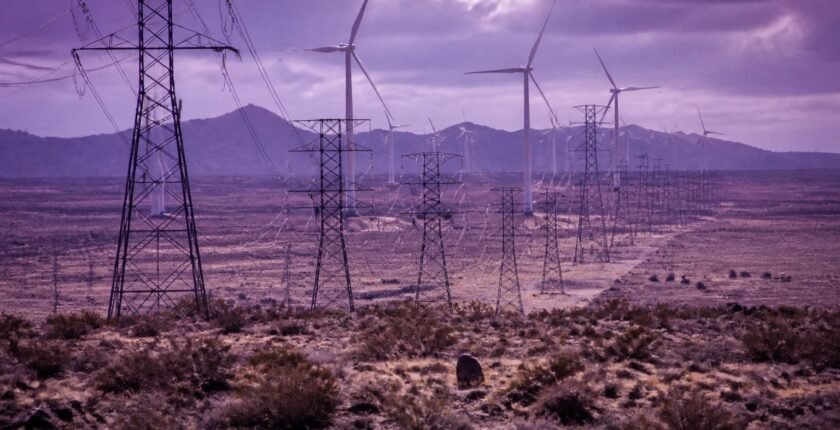
Estimated reading time: 5 minutes · Last updated:
The SunZia wind farm in central New Mexico began delivering power this year after roughly 20 years of planning and legal fights. The project pairs about 900 turbines with a roughly 550-mile transmission line that now carries electricity to customers in Arizona and California, powering over one million homes. Delays came from state and federal permitting conflicts, legal challenges from tribal and environmental groups, and a long period when investors saw little market demand for such large-scale transmission. Pattern Energy led the final push, arranging roughly $11 billion of financing and a reworked route that removed a key military obstacle, as first reported by Vox.
we really didn’t have the market need for it.
Hunter Armistead, Pattern Energy CEO
Key takeaways
- Scale: SunZia comprises about 900 turbines linked to a roughly 550-mile high-voltage transmission line.
- Reach: The project now supplies power to over one million homes across the Southwest, including customers in Arizona and California.
- Timescale and cost: SunZia took about 20 years to build and closed roughly $11 billion in financing before construction proceeded.
- Emissions impact: Pattern Energy says the project will prevent about 9 million metric tons of CO2 by next summer.
Table of contents
Why SunZia stalled for two decades
SunZia’s long delay was not a single failure but a stack of technical, legal and financial obstacles. Early in its life the project could not compete for capital because U.S. electricity demand had been essentially flat; developers could not sell the large amounts of long-duration transmission capacity the build required. On the regulatory side, the proposal bounced between state and federal reviews, and a 2018 state decision forced a major reroute in New Mexico.
The project also hit a uniquely hard constraint: access through the White Sands Missile Range required buried line segments and special coordination with the Department of Defense. That raised both cost and complexity. Meanwhile, lawsuits and tribal objections over cultural and ecological impacts were filed in multiple jurisdictions and in some cases remain active even after turbines went live. Those overlapping frontiers—finance, permitting and litigation—kept SunZia on hold until a handful of technical and capital fixes came together.
How Pattern Energy closed the gap
Pattern Energy took charge of the transmission portion in 2022 and pushed a series of practical changes that made construction feasible. The company pursued a revised federal permit that avoided the missile range footprint in key places and rerouted lines to run next to existing infrastructure where possible. That cut both permitting friction and ecological footprint in some stretches.
Crucially, Pattern’s team assembled roughly $11 billion in financing from institutional investors and pension funds, a package the project lacked in earlier years. With that capital in place, the developer moved from permitting to construction quickly by the standards of interstate transmission lines. The combination of a reworked route plus committed financing is what allowed crews to install about 900 turbines and energize the roughly 550-mile corridor.
Conservation, compromise and the remaining fights
SunZia’s builders sought to reduce wildlife and cultural harm through reroutes, visual markers and bird diverters on the line. Conservation groups such as the National Audubon Society describe Pattern’s engagement as more collaborative than earlier developers, and regulators in New Mexico ultimately approved the revised route. Those mitigation steps addressed concerns that the original plan threatened congested migratory flyways.
Yet not every community accepted those trade-offs. In Arizona, opponents including local environmentalists and tribal plaintiffs continue litigation over impacts in the San Pedro Valley and sacred lands. Those lawsuits, brought by the Tohono O’odham Nation and the San Carlos Apache Tribe among others, remain active. The SunZia case therefore illustrates both how mitigation can unlock approvals and how unresolved legal claims can persist after construction begins.
What SunZia means for future megaprojects
SunZia is now cited as a possible model for building large renewable corridors: if developers pair early, tangible mitigation with finance and smarter routing, some of the familiar delays can be shortened. The project’s arrival also reflects a broader market shift—U.S. electricity demand prospects and utility planning now make large transfers of renewable energy more bankable than they were in the 2000s.
Policymakers have pointed to the SunZia saga when discussing permitting reforms that would better coordinate federal and state reviews for interstate lines. Still, the mixed record here—approvals won in some states, ongoing suits in others—shows that legal and cultural disputes will continue to shape what projects move forward and how long they take to reach operation.
| Item | Figure | Source |
|---|---|---|
| Turbines installed | about 900 | Pattern Energy |
| Transmission length | roughly 550 miles | Pattern Energy |
| Homes served | over one million | Pattern Energy |
| Financing raised | $11 billion | Utility Dive reporting cited by Pattern Energy |
| Estimated CO2 avoided | about 9 million metric tons (by next summer) | Pattern Energy |
Outlook: two paths for large transmission projects
The case for
- If developers combine early wildlife mitigations, route-sharing with existing lines and committed institutional financing, permitting times can compress and projects can reach construction faster.
- Federal coordination or permitting reform that synchronises state reviews could reduce hold-ups that have blocked interstate lines for years.
The case against
- Persistent tribal and environmental litigation can keep disputes alive after construction starts, adding legal costs and reputational risk to developers.
- Even with capital available, difficult corridors—military ranges, protected landscapes—still require expensive engineering solutions that raise project costs.
What to be careful about
- Ongoing lawsuits by tribal nations and environmental groups could force operational changes or new mitigation requirements and raise costs.
- Route segments that run through sensitive habitat continue to expose owners to litigation and regulatory scrutiny, which may delay or limit future expansions.
- Dependence on large institutional finance creates exposure to shifts in investor appetite or interest-rate moves that could affect refinancing or future projects.
The bottom line
SunZia’s activation shows how a multi-decade infrastructure effort can succeed when technical fixes, mitigation and committed capital align. The project’s roughly 900 turbines and the roughly 550-mile line supply over one million homes today, but litigation in parts of Arizona and unresolved community concerns show the limits of engineering alone. For developers and policymakers the lesson is practical: early, concrete mitigation and routing choices matter, and without capital that reflects current demand, even large permits can sit idle. Whether SunZia becomes a straightforward blueprint depends on whether its compromises scale to other contested corridors.
What to watch
- Watch for court rulings in the pending lawsuits brought by the Tohono O’odham Nation and the San Carlos Apache Tribe; no date has been set.
- Watch for permitting and construction milestones for the 280-mile Southline Transmission Project; no date has been set.
Frequently asked questions
How large is SunZia and what infrastructure carries its power?
SunZia pairs about 900 turbines with a roughly 550-mile high-voltage transmission line that moves electricity from central New Mexico to customers in Arizona and California.
Why did the project take around 20 years to complete?
Delays came from a mix of problems: state and federal permitting conflicts, the need to reroute around the White Sands Missile Range, multi-jurisdictional lawsuits, and a long period when investors saw little market demand for such large transfers of renewable power.
Who paid for the final build-out?
Pattern Energy arranged approximately $11 billion in financing from international banks, large pension funds, and investors focused on renewable energy to close the capital gap that had stalled earlier phases.
Related reading