
Blog
Innovations could cut gigawatt-scale solar costs 22%
Estimated reading time: 5 minutes · Last updated:
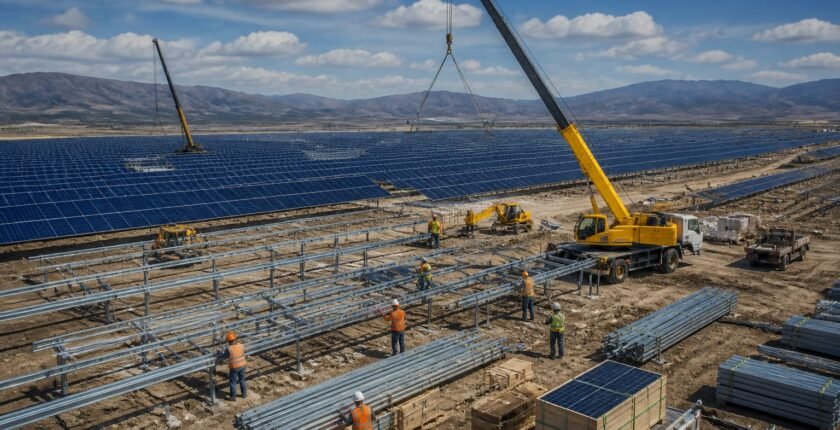
As first reported by pv magazine Global, Lightsource bp's NextGen Solar Programme found that combining four construction innovations could cut direct installation costs for gigawatt-scale solar farms by around 22% and shorten installation time by up to 30%. The UK-headquartered IPP assessed automated foundation piling, a steel frameless panel concept, press-fit bolt-free module installation and on-site pre-assembly. Lightsource bp says automated piling rigs can shave up to 12.5% from installation time and that trials are planned in Australia and the United States, with initial results targeted within the next 18 months. The company intends the combined approach for large projects from 2028 onwards.
It remains at the development stage but is expected to become relevant to major projects over the next three years.
Chris Buckland, Global Technical Director, Lightsource bp
Key takeaways
- Cost and time headline: Lightsource bp's NextGen Solar Programme found the four innovations combined could reduce direct installation costs by around 22% and installation time by up to 30%.
- Automated piling impact: Automated piling rigs using GPS precision can reduce installation time by up to 12.5%, Lightsource bp says.
- Bolt-free modules: A press-fit bolt-free module installation has potential to reduce installation time by up to 30% when combined with automated piling and a new module design, the IPP's analysis states.
- Validation plan: Lightsource bp plans trials in Australia and the United States and is targeting initial results within the next 18 months to verify supplier data points and bankability.
Table of contents
What Lightsource bp tested and the headline findings
Lightsource bp's NextGen Solar Programme ran an initial investigation of construction techniques aimed at reducing the cost and duration of gigawatt-scale photovoltaic projects. The IPP analysed four broad areas—automated foundation piling, a steel-based frameless panel approach, press-fit bolt-free module mounting and on-site pre-assembly—to see how they interact on very large sites. The modelling reported that, when combined, the four measures reduce direct installation costs by around 22% and can cut installation time by up to 30% compared with current standard practice.
The study is presented as an investigation phase: Lightsource bp modelled offerings sourced from China, Europe and Northern America with a focus on automation and novel installation methods. The firm says the combination is intended for large-scale PV developments from 2028 onwards and that real-world trials will follow to check supplier claims and support bankability.
How each construction innovation affects time, cost and safety
Automated piling replaces manual pile driving with GPS-guided rigs; Lightsource bp's analysis assigns up to a 12.5% installation-time saving to that measure alone, and highlights improved consistency and a potential reduction in site injury risk. The press-fit bolt-free module installation is described as a way to remove clamps and bolts so panels click into position, and the IPP estimates it can deliver large time savings—up to 30% in combination with automated piling and a new module design.
The modelling also explored swapping aluminium panel frames for steel in a frameless panel design and using on-site pre-assembly to shorten field work. Lightsource bp notes cost assessments for the steel option are withheld for confidentiality, so the study shows the direction of savings but stops short of publishing detailed cost breakdowns for every component.
Trials, bankability and the barriers that remain
Moving from modelling to construction is central to Lightsource bp's plan. The firm says it will run trials in Australia and the United States to validate supplier data points, test robotic module placement and verify advanced cable harnessing solutions; initial results are targeted within the next 18 months. Those trials are intended to demonstrate repeatable savings and to provide the evidence lenders require to accept the new methods on large projects.
At the same time, the programme faces three practical obstacles disclosed in the investigation: supplier claims must be validated on live sites; some cost details remain confidential; and integration of multiple novel systems—piling rigs, module fittings, frame materials and pre-assembly logistics—must be proven across different geographies. Until trials publish data, the 22% figure and the time savings remain modelled outcomes rather than confirmed project results.
| Innovation | Time impact (reported) | Cost impact (reported) | Status (Lightsource bp) |
|---|---|---|---|
| Automated foundation piling | Up to 12.5% time saving | Modelled savings; no per-component breakdown published | Under trial/validation |
| Press-fit bolt-free module installation | Part of up to 30% time saving when combined with other measures | Potential balance-of-system savings modelled | Under trial/validation |
| Steel frameless panel design | Contributes to overall time reduction when paired with bolt-free modules | Cost assessments withheld for confidentiality | Investigated; cost data restricted |
| On-site pre-assembly | Part of aggregate up to 30% time saving | Included in combined installation-cost reduction | Planned for real-world testing |
Case for and against rapid adoption
The case for
- Automation and simplified module fittings mechanically reduce on-site labour hours, which directly lowers balance-of-system costs and can improve worker safety, supporting the 22% cost-reduction case.
- Real-world trials in Australia and the United States, targeted to report initial results within the next 18 months, give a clear route to the lender evidence needed to make the methods bankable for gigawatt projects from 2028 onwards.
The case against
- Key cost inputs are confidential for some components, notably the steel frameless option, which prevents independent verification of the modelled cost reductions.
- The savings depend on multiple innovations working together; validation must show the same outcomes across soil types, regulatory regimes and supply chains before large developers and lenders will accept the approach.
What to be careful about
- Supplier performance claims used in the modelling have not yet been validated on active projects and may not hold under field conditions.
- Confidential cost data for the steel frameless design prevents third-party scrutiny of the component-level economics.
- Integration risks: combining automated piling, new module fittings, frame changes and pre-assembly could introduce coordination or compatibility issues that erode modelled savings.
The bottom line
Lightsource bp's NextGen Solar Programme presents a clear engineering route to lower the direct installation cost and shorten build schedules for gigawatt-scale solar, anchored on automation and simplified module handling. The headline figures—around 22% cost reduction and up to 30% faster installation—come from modelling across international supplier offerings, not yet from completed projects. The planned trials in Australia and the United States are the critical next step: they must validate supplier performance, reveal full component costs and demonstrate repeatability before lenders and major developers will treat these methods as standard practice from 2028.
What to watch
- Watch for Lightsource bp's trial reports from Australia and the United States; initial results are targeted within the next 18 months (no exact date set).
- Watch for the first projects to adopt the combined construction approach in 2028, the year Lightsource bp intends the method for large-scale PV development.
- Watch for published validation of supplier data points and bankability evidence after the planned trials; no exact publication date has been set.
Frequently asked questions
Which four construction innovations did Lightsource bp evaluate?
Lightsource bp's NextGen Solar Programme modelled automated foundation piling, a steel frameless panel design, press-fit bolt-free module installation and on-site pre-assembly; the combined package is the basis for the roughly 22% direct installation cost reduction cited.
How certain are the 22% cost and up to 30% time savings?
They are modelled outcomes from the investigation phase; Lightsource bp says the figures come from assessing offerings across China, Europe and Northern America and plans trials in Australia and the United States to validate supplier data and bankability.
When will the trials report and when could projects adopt these methods?
Lightsource bp targets initial trial results within the next 18 months and intends the combined approach for large-scale PV development from 2028 onwards, subject to successful validation.
Related reading