
Blog
Croatia Wind Farms Add 72 MW, Expected 203 GWh a Year
Estimated reading time: 6 minutes · Last updated:
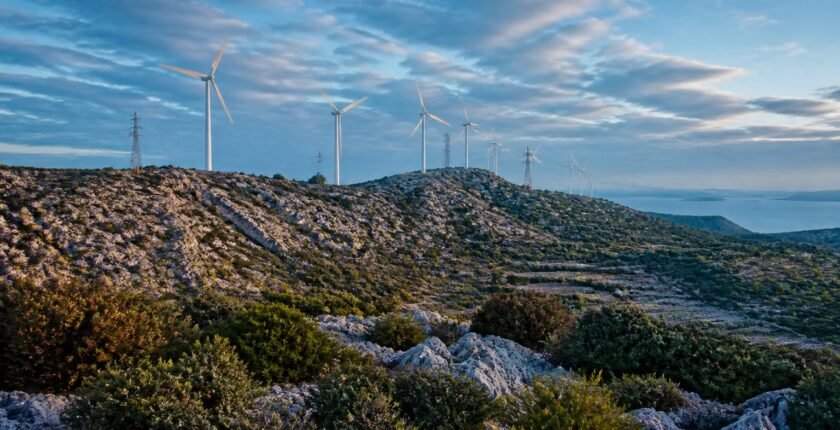
Two Croatia wind farms in the Dalmatian hinterland have entered commercial operation. Together they add 72 megawatts of onshore capacity and are expected to produce about 203 gigawatt hours of electricity a year. Opor, in the Split Dalmatia region, runs six turbines totalling 27 MW. Boraja II, in Šibenik Knin county, runs ten for 45 MW. Every machine is a 4.5 MW Nordex unit. The developer, Acciona Energia, announced commissioning and the start of commercial operations for both in late October 2026. Power from both sites now reaches the national grid through Croatia's energy market operator. The output figure is a projection rather than a measured year, and the limestone foundations under the towers have not yet been through a full season of weather.
Key takeaways
- Two farms, one week: Opor (27 MW, six turbines) and Boraja II (45 MW, ten turbines) both began commercial operation in Croatia in late October 2026.
- Expected output: Acciona Energia expects the 72 MW pair to generate around 203 GWh a year, which implies a capacity factor of roughly 32 percent.
- Same hardware: All 16 machines are 4.5 MW Nordex turbines on towers of roughly 344 feet, hauled in sections up hill roads built for farm traffic.
- Unproven ground: The towers stand on fissured karst limestone, and Hugo Rojas notes the foundations have not yet faced a full winter and summer.
Table of contents
- Key takeaways
- What 203 GWh a Year Means for 72 MW of Turbines
- Why the Dalmatian Karst Finally Drew Turbines
- Building on a Limestone Ridge Meant Narrow Roads and Deep Foundations
- Small Onshore Builds Are How Croatia's Wind Fleet Grows
- What could help or hold back these farms
- What to be careful about
- Frequently asked questions
What 203 GWh a Year Means for 72 MW of Turbines
A gigawatt hour is one million kilowatt hours, the unit utilities use to measure electricity delivered over time. Acciona Energia puts the combined annual output of Opor and Boraja II at around 203 GWh. Hugo Rojas, an engineer and editor at Energies Media, wrote that the estimate rests on wind data measured at the two sites, not on a marketing target.
Set against the nameplate figure, the projection is easy to test. If 72 MW ran flat out for every one of the 8,760 hours in a year, it would produce about 631 GWh. An expected 203 GWh therefore implies a capacity factor of roughly 32 percent. Capacity factor is the share of that theoretical maximum a plant actually delivers. Split evenly, each of the 16 turbines would contribute about 12.7 GWh a year.
Rojas framed the output in household terms. By his reckoning, the two farms could supply a year's worth of power for tens of thousands of homes, which is a noticeable share for a national grid the size of Croatia's. He gave no precise household count, and neither did the developer.
Why the Dalmatian Karst Finally Drew Turbines
Both sites lie in rough, thinly settled country behind Split and Šibenik. Here the Adriatic pushes strong, steady coastal wind up over the karst. Karst is limestone terrain worn into cracks, sinkholes and bare rock, and it leaves little soil for farming. Rojas argues that this lack of agricultural value is exactly what makes the ground useful for wind.
His case is about land use more than wind speed. The ridges are mostly grazing land and abandoned terraces. They sit away from the tourist strip along the coast, where complaints about how turbines look often stop projects before construction begins. A vineyard or a beach town would fight a wind farm. A hillside of sheep pasture rarely does.
That lack of local resistance, Rojas wrote, allowed both farms to reach commercial operation on an ordinary schedule instead of spending years in appeals. The terrain still exacted a price, though. It was paid in construction difficulty rather than in permitting delays.
Building on a Limestone Ridge Meant Narrow Roads and Deep Foundations
Each tower rises roughly 344 feet. Every section had to arrive by truck on narrow roads designed for tractors, not turbine convoys. Rojas described switchbacks with no straight stretch longer than a few hundred feet. Moving a blade or a tower segment around those bends is a logistics problem that, in his words, rarely appears in a press release.
The foundations posed a second problem. Karst limestone is full of fissures, so it does not carry load as predictably as solid inland rock. Rojas wrote that comparable ridge projects in the Balkans have needed deeper drilling and more concrete than a standard site would. He did not give figures for Opor or Boraja II.
Both farms use the same machine, the 4.5 MW Nordex turbine. The numbers line up: six units account for Opor's 27 MW and ten account for Boraja II's 45 MW. Standardising on a single model across two counties keeps spare parts and servicing simpler for one operator.
Small Onshore Builds Are How Croatia's Wind Fleet Grows
The two farms sit in different counties, yet they were connected to the grid within days of each other. Rojas reads that timing as a sign the projects were built in parallel rather than one after another. In his view, that points to developers moving Croatian wind capacity through the pipeline more aggressively.
Croatia is not a wind heavyweight next to countries on the Baltic or North Sea, and 72 MW will not change that. Rojas argues the country's real pattern is a steady run of modest onshore builds rather than one large offshore array. He compares it with the way wind additions accumulate across several US states.
He also sets out the limit of that approach. Karst ground and tight coastal roads restrict how large any single ridge project can grow. Growth therefore depends on repeating projects of this size across many hillsides, not on making one site bigger. The 203 GWh estimate also assumes typical winds, so weaker years would lower output.
| Wind farm | Location | Turbines | Turbine model | Capacity |
|---|---|---|---|---|
| Opor | Split Dalmatia region | 6 | Nordex 4.5 MW | 27 MW |
| Boraja II | Šibenik Knin county | 10 | Nordex 4.5 MW | 45 MW |
| Combined | Two counties | 16 | Nordex 4.5 MW | 72 MW, about 203 GWh a year expected |
What could help or hold back these farms
The case for
- The output estimate is based on wind measured at both sites, not on a generic target.
- Grazing land and abandoned terraces drew little local opposition, which allowed an ordinary construction schedule.
- A single turbine model across both farms simplifies maintenance and spare parts.
The case against
- Annual output will swing with wind conditions, so 203 GWh may not be reached in a weak year.
- Fissured karst foundations have not yet been through a full winter and summer.
- Narrow hill roads and difficult rock cap how large any single ridge project can grow.
What to be careful about
- Production could fall short of the 203 GWh projection in below-average wind years.
- Foundation maintenance costs on fissured karst limestone are still unknown.
- Road access built for farm traffic complicates any future replacement of blades or tower sections.
The bottom line
Opor and Boraja II are small next to a gigawatt-scale offshore array. What they show is how wind power is being built in Croatia: on cheap, quiet ridges where few people object, using standard 4.5 MW Nordex machines, with two projects built at the same time. The 72 MW and the roughly 32 percent capacity factor implied by the 203 GWh estimate are reasonable on paper. Two things remain untested. One is whether real wind years match the measured resource. The other is whether foundations sunk into fissured limestone stay cheap to maintain. The first full year of operation will answer both, and it will show whether repeating ridge projects like these can add up to a meaningful national total.
What to watch
- Watch how the karst foundations hold up through the coming winter storms, the first the towers will face; no inspection results have been scheduled for publication.
- Watch for measured output once the farms complete their first full year, which by arithmetic on the October 2026 commissioning would be October 2027, and compare it with the 203 GWh estimate.
- Watch for further onshore wind projects in the Dalmatian interior that follow the same small-ridge pattern; no specific projects or dates have been named.
Frequently asked questions
Who built the Opor and Boraja II wind farms in Croatia?
The developer is Acciona Energia, which announced commissioning and the start of commercial operations for both farms in late October 2026. Opor has 27 MW and Boraja II has 45 MW, all from Nordex turbines.
How many homes can 203 GWh of wind power supply?
By Hugo Rojas's estimate, 203 GWh a year is enough to meet what tens of thousands of households consume at home. Neither he nor the developer gave an exact number.
Why is karst limestone a problem for wind turbine foundations?
Karst is limestone riddled with fissures, so it bears load less predictably than solid rock. Rojas wrote that similar Balkan ridge projects have needed deeper drilling and more concrete, and the foundations under these 344-foot towers have not yet been through a full year of weather.
What capacity factor do Croatia's new wind farms imply?
An expected 203 GWh a year from 72 MW works out to roughly 32 percent of the theoretical maximum of about 631 GWh. The real figure will depend on whether wind years come in above or below average.
Related reading