
Blog
Lewis River Fish Passage Reopens 117 Miles to Salmon
Estimated reading time: 6 minutes · Last updated:
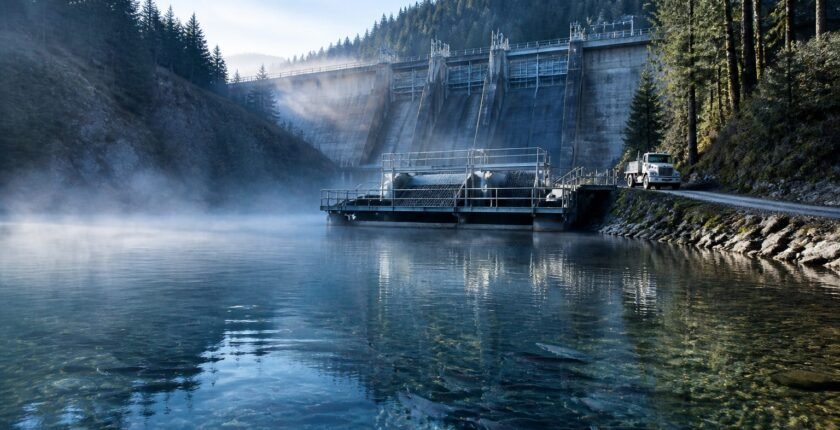
Salmon and steelhead on Washington's Lewis River now get past three hydroelectric dams by truck. PacifiCorp's Lewis River fish passage network on the Swift, Merwin and Yale dams traps adult fish at a collection facility and drives them above Swift Dam to spawn. A floating collector in Swift Reservoir gathers young fish and carries them back down to the lower river. The programme has reopened 117 miles of historic upstream habitat. Construction began in April 2011, and the system was fully running in 2012. The 510-megawatt hydropower complex stayed in place throughout. That matters because Washington leans on its dams for clean power, and tearing them out would open a gap in supply.
Key takeaways
- 117 miles reopened: PacifiCorp's passage network across the Swift, Merwin and Yale dams has restored salmon and steelhead access to 117 miles of historic upstream habitat on Washington's Lewis River.
- Adults go up by road: At the Merwin Upstream Collection Facility, water currents steer returning adults into ladder traps, and the fish are sorted and trucked to release points above Swift Dam.
- Juveniles come down by road: Swift Reservoir's Floating Surface Collector recreates downstream flow, nets guide young fish into it, and they are then trucked to the lower river.
- Dams stay, power stays: Work on the 510-megawatt system began in April 2011 and was complete in 2012, keeping hydropower online as Washington pursues a 100% carbon-free grid by 2045.
Table of contents
- Key takeaways
- How Adult Salmon Ride a Truck Past Three Dams
- How the Floating Surface Collector Gathers Young Fish
- What a Century of Dam Building Did to Northwest Rivers
- Why Washington Is Fixing Dams Instead of Removing Them
- Can collection and trucking restore Lewis River fish runs?
- What to be careful about
- Frequently asked questions
How Adult Salmon Ride a Truck Past Three Dams
The upstream half of the system begins at the Merwin Upstream Collection Facility. A collection facility is a structure built to gather migrating fish in one place so they can be moved around an obstacle. At Merwin, a steady flow of water draws returning adults away from the turbines and into ladder traps. There they are held instead of being left to search for a route that no longer exists.
Crews then sort the catch, load the fish onto trucks and drive them to water above Swift Dam. The adults are released there to spawn without further help, in stretches of river that had been out of their reach. In effect, the trucks replace a climb that the concrete made impossible.
Moving fish by road lets a single collection point serve a migration route that crosses three dams. The approach treats the Swift, Merwin and Yale dams as one barrier to be bypassed rather than three separate engineering problems. Each fish makes one trip by truck instead of tackling a series of structures on its own.
How the Floating Surface Collector Gathers Young Fish
Juvenile salmon heading out to sea face the same barriers in reverse. Swift Reservoir replaced a moving river with still water, so young fish lose the current that would otherwise carry them downstream. The Floating Surface Collector in Swift Reservoir addresses this by generating an artificial flow that mimics the pull of a river heading downhill.
Nets steer the juveniles toward the floating structure, and the fish are collected inside it. They are then trucked to the lower river and released below the dams. That completes a journey the reservoir would otherwise have stalled.
Both facilities were still moving migrating fish in October 2026, about 14 years after the network became fully operational in 2012. Together they run a two-way transport programme for native salmon and steelhead. Adults are carried up to spawning water and their offspring are carried back down. The combined result is the 117 miles of historic habitat now open to fish again.
What a Century of Dam Building Did to Northwest Rivers
Hydropower drove much of American industrial growth in the twentieth century. By the 1940s it supplied up to 40% of all electricity generated in the United States. That gave cities and factories cheap, plentiful power and steadier grids. Federal and private builders turned free-flowing rivers into dependable generating corridors, and their output fed the post-war boom.
Washington leaned on hydropower especially heavily. The state produces more than 25% of the country's hydroelectric power, and river dams supply upwards of half the electricity its own residents and businesses use. That reliance has kept its power rates low.
The rivers paid the cost. Fast, cold Pacific Northwest streams became slow, warm reservoirs, and the dams cut off the routes migrating fish used to reach spawning grounds. Habitat access shrank over the past century, and wild salmon and steelhead numbers have fallen by more than 90% in several basins. That decline is the problem the Lewis River work was built to address.
Why Washington Is Fixing Dams Instead of Removing Them
Demolition can look like the most direct way to bring fish back. Anke Maree, a staff writer at Energies Media, argues it is not realistic in Washington, where large dams anchor the power supply. Taking them out, she writes, would leave a shortfall that intermittent generators could not cover straight away. Intermittent generators are sources whose output rises and falls with conditions.
State law sharpens the point. Washington's Clean Energy Transformation Act requires a 100% carbon-free electric grid by 2045. Maree's case is that without the big hydroelectric dams, utilities would have to turn to fossil fuels to meet peak demand, which would push that target further out of reach.
The Lewis River system shows the alternative in practice. The 510-megawatt complex in southwest Washington kept generating while passage was added around it, with construction starting in April 2011. Maree presents it as a model for other ageing hydropower fleets. Still, the 117-mile figure measures habitat reopened, not fish recovered. How many salmon and steelhead are actually returning is a separate question the habitat number does not answer.
| Facility | Fish served | How fish are guided | Where fish are trucked |
|---|---|---|---|
| Merwin Upstream Collection Facility | Returning adult salmon and steelhead | Steady water currents lead them into ladder traps | Above Swift Dam, to spawn |
| Floating Surface Collector, Swift Reservoir | Outbound juvenile salmon | Simulated downstream currents and nets | The lower river, below the dams |
Can collection and trucking restore Lewis River fish runs?
The case for
- Both facilities were still operating in October 2026, about 14 years after full operation began in 2012.
- The network serves adults and juveniles alike, so fish can complete their whole life cycle around the three dams.
- The 510-megawatt complex keeps generating carbon-free power that Washington needs for its 2045 target.
The case against
- Truck-based passage only works while a collection and haul operation is staffed and funded indefinitely.
- The 117-mile figure describes reopened habitat, not counted returns of salmon and steelhead.
- Basins across the region have lost more than 90% of wild salmon and steelhead, a deep hole for any single passage system to climb out of.
What to be careful about
- The route depends entirely on continuous operation of two collection facilities and a trucking programme; any interruption leaves fish blocked by the dams.
- No figures on how many adults return or how many juveniles are collected accompany the 117-mile habitat figure, so biological success cannot yet be judged.
- Maree's claim that the Lewis River system is a framework for other ageing dams rests on one river system.
The bottom line
The Lewis River fish passage is a working answer to a hard trade-off. PacifiCorp kept a 510-megawatt hydropower complex running and built a route around it. Adults heading upstream go through ladder traps and onto trucks, and juveniles heading downstream go through a floating collector and onto trucks. The result is 117 miles of historic habitat back within reach of salmon and steelhead. The open question is what that habitat yields. Reopened river miles are a precondition for recovery, not proof of it. The real test is whether returns rise in a region where several basins have lost more than 90% of their wild fish. With a 2045 carbon-free deadline, Washington needs both its dams and its rivers.
What to watch
- Watch for published counts of adult salmon and steelhead using the 117 miles of reopened habitat above Swift Dam; no date has been set for such figures.
- Watch Washington's progress toward the 2045 deadline under the Clean Energy Transformation Act, where Maree argues large dams are needed to meet peak demand without fossil fuels.
- Watch whether other ageing hydropower operators adopt collection-and-trucking passage modelled on the Lewis River system; no date has been set.
Frequently asked questions
Who runs the Lewis River fish passage program?
PacifiCorp launched the programme on its 510-megawatt Lewis River hydropower system in southwest Washington. It covers the Swift, Merwin and Yale dams as a single passage network.
When did the Lewis River fish passage start operating?
Construction began in April 2011, and the network became fully operational in 2012. Both collection facilities were still transporting fish in October 2026.
Do salmon on the Lewis River climb fish ladders over the dams?
Only partway. At the Merwin Upstream Collection Facility, adults enter ladder traps, but the climb past the dams is done by truck to release points above Swift Dam.
What does Washington's Clean Energy Transformation Act require?
The law requires Washington to reach a 100% carbon-free electric grid by 2045. Hydropower already supplies over half of the state's electricity, which is why dam removal would make the target harder to reach.
Related reading