
Blog
North Africa Green Hydrogen Could Strain Water, Study Finds
Estimated reading time: 6 minutes · Last updated:
North Africa green hydrogen plants built to supply Europe could use far more water than the industry assumes, a study co-authored by Mustafa Gazi finds. The researchers modelled a 1-gigawatt plant in a hot, dry climate. Once purification losses and cooling are counted, they estimate it would draw 35 to 170 litres of water per kilogram of hydrogen. They set that against a nine-litre figure they say the industry quotes. The gap matters for Morocco, Algeria and Egypt, which are lining up as suppliers to a European Union that wants to import 10 million tonnes of renewable hydrogen a year by 2030. The authors also warn that ancient aquifers could be drained and that brine from desalination could harm coastal sea life.
Key takeaways
- Water use: A model built by Mustafa Gazi and his co-author puts a desert hydrogen plant's water draw at 35 to 170 litres per kilogram, against the nine litres the authors say industry cites.
- European demand: The European Union aims to import 10 million tonnes of renewable hydrogen a year by 2030, and Morocco, Algeria and Egypt are positioning themselves to supply it.
- Export plans: Egypt has signed US$40 billion of hydrogen and ammonia agreements for the Suez Canal Economic Zone, and Morocco proposes reserving one million hectares for developers.
- Marine risk: The authors say chemical-laden brine from desalination sinks to the seabed in lagoons, suffocating marine life and damaging fisheries.
- Certification fix: The study proposes a Water Sustainability Index and a brine-harm score, and says projects that exceed local water limits should not qualify as green.
Table of contents
- Key takeaways
- Why the Nine-Litre Figure Counts Only the Chemistry
- How North Africa Is Positioning Itself as Europe's Supplier
- Desalination Shifts the Burden From Aquifers to the Sea
- Should Hydrogen Count as Green If It Drains Local Water?
- What could ease or worsen the water problem
- What to be careful about
- Frequently asked questions
Why the Nine-Litre Figure Counts Only the Chemistry
Green hydrogen is made by electrolysis, a process in which renewable electricity splits water into hydrogen and oxygen. The study's authors say the industry figure of about nine litres per kilogram covers only the water consumed by that reaction. In their view, presenting it as the total a working plant uses is a myth.
To estimate real demand, the lead author, a researcher in materials and environmental science, and co-author Mustafa Gazi gathered engineering and environmental data from around the world. They used it to model a plant covering 10 hectares with 1 gigawatt of capacity in a hot, arid climate. The model tallied water for making hydrogen, for treating supply and for cooling equipment.
Two losses drive the gap. Electrolysers need extremely pure water, and part of the intake is rejected during purification. Cooling systems in desert heat also lose large volumes to evaporation. With both counted, the model gives 35 to 170 litres per kilogram, roughly four to 19 times the industry number.
How North Africa Is Positioning Itself as Europe's Supplier
Demand will come mainly from colder northern countries that lack the sunshine for large solar output. Steel makers and chemical refiners are the main users of the fuel today. The authors add maritime shipping, aviation and long-haul trucking as possible future users. The EU has set a target of 10 million tonnes of imported renewable hydrogen a year by 2030.
Egypt has signed agreements worth US$40 billion with international developers to build green hydrogen and ammonia hubs in the Suez Canal Economic Zone. Morocco proposes reserving one million hectares of land for project developers. Algeria intends to send green hydrogen straight to Europe through the planned SoutH2 Corridor pipeline.
None of the large North African plants exists yet. Dozens of mega-projects have signed memorandums of understanding, are in early development or have reached the pilot stage, and a few pilot facilities already operate. Most commercial-scale production and export infrastructure is due between 2027 and 2035. That leaves time for water findings to shape how the plants are designed.
Desalination Shifts the Burden From Aquifers to the Sea
The authors expect the strain to be worst in North Africa, where regional groundwater is already severely depleted. They also flag that some reserves are ancient and do not refill on human timescales. Pumping them to make export fuel would draw down a fixed stock rather than a renewing supply.
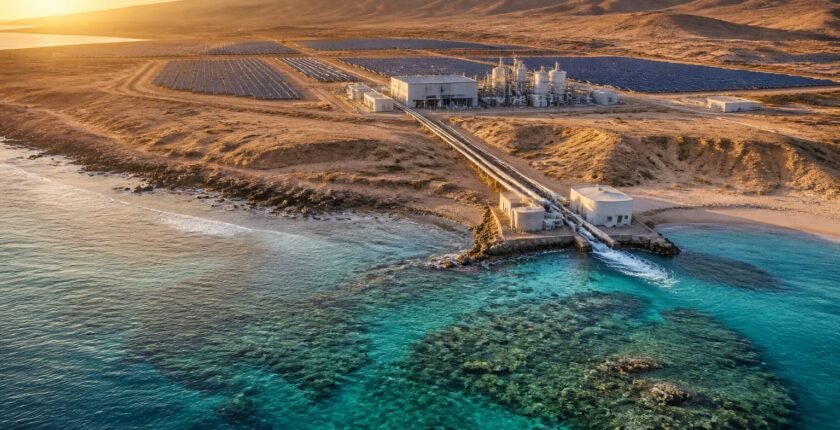
Desalinating seawater is the expected route to fresh water, but it carries costs of its own. Removing salt takes a large amount of energy, which competes with the clean power the plants exist to use. It also leaves brine, a concentrated salty wastewater discharged back into the sea. That brine carries chemicals used to prevent mineral scale on equipment, remove impurities and clean filters.
Brine is denser than seawater. In semi-enclosed coastal waters such as lagoons, it sinks and settles across the seabed. There, the authors say, it suffocates marine organisms and damages local fisheries, so the burden moves from inland aquifers to the coast.
Should Hydrogen Count as Green If It Drains Local Water?
The authors argue that international regulators judge hydrogen almost entirely on greenhouse gas emissions, and treat low-carbon output as sustainable by default. Those rules do not ask whether a project dries out its watershed or pollutes marine habitat. Nor do they ask whether residents keep enough water for drinking and farming.
They call the outcome "green extractivism". Wealthy importing countries take credit for the emission cuts, while the exporting countries absorb the ecological damage and the water stress.
Their remedy is to write water into certification. The study proposes a Water Sustainability Index to judge whether a project's consumption is sustainable, and a score rating how its brine could harm marine life. Under their proposal, a project that uses more water than its local environment can safely spare would lose the green label.
The authors also want plants to partner with nearby cities and reuse treated sewage, purifying it further for electrolysis. That would ease competition with households, farms and ecosystems for fresh water. It would also avoid desalination brine altogether.
| Country | Plan | Stated scale | Route or location |
|---|---|---|---|
| Egypt | Hydrogen and ammonia hubs with international developers | US$40 billion in agreements | Suez Canal Economic Zone |
| Morocco | Land set aside for project developers | One million hectares proposed | Not specified |
| Algeria | Direct pipeline exports to Europe | Not stated | Planned SoutH2 Corridor |
What could ease or worsen the water problem
The case for
- The large plants are not built yet, so cooling, water sourcing and brine handling can still be designed in.
- Reusing treated city sewage would avoid both competition for fresh water and brine discharges.
- A Water Sustainability Index and a brine-harm score would give certifiers a measurable test rather than a carbon-only one.
The case against
- The model's range of 35 to 170 litres per kilogram is wide, leaving real demand uncertain until plants operate.
- North African groundwater is already severely depleted, and some reserves do not recharge on human timescales.
- Desalination adds energy demand and produces chemical-laden brine that harms marine life in lagoons.
- Current certification focuses almost entirely on emissions, so water-intensive projects can still qualify as green.
What to be careful about
- Export plants drawing on ancient groundwater could deplete reserves that will not refill within human timescales.
- Brine discharged into semi-enclosed lagoons could suffocate seabed life and damage local fisheries.
- Hydrogen plants could compete with communities and farms for drinking and irrigation water in already stressed regions.
- Carbon-only certification rules could label projects green even if they exceed what local ecosystems can spare.
The bottom line
The study does not reject green hydrogen. Its authors call the shift away from fossil fuels necessary, but they argue the accounting behind it is incomplete. Their case rests on a modelled 1-gigawatt plant, not on measurements from North African facilities that do not yet exist. The width of the 35 to 170 litre range shows how much depends on design choices. That is also the opening. With most export capacity still years from completion, Egypt, Morocco and Algeria can choose between depleted aquifers, energy-hungry desalination and treated sewage. Whether certifiers add water and brine tests before 2030 will decide if the green label covers the places that produce the fuel.
What to watch
- Watch the run-up to 2030, the year by which the European Union aims to import 10 million tonnes of renewable hydrogen a year, for whether certification rules start to include water use.
- Large-scale North African production and export infrastructure is scheduled to come online from 2027. Watch whether the first plants rely on desalination, groundwater or treated sewage.
- Watch for progress on Algeria's planned SoutH2 Corridor pipeline to Europe. No completion date is given.
Frequently asked questions
Why do green hydrogen plants in deserts need extra water?
Mustafa Gazi and his co-author found that cooling systems in hot, dry climates lose large amounts of water to evaporation. Purification also rejects part of the intake. Together these push modelled use to 35 to 170 litres per kilogram.
When will North Africa start exporting green hydrogen to Europe?
Only a few pilot facilities operate today. Most large-scale production and export infrastructure is scheduled between 2027 and 2035, as the EU works towards importing 10 million tonnes a year by 2030.
Could treated sewage replace seawater for hydrogen production?
The study's authors recommend that plants partner with nearby cities to reuse treated sewage, purified further for electrolysis. They say this would avoid competing for fresh water and avoid releasing desalination brine into the sea.
What is the Water Sustainability Index for hydrogen?
It is a measure the study proposes to test whether a project's water use is sustainable, alongside a score for how its brine could harm marine life. The authors want certification bodies to use both before labelling hydrogen green.
Related reading