
Blog
Lost Hills Solar Covers 80% of Chevron Oil Field Power
Estimated reading time: 6 minutes · Last updated:
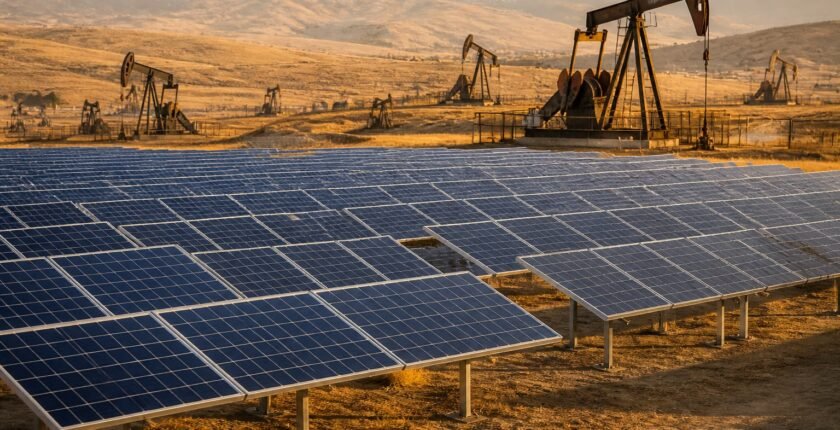
At Chevron's Lost Hills oil field in Kern County, California, about 65,000 solar panels supply roughly 80 percent of the electricity the operation uses in a year. That power runs the beam pumps, pipelines and steam generators that bring heavy crude to the surface. Before the array, the field bought that power from a regional grid built largely on natural gas. The Lost Hills solar array does not reduce the oil coming out of the ground. It trims the emissions and the power bill of extracting it, while the barrels are burned exactly as before. Chevron expects more than 1.4 billion kilowatt hours from the project across a potential 20-year agreement. Critics, including Shaye Wolf, say that solves the wrong problem.
We expect that the project will provide more than 1.4 billion kilowatt hours of solar energy over the potential 20 year term of the agreement.
Chevron spokesperson
Key takeaways
- Most of the field runs on sunlight: About 65,000 solar panels at Chevron's Lost Hills oil field in Kern County meet roughly 80 percent of the field's annual energy demand.
- Chevron's lifetime estimate: A Chevron spokesperson said the project is expected to provide more than 1.4 billion kilowatt hours over a potential 20-year agreement, an average of more than about 70 million kilowatt hours a year.
- Power used where it is made: Chevron feeds the array's output directly into the field's pumps and pipelines instead of buying gas-heavy grid electricity, matching steady daytime demand to midday solar peaks.
- Critics point to the oil: Shaye Wolf argued that the oil industry must move away from fossil fuels, because solar pumps cut extraction emissions but leave the far larger emissions from burning the crude untouched.
Table of contents
- Key takeaways
- Why an Oil Field Is a Natural Customer for Solar
- Where the Lost Hills Array Sits and How Much It Covers
- What 1.4 Billion Kilowatt Hours Means Over 20 Years
- Cleaner Pumping Does Not Mean Cleaner Oil
- Solar at Oil Fields Is Turning Ordinary
- What the Lost Hills model does and does not change
- What to be careful about
- Frequently asked questions
Why an Oil Field Is a Natural Customer for Solar
Oil production at Lost Hills depends on electricity as much as on drilling. Beam pumps, the nodding pumpjacks that lift crude from each well, need power without a break. So do the pipelines that move the oil and the steam generators used to warm thick, heavy crude underground so that it flows.
Historically that electricity came from the regional grid, which is built largely on natural gas. Buying it that way is costly, and its price moves with the gas market, leaving the operator exposed to swings it cannot control.
The fit with solar comes down to timing. Demand at the field during daylight is steady and predictable, and solar output peaks around midday. Chevron, the operator, sends the array's output straight into its pumps and pipelines, so the power is generated and consumed on the same site rather than sold into the grid.
Where the Lost Hills Array Sits and How Much It Covers
The panels stand near the junction of Paso Robles Highway and State Route 33, a road locals call Petroleum Highway. Thousands of wells are scattered across the surrounding gold-coloured fields, and the solar rows run in flat, straight lines between pump stations and access roads.
The array meets roughly 80 percent of the field's annual energy demand. Electricity that used to arrive from distant power plants is now produced a few hundred yards from the equipment that draws it. The field's output of barrels has not changed. Only the source of its power has.
Location adds a second argument for building here. Wellheads in the San Joaquin Valley tend to sit far from substations, and adding new grid capacity in that part of California is expensive. Generating power next to the wells avoids part of that cost, which matters for a site whose only customer is itself.
What 1.4 Billion Kilowatt Hours Means Over 20 Years
A Chevron spokesperson gave a lifetime figure for the project, and the word potential in that statement matters. The 20-year term is a possibility under the agreement, not a fixed commitment, so the total depends on how long the arrangement actually runs.
A kilowatt hour is the standard unit on a household electricity bill. Spread evenly over two decades, more than 1.4 billion of them works out to more than about 70 million kilowatt hours a year. Over the full term, that would be enough to supply tens of thousands of homes, yet every unit is earmarked for oil production.
The idea predates this array. Solarmine, a much smaller installation at the nearby Midway Sunset field, went in decades earlier and showed on a tiny scale that panels could help run an oil operation. Lost Hills applies the same concept to a working field that still pumps crude every day.
Cleaner Pumping Does Not Mean Cleaner Oil
The objection to Lost Hills concerns purpose, not engineering. Gustavo Aguirre, who lives near the field, describes nights lit by gas flares: "We see flares from the oil fields that light up the night sky with puffs of bright red and orange flames." Panels standing beside those flares do nothing about what the wells release.
Shaye Wolf, a critic of the project, put the case bluntly: "If the oil industry is serious about a role in the energy transition, it needs to transition away from fossil fuels." Her argument rests on where the emissions fall. Running the pumps on sunlight lowers the carbon cost of extraction, but the much larger share arrives when the crude is burned as fuel, and the array does not touch that.
Air quality near the field is a separate question again. A field with solar-powered pumps can still flare gas, and the communities downwind of its wellheads breathe the same air they did before the panels went up.
Solar at Oil Fields Is Turning Ordinary
Lost Hills is one example of a wider pattern. Operators apply similar reasoning from Gulf Coast platforms to isolated prairie wellheads in Alberta: daytime solar can cost less and prove more dependable than a diesel generator or a new line to the grid.
Chevron has framed the project as part of a broader effort to pair solar with its upstream operations, the exploration and production end of the oil business, wherever the numbers justify it. That framing is about cost and reliability. It says nothing about producing less oil.
This is the tension the project makes plain. Nothing about the panels slows the pumpjacks, and the 20-year horizon suggests the field expects to keep producing for a long time. What has shifted is that renewable power serving fossil fuel extraction no longer looks strange. It looks like routine cost management.
What the Lost Hills model does and does not change
The case for
- Onsite solar replaces grid electricity drawn largely from natural gas, cutting emissions from the pumping stage.
- Steady daytime demand at the field matches midday solar output, so most generation is used directly.
- Generating power at remote San Joaquin Valley wellheads avoids part of the cost of building new grid capacity.
The case against
- Emissions from burning the extracted crude, the far larger share, are untouched by the array.
- Gas flaring near Lost Hills continues, according to resident Gustavo Aguirre.
- Cheaper, more stable power for extraction may support continued production rather than any reduction.
What to be careful about
- The 20-year term Chevron cites is described as potential, so the lifetime output of more than 1.4 billion kilowatt hours is not assured.
- The solar supply covers roughly 80 percent of annual demand, leaving the field still reliant on other power for the remainder.
- Communities near the field gain no change in flaring or downwind air quality from the panels.
The bottom line
Lost Hills shows solar winning on narrow economics. A field with steady daytime demand, remote wellheads and an expensive grid connection is close to an ideal buyer for panels, and Chevron is using about 65,000 of them to cover roughly 80 percent of its yearly power needs there. What the project does not do is change the product. The same crude leaves the field, the flares Gustavo Aguirre describes still burn at night, and the bulk of the emissions arrive later, when the oil is burned. Judged as an energy cost measure, the array works. Judged as a climate measure, it addresses the smaller part of the problem, which is the gap Shaye Wolf points to.
What to watch
- Watch for Chevron to disclose actual yearly output from the Lost Hills array against its expectation of more than 1.4 billion kilowatt hours over the potential 20-year term; no reporting date has been set.
- Watch whether Chevron extends onsite solar to other upstream sites, in line with its stated push to pair solar with production where the economics work; no timetable has been given.
Frequently asked questions
Does solar power make Lost Hills oil cleaner?
Only at the pumping stage. The panels supply roughly 80 percent of the field's yearly electricity, but most of the emissions tied to the crude occur when it is burned, which the array does not affect.
What was Solarmine?
Solarmine was a much smaller solar installation at the Midway Sunset field near Lost Hills, put in decades earlier. It showed that panels could help run an oil operation before Lost Hills scaled the idea up.
How long will the Lost Hills solar deal last?
Chevron describes a potential 20-year agreement, over which it expects more than 1.4 billion kilowatt hours. Because the term is described as potential, the full period is not guaranteed.
Related reading