
Blog
Battery storage boosts West Africa mini-grid rollout
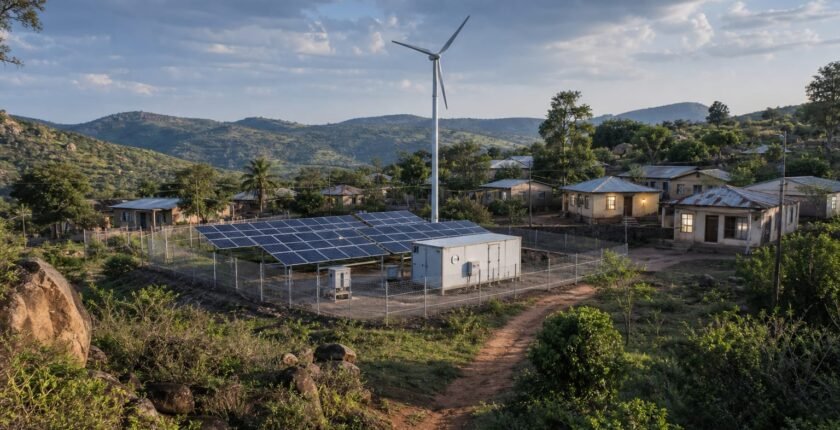
Estimated reading time: 4 minutes · Last updated:
An analysis by the International Renewable Energy Agency (IRENA), as first reported by IRENA, finds that battery storage substantially raises the feasibility and economic case for decentralised mini-grids across Burkina Faso, Mali, Nigeria and Senegal. The study uses the SEAPS framework and an enhanced OnSSET model to compare supply scenarios and introduces a “value of storage” metric to measure batteries’ economic contribution. IRENA estimates a near-term market of 568 MW of solar PV mini-grids with battery storage across the four countries and highlights that storage can deliver about 130 GWh of batteries and nearly USD 25 billion in value in the highest-demand scenario.
Key takeaways
- IRENA estimates a near-term market of 568 MW of solar PV mini-grids with battery storage across Burkina Faso, Mali, Nigeria and Senegal.
- In the highest-demand scenario the analysis finds about 130 GWh of batteries would be required and a nearly USD 25 billion value of storage.
- Western Africa had about 33% of 565 million people without electricity in 2023, concentrated in rural and remote areas.
- The report shows avoided fuel costs from storage can outweigh incremental investment by between two and four times during volatile diesel prices.
Table of contents
Why battery storage changes the mini-grid case in West Africa
Rural and remote communities in Western Africa carry a heavy access gap: about 33% of 565 million people lacked electricity in 2023. Extending central grids to those areas is often uneconomic, which is why decentralised renewable mini-grids are now central to electrification strategies. Battery storage lets a solar-heavy mini-grid serve higher, more reliable demand tiers by shifting generation from daytime peaks to evening hours and by reducing reliance on diesel back-up when the sun is low.
The study models multiple demand tiers and grid-expansion scenarios and finds that pairing batteries with solar PV increases the portion of demand mini-grids can meet economically. That effect is strongest where central grid expansion is constrained or remote, because storage reduces the operating hours and fuel consumption of diesel generators. The material frames this effect around solar PV mini-grids with battery storage as the practical route to universal access in the modeled countries.
How the analysis quantifies the value of storage
The report couples an enhanced OnSSET geospatial model with a mini-grid optimisation tool under IRENA's SEAPS framework to compare systems with and without batteries. It introduces the value of storage metric, defined as the difference in total discounted lifecycle cost between a hybrid solar PV–diesel mini-grid with battery storage and an equivalent system that uses diesel flexibility alone.
Using that metric across scenarios, the modelling produces the headline numbers: a near-term market of 568 MW across the four countries and, in the highest-demand scenario, roughly 130 GWh of batteries and nearly USD 25 billion in value of storage. The analysis also quantifies avoided fuel spending and finds that, at recent diesel-price volatility, avoided fuel costs outweigh incremental battery investment by between two and four times.
Policy, institutional and finance measures to scale storage
IRENA sets out practical recommendations across four areas: integrated electrification planning, geospatial and modelling tools, enabling mini-grid regulation, and innovative finance and de-risking mechanisms. Integrated planning means using geospatial tools to sequence where mini-grids with storage are prioritised relative to central-grid expansion and to set appropriate demand tiers for developers and funders.
On finance, the report argues that structured de-risking—grants for early capital, payment guarantees, and fuel-savings-linked revenue models—can close the gap between incremental battery costs and quantified avoided fuel and operational savings. Strengthening institutional capacity to run SEAPS-style planning and publishing standardised cost and performance assumptions are other concrete steps that would lower investment risk and accelerate deployment.
What could move this either way
The case for
- Battery costs continuing to fall and lenders adopting fuel-savings-backed contracts would improve project IRRs and drive deployment of the estimated 568 MW market.
- Stronger integrated planning using SEAPS and OnSSET can prioritise sites where batteries deliver the highest avoided-fuel value, unlocking portions of the 130 GWh battery need in a cost-effective order.
The case against
- Weak regulatory frameworks for mini-grids, or policies that prioritise rapid central-grid expansion without coordination, could strand mini-grid investments and reduce the practical market for batteries.
- Limited concessional finance and high perceived developer risk would keep incremental battery costs from being recovered, undermining projects where modelled avoided fuel savings are necessary to reach viability.
What to be careful about
- Diesel-price volatility: while storage hedges fuel shocks, projects remain sensitive to short-term fuel price swings that affect payback assumptions.
- Financing gap: incremental battery capital needs may exceed available concessional or commercial funding without tailored de-risking instruments.
- Institutional capacity: countries that cannot operationalise SEAPS-style planning and standardized assumptions will struggle to attract coordinated investment.
- Grid-extension uncertainty: uncoordinated central-grid rollouts risk prematurely decommissioning mini-grids or changing demand projections used in planning.
The bottom line
The IRENA analysis frames battery storage not as an optional add-on but as a practical enabler of reliable, higher-tier electrification in remote parts of Burkina Faso, Mali, Nigeria and Senegal. With a near-term 568 MW market and modelled needs of about 130 GWh of batteries in high-demand scenarios, the economics hinge on coordinated planning, standardized modelling assumptions and targeted de-risking finance. Where those elements are put in place, avoided fuel costs and lifecycle savings make a strong case for scaling storage as part of universal-access strategies through 2030 and beyond.
What to watch
- Watch for national electrification-plan updates in Nigeria; no date has been set.
- Watch for Senegal’s published SEAPS implementation steps; no date has been set.
- Watch for new concessional finance facilities or de-risking products announced for West African mini-grids; no date has been set.
Frequently asked questions
How large is the near-term mini-grid market that storage can serve?
IRENA’s analysis estimates a near-term market of 568 MW of solar PV mini-grids with battery storage across Burkina Faso, Mali, Nigeria and Senegal.
What does the ‘value of storage’ measure show?
The value of storage is the difference in total discounted lifecycle cost between a hybrid solar PV–diesel mini-grid with battery storage and an equivalent system using diesel-only flexibility; in the highest-demand scenario it totals nearly USD 25 billion and about 130 GWh of batteries.
Does storage pay back if diesel prices are volatile?
The modelling finds avoided fuel costs can outweigh incremental battery investment by between two and four times under volatile diesel prices, making storage an effective hedge in those scenarios.
Related reading