
Blog
Compressed air energy storage MESH seeks policy certainty
Estimated reading time: 5 minutes · Last updated:
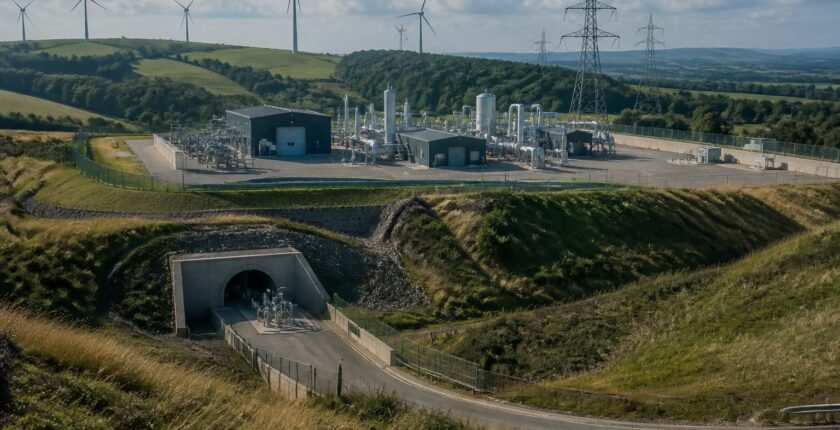
EnergyPathways is developing the Marram Energy Storage Hub (MESH), a compressed air energy storage project that would deliver 300 MW and 55.2 GWh from salt caverns beneath the East Irish Sea, with onshore facilities at the Port of Barrow. Ben Clube, EnergyPathways CEO, told pv-magazine that the company is targeting a final investment decision in 2028 and first operations at the end of 2031 or early 2032, as first reported by pv-magazine. The system combines CAES with gas and hydrogen storage and is designed for multi-day surplus events rather than the hour-scale response batteries provide.
We didn’t apply for the first round. We were invited to, but we chose not to, so it wasn’t a matter of being picked or not.
Ben Clube, EnergyPathways CEO
Key takeaways
- Project scale: MESH’s first phase is a 300 MW/55.2 GWh CAES plant — more than seven days at full power — with four salt caverns each sized at 700,000 cubic meters.
- Timeline: EnergyPathways is targeting final investment decision in 2028 and first operations at the end of 2031 or in early 2032, subject to consents and Ofgem cap-and-floor support.
- Strategic role: MESH pairs compressed air with gas and hydrogen storage to provide seasonal and multi-day strategic reserve as the UK moves toward higher gas import dependence.
- Comparative shortfall: Ofgem’s first cap-and-floor window provisionally selected 16 projects totalling 7.6 GW and 136.9 GWh, while EnergyPathways highlights system surpluses that could reach about 70 TWh a year.
Table of contents
How salt caverns give MESH scale
EnergyPathways is building the Marram Energy Storage Hub in a salt formation about 18 km off Lancashire. Ben Clube says the salt sequence offers 500 to 600 meters of vertical relief and is “virtually pure halite,” conditions the company regards as ideal for very large caverns.
Each planned cavern measures 700,000 cubic meters — described by the developer as the equivalent of four St. Paul’s cathedrals — and the first phase needs four of them. EnergyPathways says the licence area could host up to 60 such caverns, a scale that underpins the project’s low-cost proposition and its ability to store multi-day surpluses of wind generation.
Why MESH targets multi-day and seasonal needs
MESH is designed to capture surplus wind generation that can last well beyond the hour-scale events batteries handle. The project’s first phase — 300 MW and 55.2 GWh — is intended to provide more than seven days of output at full power, letting operators cover prolonged low-wind spells and export seasonal security.
Clube argues that UK system characteristics make this necessary: about 50% of gas supply currently comes from the UK North Sea, but he says imports could supply up to 90% of gas needs during peak winter demand. He also highlights the UK’s limited gas storage — under six days of national supply — versus roughly 80 days in the EU and more than 40 days for large importers such as China, positioning MESH’s gas and hydrogen storage as a security asset.
Policy, financing and near-term milestones
EnergyPathways did not enter Ofgem’s first cap-and-floor window; Clube says the company was invited but chose to sit out and wait for a more mature second-round submission. Ofgem’s first window provisionally selected 16 projects that together total 7.6 GW and 136.9 GWh in June, a figure EnergyPathways contrasts with its view of system needs.
The company announced a proposed fundraise on Sept. 28 and is pre-revenue; its last accounts carried a going-concern warning and the firm has a market capitalisation of just over GBP 20 million ($26.6 million). Clube is clear that the cap-and-floor revenue stabilisation and government positions on gas security and hydrogen strategy are the two policy pillars needed to unlock external finance ahead of a 2028 FID.
Technical windows and the risks to the 2031 target
MESH’s engineering plan assumes rapid dispatch capability — the developer says the system can reach full power from a cold start within a couple of minutes — while offering duration measured in days. That combination is what EnergyPathways presents as complementary to batteries and pumped hydro, which it says are duration-limited to hours.
Clube identifies the rollout speed of policy and regulatory frameworks as the main constraint to hitting the 2028 FID and the end-of-2031 operating target. He also flags the need for a hydrogen framework and the government’s treatment of gas security in upcoming legislation, both of which are required to clear the pathway for investment and to remove conditional financing risk.
| Item | Duration | Response time | Developer claim |
|---|---|---|---|
| MESH CAES (phase 1) | 55.2 GWh (more than seven days) | A couple of minutes to full power | 300 MW, first operations end of 2031 or early 2032 |
| Grid batteries (typical) | ≈1.5 hours | Milliseconds–seconds | Hourly flexibility markets |
| Pumped hydro (typical) | Within the hour | Minutes | Site dependent; longer lead times |
Case for and against MESH delivering at scale
The case for
- Salt geology, cavern scale and integrated gas/hydrogen storage give MESH technical advantage for multi-day and seasonal storage.
- Ofgem’s cap-and-floor mechanism, if accessible in round two, can provide the revenue certainty needed for project financing ahead of a 2028 FID.
The case against
- Delay or a narrower cap-and-floor window would push FID and construction timelines beyond the 2028–2031 targets.
- Hydrogen strategy and gas-security legislation must arrive in usable form; absent clear frameworks, private investors may withhold binding commitments.
What to be careful about
- Policy timing: the cap-and-floor second round and hydrogen/gas-security decisions may be delayed, blocking project finance.
- Permitting and consenting for offshore caverns and onshore facilities could take longer than the developer expects, affecting the 2031 operations target.
- Financing risk: EnergyPathways is pre-revenue with a market cap just over GBP 20 million ($26.6 million) and needs external capital to progress development work.
- Technical execution: constructing four 700,000 cubic metre caverns and integrating CAES with hydrogen and gas storage is complex and may uncover unforeseen costs or schedule slippage.
The bottom line
MESH presents a different commercial and technical proposition from hour-scale batteries: very large-volume salt caverns plus integrated gas and hydrogen storage aimed at multi-day and seasonal needs. EnergyPathways frames the project as a strategic buffer for a wind-dominated system and for a UK with rising gas import dependence. Delivering on the developer’s 2028 FID target and end-of-2031 operations plan hinges on timely cap-and-floor access and clear hydrogen and gas-security policy. If those policy signals arrive, MESH’s cavern scale and duration could make it a key long-duration resource; if they do not, the timetable and financing case will be harder to close.
What to watch
- Watch for EnergyPathways’ final investment decision target in 2028.
- Watch for first cavern operations at the end of 2031 or in early 2032.
Frequently asked questions
How large is MESH’s first phase?
The developer says the first phase is 300 MW and 55.2 GWh of compressed air energy storage, which it describes as more than seven days at full power.
Why use salt caverns?
EnergyPathways says the site has about 500–600 metres of near-pure halite and room for caverns of 700,000 cubic metres each; four caverns are planned for phase one and the licence area could support up to 60.
How does MESH affect UK gas security?
Ben Clube argues the project adds seasonal capacity: he notes about 50% of current gas comes from the UK North Sea, imports could reach up to 90% during peak winter demand, and the UK has under six days of gas storage compared with about 80 days in the EU.
Related reading