
Blog
Ebara Elliott Wins LH2 Pump Contract for Chart Ferox
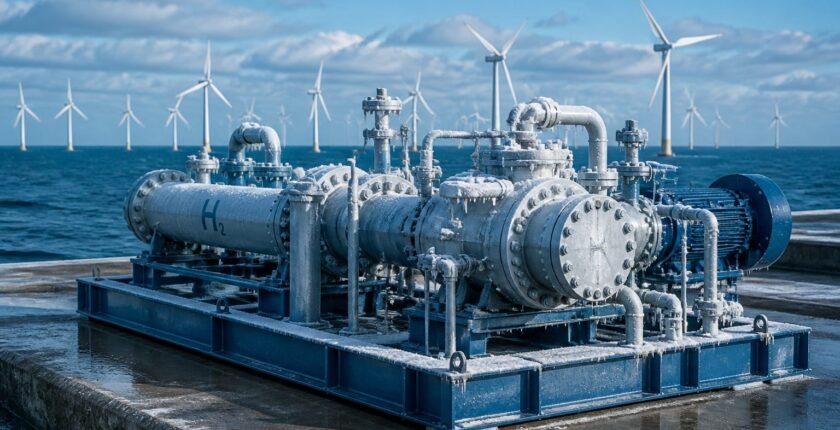
Estimated reading time: 4 minutes · Last updated:
Ebara Elliott Energy (EEE) has been awarded a contract to supply a liquid hydrogen pump system to Chart Ferox, a.s., a Baker Hughes subsidiary, for integration into a high-performance hydrogen refuelling trailer. Chart Ferox ordered the pump to support the GOLIAT (Ground Operations of Liquid hydrogen Aircraft) project, a European consortium coordinated by Airbus and backed by Horizon Europe, which comprises 15 EU partners. Initial engineering and design validation are under way and equipment delivery is scheduled to Chart Ferox in the Czech Republic ahead of a trailer test in Bristol, UK later in 2028. JEANNETTE, PA is listed as EEE’s announcement location.
Securing a position inside Chart’s portfolio for the GOLIAT project represents an important milestone for our global team as we expand our footprint into the clean energy infrastructure frontier,
Shane Reph, Deputy Chief Executive Officer and Chief Operating Officer at Ebara Elliott Energy
Key takeaways
- Contract award: Ebara Elliott Energy will supply a liquid hydrogen pump system to Chart Ferox, a.s., a Baker Hughes subsidiary, for a hydrogen refuelling trailer.
- Program: The pump will support the GOLIAT project, a Horizon Europe initiative coordinated by Airbus that includes 15 EU partners.
- Schedule: Initial engineering and design validation are underway, with the refueller slated for testing in Bristol, UK later in 2028.
- Commercial milestone: EEE says this contract is its first commercial application in the liquid hydrogen aviation infrastructure market.
Table of contents
What Ebara Elliott will deliver and why it matters
Ebara Elliott Energy has been selected to design and deliver a specialized liquid hydrogen pump system for Chart Ferox’s virtual-pipeline refuelling trailer. The pumped system will handle cryogenic liquid hydrogen (LH2) flows required by the trailer, which Chart Ferox will use to demonstrate high-flow refuelling concepts for future large commercial aircraft under the GOLIAT programme.
The contract is framed as EEE’s commercial entry into aviation LH2 infrastructure and builds on its rotating equipment and cryogenic validation capabilities. Chart Ferox, a.s. selected EEE on the basis of its technical solution and dedicated support, according to the announcement. The supplier role places EEE on the supply chain path for ground-based LH2 handling and refuelling prototypes that the consortium aims to scale and standardize.
How the pump fits into GOLIAT’s trailer tests and schedule
Chart Ferox will integrate the pump into a high-performance refuelling trailer that the GOLIAT consortium will use to validate refuelling operations for large aircraft. GOLIAT, coordinated by Airbus and supported by Horizon Europe, is tasked with maturing and preparing standardization for high-flow LH2 handling and refuelling technologies across 15 EU partners; the consortium’s scope includes hardware validation, operational procedures and standard-setting workstreams.
EEE says initial engineering and design validation are underway and that equipment will be delivered to Chart Ferox in the Czech Republic ahead of testing in Bristol, UK later in 2028. The Bristol test is presented as a field validation of the trailer concept rather than a certification event; subsequent certification and operational approvals will depend on the test outcomes and on the consortium’s standardization work under Horizon Europe (project id 101138379).
Technical, schedule and market risks around a first commercial application
This contract is EEE’s first announced commercial application in the liquid hydrogen aviation infrastructure market, which carries development and integration risk. Cryogenic LH2 pumps operate at very low temperatures and demand tight tolerances on materials, sealing and rotating machinery validation; the announcement notes EEE’s ongoing cryogenic validation work but does not publish pump flow rates, power ratings or accepted tolerances.
Delivery and the planned Bristol test in 2028 create a near-term schedule milestone that must be met for the trailer demonstration to proceed on the consortium’s timetable. The wider rollout of similar ground systems also depends on standardization outcomes produced by GOLIAT and on airport, safety authority and aircraft integrator approvals. EEE’s place on Chart Ferox’s supply chain gives it exposure to the programme’s technical outcomes and to any adjustments that arise from the trailer’s test results.
Outlook — the case for and against wider adoption
The case for
- The contract gives Ebara Elliott a position on a high-profile EU-backed programme coordinated by Airbus, which could open further industrial follow-on work if the Bristol trailer validates the technical approach.
- Integration with Chart Ferox and backing from Horizon Europe and a 15-partner consortium creates institutional momentum for harmonised LH2 refuelling standards and shared test data.
The case against
- Technical validation of cryogenic pumps at the scale required for large aircraft ground operations is still unsettled; failures or underperformance in the Bristol test could delay standardization and procurement decisions.
- Regulatory approvals, airport implementation challenges and supply-chain constraints for cryogenic components could slow commercial rollout even if the trailer tests succeed.
What to be careful about
- Engineering risk from cryogenic operation: material, sealing and rotating-equipment failures could require design revision.
- Schedule risk tied to the Bristol test in 2028; delays there would cascade into GOLIAT demonstration and standardization timelines.
- Regulatory and certification risk: airport and aviation regulators must accept operational procedures developed from the trailer tests before deployment at scale.
- Market concentration risk: as a first commercial application, EEE’s near-term revenue from this project depends on follow-on orders that are not yet contracted.
The bottom line
The Chart Ferox contract places Ebara Elliott Energy on a visible pathway into aviation-scale LH2 ground infrastructure by tying its rotating-equipment expertise to a Horizon Europe-backed demonstration with Airbus and 15 EU partners. The Bristol test in 2028 is the immediate technical milestone: success would feed GOLIAT’s standardization work and could unlock follow-on procurement, while setbacks would force design or schedule changes. Key unanswered items remain technical specifications, commercial terms and the regulatory path from demonstration to certified, repeatable airport operations.
What to watch
- Watch for the Chart Ferox refuelling trailer test in Bristol, UK later in 2028.
- Watch for GOLIAT consortium standardization deliverables and demonstration reports; no date has been set.
Frequently asked questions
Who awarded the contract and who will receive the pump?
Ebara Elliott Energy announced it was awarded the contract to supply the liquid hydrogen pump; Chart Ferox, a.s., a subsidiary of Baker Hughes’ Chart Industries, Inc., will integrate the pump into its refuelling trailer.
What programme funds or coordinates this work?
The work supports the GOLIAT project, coordinated by Airbus and supported by the EU’s Horizon Europe framework, and the consortium comprises 15 EU partners.
When will the integrated refuelling trailer be tested?
Equipment delivery is scheduled to Chart Ferox in the Czech Republic and the refueller is due to be tested in Bristol, UK later in 2028.
Related reading