
Blog
Ice Harbor Dam Turbine Lifts Salmon Survival to 98.25%
Estimated reading time: 6 minutes · Last updated:
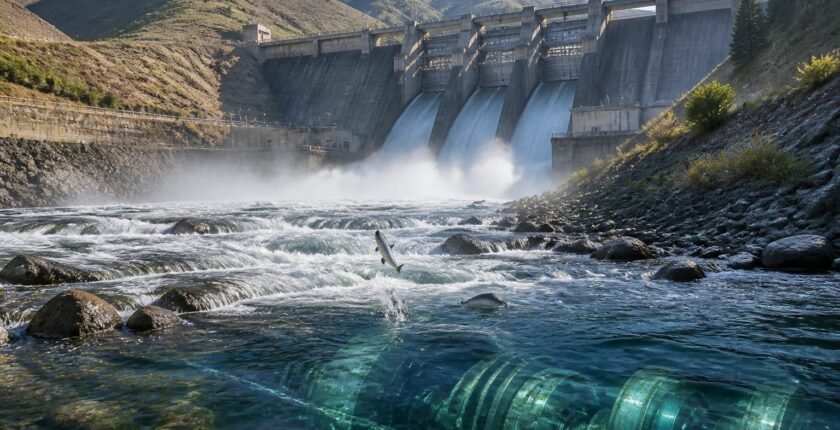
A redesigned turbine at Ice Harbor Dam on Washington's Snake River let 98.25% of juvenile salmon survive direct passage in U.S. Army Corps of Engineers testing. Fish moving through turbine routes historically survived at roughly 90%. The fixed-blade unit also raised power generation efficiency by 4%. Its forward-slanted geometry, thicker blade edges and reshaped water paths are built to reduce the shear stress, turbulence and sudden pressure drops that injure young fish. After the results came in, Ice Harbor began replacing every remaining turbine unit with the new design. The Ice Harbor Dam turbine matters because Washington draws over 60% of its electricity from hydropower, so protecting fish cannot come at the cost of output.
Key takeaways
- Survival jump: Juvenile salmon passing through the new Ice Harbor Dam turbine had a 98.25% direct survival rate, against a historical benchmark of roughly 90% for turbine routes.
- More power, not less: The U.S. Army Corps of Engineers' fixed-blade runner increased turbine power generation efficiency by 4% while improving fish safety.
- Full rollout: Ice Harbor Dam on the Snake River is replacing all of its remaining turbine units with the fish-friendly design.
- Why output matters: Hydropower supplies over 60% of Washington's electricity production and almost 29% of all American renewable energy generation.
Table of contents
- Key takeaways
- What Harms Juvenile Salmon Inside a Conventional Turbine
- How the Fixed-Blade Redesign Changes the Water's Path
- What the Sensor Fish Measured, and What 98.25% Means
- Why Washington Cannot Trade Megawatts for Fish
- What could help or hold back the fish-friendly turbine
- What to be careful about
- Frequently asked questions
What Harms Juvenile Salmon Inside a Conventional Turbine
Young salmon heading downstream to the ocean have to get past the dams on the Columbia and Snake rivers. At a hydropower plant, one route runs straight through the turbines, where moving water spins the machinery that generates electricity.
That route carries three distinct hazards. Water pressure can fall abruptly as it passes the blades. Hydraulic forces inside the passage can be extreme. And a fish can be hit directly by a blade. Taken together, these dangers have historically held survival through turbine routes at roughly 90%.
Dams cause harm beyond the turbines as well. Concrete barriers cut across old migration routes and make it harder for fish to reach the areas where they spawn, which feeds through into population numbers. The Ice Harbor work targets only the turbine passage, but that is the hazard a turbine redesign can directly change, and it is where the U.S. Army Corps of Engineers focused its testing.
How the Fixed-Blade Redesign Changes the Water's Path
The Corps' new unit is a fixed-blade runner. The runner is the rotating part of a turbine that water pushes against, and a fixed-blade version has blades set at a constant angle rather than adjustable ones.
Three design choices set it apart from the legacy units it replaces. The blades have a forward-slanted geometry. Their edges are thicker. And the flow paths through the unit have been optimised so water moves more smoothly.
Each feature is aimed at the forces that hurt fish. The design lowers shear stress, the tearing force created when layers of water move past each other at different speeds. It also reduces turbulence inside the passage and softens the severe pressure drops that conventional turbines produce. A thicker blade edge presents a blunter surface, which is meant to make any contact with a fish less damaging. The goal throughout was to limit physical impacts on migrating fish without giving up generating capacity.
What the Sensor Fish Measured, and What 98.25% Means
To judge the unit, the Corps sent an autonomous sensor fish through the turbine passage. The device is packed with miniature data collectors that record the conditions a real fish would experience on the way through.
Biological testing then put direct survival for migrating juvenile salmon at 98.25%. Against the roughly 90% historical benchmark, that is a gain of about 8 percentage points. Put the other way, the share of fish lost on the turbine route falls from roughly one in ten to under two in a hundred, about 1.75%.
The word direct matters. It describes survival through the turbine passage itself, the part of the journey the redesign was built to change. It does not measure the barrier effect of the dam as a whole on migration and spawning, which the turbine does not address. Even so, cutting turbine losses by that margin is a large result for a single equipment change at an existing plant.
Why Washington Cannot Trade Megawatts for Fish
Hydropower has long been the backbone of Washington's power supply. Engineers built extensive dam networks on the Columbia and Snake rivers, and those networks expanded through the 20th century as cities grew and industry modernised across the Pacific Northwest.
Today, hydroelectric generation supplies more than 60% of the electricity produced in Washington. Across the United States, close to 29% of renewable power comes from hydropower.
Large dams also do a job that wind and solar cannot do alone. They can raise output quickly when demand climbs, which helps keep the regional grid stable, and they fill gaps when wind and sun fluctuate. As the state electrifies more of its infrastructure, that role grows. This is why the 4% efficiency gain matters as much as the survival figure. A fish-friendly turbine that cost generating capacity would face resistance on a strained grid. One that adds output removes that trade-off.
| Attribute | Legacy turbine | New fixed-blade runner |
|---|---|---|
| Juvenile salmon survival | Roughly 90% | 98.25% direct |
| Power generation efficiency | Baseline | 4% higher |
| Blade geometry | Standard | Forward-slanted |
| Blade edges | Standard | Thicker |
| Main hazards targeted | Pressure drops, hydraulic forces, blade strikes | Lower shear stress, turbulence, pressure drops |
| Status at Ice Harbor | Being replaced | Rolling out to all remaining units |
What could help or hold back the fish-friendly turbine
The case for
- The 4% efficiency gain means the redesign adds output, removing the usual trade-off between fish protection and generation.
- Ice Harbor has committed to replacing all remaining units, turning a single test result into plant-wide practice.
- The design targets measurable forces (shear stress, turbulence and pressure drops), so performance can be checked with sensor fish at other sites.
The case against
- The 98.25% figure covers direct turbine passage only and does nothing about dams blocking upstream migration and access to spawning areas.
- Results come from one dam on the Snake River, and performance at plants with different flows and layouts has not been demonstrated.
- Replacing turbine units at existing dams is a capital project, and no cost or completion date for the Ice Harbor rollout has been published.
What to be careful about
- Survival measured at Ice Harbor may not carry over to dams with different heads, flows or turbine sizes.
- Direct survival through the turbine does not capture the wider harm from dams blocking migration routes and spawning access.
- The pace of the plant-wide replacement is undefined, so fish on the remaining legacy units still face the roughly 90% historical survival rate until it is done.
The bottom line
The Ice Harbor result shows that a turbine can be redesigned around fish without costing power. Direct survival rose to 98.25% from a historical benchmark of roughly 90%, and efficiency climbed 4%. That combination is why the plant is now replacing every remaining unit. What the result does not settle is equally clear. The figure covers turbine passage only, not the wider barrier dams pose to migration and spawning. It also comes from a single plant on the Snake River. For a state that draws over 60% of its electricity from hydropower, the next test is whether the design performs as well across the rest of the Ice Harbor plant and at other dams.
What to watch
- Watch for Ice Harbor Dam to finish replacing its remaining turbine units with the fixed-blade design; no completion date has been set.
- Watch for whether the U.S. Army Corps of Engineers publishes survival and efficiency results from the additional units as they enter service; no date has been announced.
- Watch for whether other Columbia and Snake river dams adopt the same runner design; no plans have been announced.
Frequently asked questions
What is a sensor fish?
It is an autonomous device packed with miniature data collectors that travels through a turbine passage. The U.S. Army Corps of Engineers used one at Ice Harbor Dam to record the conditions a juvenile salmon would face.
Does the Ice Harbor turbine make less electricity?
No. The fixed-blade runner increased turbine power generation efficiency by 4% while raising juvenile salmon direct survival to 98.25%.
Where is Ice Harbor Dam?
Ice Harbor Dam stands on the Snake River in Washington state. Its position on a major salmon migration corridor made it the main site selected for testing.
Related reading