
Blog
Kōwhai Park Solar Farm Opens at Christchurch Airport
Estimated reading time: 7 minutes · Last updated:
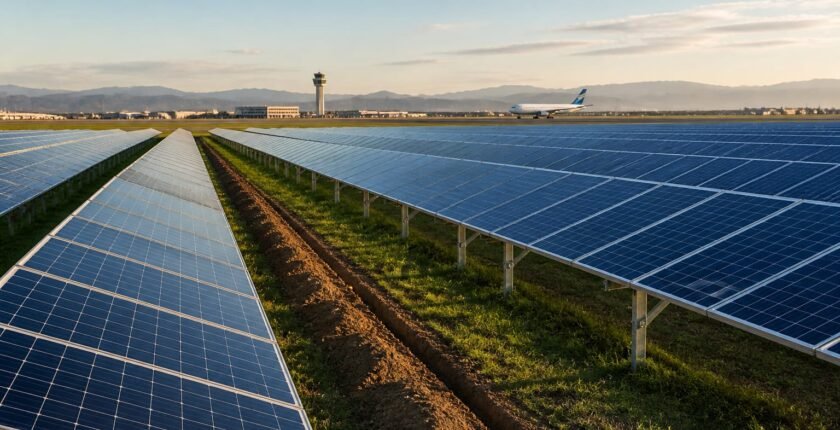
The Kōwhai Park solar farm, built on 568 acres beside the runways at Christchurch Airport, is now feeding New Zealand's national grid. Its roughly 300,000 panels can export up to 150 megawatts, and the airport expects about 275 gigawatt-hours a year, close to the annual use of 36,000 homes. Getting that power off site meant burying a 66,000-volt cable in short overnight stretches, so that no trench was open when flights resumed. Prime Minister Christopher Luxon opened the farm on 15 October 2026, although it began generating in August. Contact Energy and Lightsource bp own it equally. The airport puts the cost at NZ$273 million, and dairy firm Synlait has contracted a quarter of the output.
the disruption to the airport would be huge otherwise.
Kalim Guthrie, Ventia project manager
Key takeaways
- Scale: Kōwhai Park carries about 300,000 panels on 568 acres west of Christchurch Airport's runways, rated at 168 MW DC with up to 150 MW exported to the grid.
- Night-shift cable: Ventia laid about 10.5 miles of 66,000-volt cable in roughly 2.8 miles of trench, with each stretch dug, ducted and refilled overnight while no aircraft were operating.
- Output: Christchurch Airport expects 275 GWh a year from the farm, which it equates to the yearly consumption of 36,000 homes.
- Buyers and owners: Contact Energy and Lightsource bp own the NZ$273 million farm 50/50, and Synlait has agreed to buy 25% of its output under a long-term power purchase agreement.
Table of contents
- Key takeaways
- How Night Crews Buried the Cable Without Stopping Flights
- Why the Power Climbs to 66,000 Volts and Then Comes Back Down
- Why Kōwhai Park Has Two Capacity Figures
- How the Airport Answers the Question of Pilot Glare
- Who Owns the Farm and Who Is Buying Its Power
- What could help or hold back Kōwhai Park
- What to be careful about
- Frequently asked questions
How Night Crews Buried the Cable Without Stopping Flights
Ventia, the contractor that built the grid connection, did the underground cable work late at night, when no aircraft were moving. The routine repeated each shift. A crew opened a length of trench, put ducting into it and backfilled the ground before morning operations began.
Ducting is a buried run of pipe that goes in first. The cable is pulled through it at a later stage. Kalim Guthrie, who manages the job for Ventia, said keeping to the timetable mattered because "the disruption to the airport would be huge otherwise."
The full connection used about 10.5 miles of cable laid inside roughly 2.8 miles of trench, Ventia says. The company has not said how many nights the work took, or which parts of the route ran close enough to the airfield to need the night shift. Paris took a slower route to the same problem. At that city's main airport, a tunnel boring machine took 19 months to cut beneath two runways while planes kept landing above it.
Why the Power Climbs to 66,000 Volts and Then Comes Back Down
Inside the farm, the electrical system runs at 33,000 volts. Ventia designed and built both substations. It says the one on Pound Road raises the voltage to 66,000 volts for the trip through the buried cable. At the far end, a substation on Grays Road lowers it back to 33,000 volts. That is where the airport and Orion, the company operating the local power lines, will eventually connect.
Doubling the voltage only to halve it can look pointless. It is not. Moving a given amount of power at higher voltage means less current in the conductor, and lower current wastes less energy as heat. The same physics explains why long-distance transmission lines operate at very high voltages.
Location does part of the job too. Christchurch Airport argues in its FAQ that generating electricity right beside the airfield loses far less of it than producing power in a distant region and moving it across the network.
Why Kōwhai Park Has Two Capacity Figures
The farm is quoted at both 150 megawatts and 168 megawatts, and neither number is wrong. Panels produce direct current, while the grid carries alternating current. All output therefore passes through inverters, which are devices that convert DC to AC. The 168 MW figure is the panels' DC rating. The 150 MW figure is the most the farm can export at any moment.
Over a year, Christchurch Airport expects about 275 gigawatt-hours of generation, which it compares to the annual consumption of 36,000 homes. The Press, Christchurch's daily newspaper, reports that the amount reaching the national grid has been climbing since the farm went live in August.
The airport says the panels cover 568 acres on the western side of the airfield. Some of that ground is owned by Environment Canterbury, the regional council, and leased to the airport. Strictly, Kōwhai Park is the name of a 988-acre energy park the airport has reserved, and the solar farm is only its first phase. That leaves about 420 acres of the park outside the current footprint.
How the Airport Answers the Question of Pilot Glare
Glare is the obvious worry with a field of panels at the end of a runway, and Christchurch Airport addresses it directly in its FAQ. Its answer is that solar panels are designed to absorb light, not reflect it. Before construction began, the airport said it was carrying out technical studies and consulting aviation groups to establish that the project was safe.
The reasoning holds at a basic level. A panel that threw a lot of sunlight back toward the sky would be failing at its main task. The airport also points to precedent. Its FAQ lists airports that already operate near solar arrays, three of them in the United States: Denver, San Francisco and San Diego.
Europe offers other models. Frankfurt has installed upright panels alongside a runway. Berlin's airport has raised panels beside it, and corn is banned beneath them because the crop draws birds, which are a separate hazard for aircraft.
Who Owns the Farm and Who Is Buying Its Power
Contact Energy, one of New Zealand's large power companies, owns the farm in a 50/50 partnership with Lightsource bp, an international solar developer. The airport puts the price at NZ$273 million, about $160 million. It says 235 people were on site at the peak of construction.
Two long-term power purchase agreements underpin the revenue. A power purchase agreement is a contract to buy a fixed share of a plant's output over many years, which gives the owners a paying customer for what they generate. Synlait, a New Zealand dairy company, will take 25% of the output to run its Dunsandel and Dairyworks sites, and the airport has signed to buy power from the farm too.
The airport itself is in public hands. New Zealand's Treasury says Christchurch's city council has a 75% stake, held through a holding company, and the national government owns the remaining 25%. Mike Fuge, Contact's chief executive, said in the airport's 15 October opening announcement that Kōwhai Park is the company's first finished solar farm. He added that two further projects with Lightsource bp, in Taranaki and Northland, are already approved.
| Party | Role | Stake or share |
|---|---|---|
| Contact Energy | Co-owner | 50% |
| Lightsource bp | Co-owner | 50% |
| Synlait | Power buyer for Dunsandel and Dairyworks sites | 25% of output |
| Christchurch Airport | Host site and power buyer | Long-term PPA |
| Ventia | Built grid connection and both substations | Contractor |
| Orion | Local lines company, to connect at Grays Road | Future connection |
What could help or hold back Kōwhai Park
The case for
- Long-term agreements with Synlait and the airport give the owners committed buyers for part of the output.
- Generating beside the airfield cuts the transmission losses that a distant plant would incur, according to the airport.
- Only the first phase of the 988-acre energy park is built, leaving room for later stages.
- Contact holds approval for two more solar farms with Lightsource bp, in Taranaki and Northland.
The case against
- The 150 MW export limit sits below the 168 MW panel rating, capping what reaches the grid at peak.
- The 275 GWh annual figure is an airport estimate, not yet tested by a full year of operation.
- The Grays Road connection for the airport and Orion is described as eventual, with no timing given.
What to be careful about
- The annual output estimate of 275 GWh has not yet been checked against a full year of measured generation.
- The results of the airport's pre-construction glare studies are not part of what it has cited, so the safety case rests on panel design and precedent.
- The airport and Orion are yet to connect at the Grays Road substation, and no date has been given for that step.
The bottom line
Kōwhai Park shows that an airport's spare land can host utility-scale generation if the build is fitted around the flight schedule. The panels were the simple part. The connection was harder: a cable that carries power at 66,000 volts through 2.8 miles of trench, each stretch dug and refilled within an overnight window. Two questions remain open. One is how much more of the 988-acre energy park will follow the first phase. The other is when the airport and Orion connect at Grays Road. Fuge calls the farm Contact's first finished solar project, and it gives the company a working model for Taranaki and Northland. A full year of generation will test the 275 gigawatt-hour estimate.
What to watch
- Watch for the airport and Orion connecting to the Grays Road substation; no date has been set for that hook-up.
- Watch for progress on the Taranaki and Northland solar farms that Contact Energy has approved with Lightsource bp; no construction dates have been given.
- Watch for plans for later phases of the 988-acre Kōwhai Park energy park; the airport has not named a date for the next stage.
Frequently asked questions
Where is the Kōwhai Park solar farm?
It sits on 568 acres on the west side of Christchurch Airport's airfield in New Zealand. Part of the land belongs to Environment Canterbury, which leases it to the airport, and the farm is the first phase of a 988-acre energy park.
When did Kōwhai Park start producing electricity?
The farm went live in August 2026, and Prime Minister Christopher Luxon formally opened it on 15 October 2026. The Press reports that the electricity reaching the grid has been increasing since it went live.
Do other airports have solar farms next to their runways?
Christchurch Airport's FAQ cites Denver, San Francisco and San Diego as US airports with solar arrays nearby. In Europe, Frankfurt has upright panels along a runway and Berlin has raised panels beside its airport.
Is Contact Energy building more solar farms?
Yes. Chief executive Mike Fuge said Contact has approval for two more solar farms with Lightsource bp, one in Taranaki and one in Northland, after completing Kōwhai Park.
Related reading