
Blog
Allegheny Valley School District to Install Rooftop Solar
Estimated reading time: 5 minutes · Last updated:
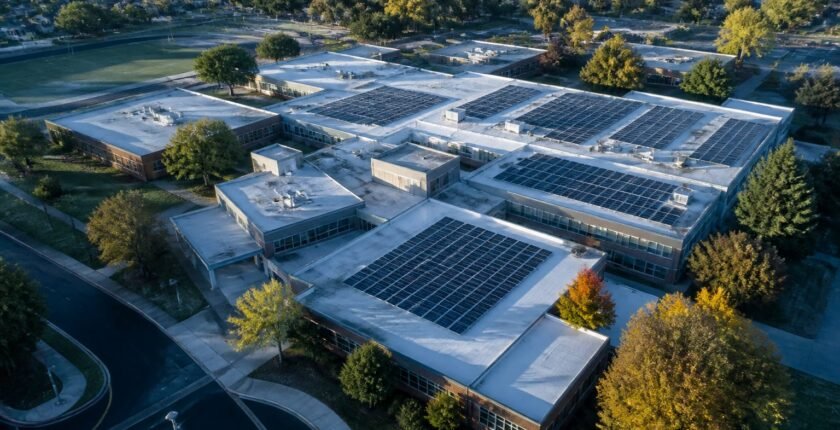
Allegheny Valley School District plans to install a rooftop solar system on Acmetonia Elementary School at 300 Pearl Ave., Harmar, using a $300,000 Pennsylvania Solar for Schools grant, with work scheduled for late spring and early summer. The district said the panels will lessen its dependence on the electrical grid and lower long-term utility costs so savings can be redirected to educational programs, Hamsini Rajgopal, the district’s director of finance and business operations, told TribLIVE. The district also intends to fold the installation into K‑6 science lessons so students can study renewable energy on campus.
Rising energy costs pose a continuous challenge to our budget,
Hamsini Rajgopal, director of finance and business operations
Key takeaways
- Site and timing: Allegheny Valley School District will install rooftop solar at Acmetonia Elementary, 300 Pearl Ave., Harmar, in late spring and early summer.
- Funding: The project is supported by a $300,000 grant from Pennsylvania’s Solar for Schools grant program, Hamsini Rajgopal said.
- Budget impact: Rajgopal said the district expects the rooftop system to cut its dependence on the power grid and lower long-term utility costs, allowing savings to be redirected toward academic programs.
- Education use: Allegheny Valley plans to incorporate the solar installation into its K-6 science curriculum to give students hands-on learning about renewable energy.
Table of contents
What the project covers and how it is funded
The planned installation will place photovoltaic panels on the elementary school's roof and is funded in part by Pennsylvania’s Solar for Schools grant program. Rajgopal said the $300,000 grant made the project possible and that the district appreciates State Rep. Mandy Steele’s support for public education and for small, local districts.
The district frames the spending as a way to shift facilities from a recurring cost into a source of ongoing savings for classrooms. The Pennsylvania Solar for Schools award listing is the only specific funding figure provided to date; that award announcement does not specify the system size, expected annual generation, installer or remaining budget items.
Why the district says it needs rooftop solar
School officials cast the project as a response to rising energy bills and an opportunity to stabilise long-term operating costs. Rajgopal is quoted saying higher energy costs are a persistent budget pressure and that on-site generation will let the district take greater control of its operational spending.
Apart from lower utility bills, the district expects reduced grid dependence to improve financial predictability and support program funding. The exact savings projections or payback period were not included in the material; the district has said only that redirected savings would support academic programs rather than naming specific dollar amounts or timelines.
Schedule, implementation and missing technical details
The installation window is described as late spring and early summer; the district directs the public to avsd.school and its social channels for project updates. The material names the school (Acmetonia Elementary) and the timing but does not specify the contractor, system capacity in kilowatts, expected annual kilowatt‑hours, interconnection timing with the utility, or warranty terms.
Those technical and procurement details determine how much energy the panels will produce and how quickly the district will see net cost reductions. Until the district publishes system specs or posts procurement documents, readers cannot verify projected savings or compute a simple payback; those are typical follow-up items for any rooftop school installation.
Education and local advocacy around the project
Beyond budgetary aims, the district plans to use the array as a K‑6 teaching tool, creating opportunities for students to explore sustainability and the technology behind solar power. Rajgopal framed the work as both fiscal stewardship and civic leadership, saying the project will benefit the entire elementary student body.
Rajgopal said the district credited State Rep. Mandy Steele with advocating on its behalf, though no direct quote from Steele was provided. Local advocacy and grant awards often speed small-district projects, but the district has not released a timeline for permitting, inspections or the classroom curriculum roll-out.
| Item | Detail |
|---|---|
| School | Acmetonia Elementary School, 300 Pearl Ave., Harmar |
| Grades served | Pre-kindergarten through sixth grade (K-6) |
| Grant | $300,000 from Pennsylvania’s Solar for Schools program |
| Installation timing | Late spring and early summer |
| Education use | Integrated into K-6 science curriculum |
How the project could play out
The case for
- If the installed system matches the district’s needs, on-site generation could cut annual utility bills and free recurring funds for classroom programs as Rajgopal describes.
- Using the array as a hands-on K‑6 teaching tool could increase student engagement with STEM and sustainability, turning capital investment into curricular value.
The case against
- Without published system capacity, installer commitments or a savings estimate, the district may find that actual energy offsets and budget relief are smaller than expected.
- Permitting, supply-chain delays or installation complications in the late-spring window could push the project into the following school year and delay any fiscal or educational benefits.
What to be careful about
- The material does not state system capacity or expected annual generation, so projected savings are unverified and may be smaller than implied.
- No installer or procurement contract is named, exposing the timeline to vendor selection and permitting delays.
- Grant terms or conditions (reporting, matching funds, or installation deadlines) are not detailed and could affect budget or schedule.
- Integrating the array into K-6 curricula requires teacher time and resources that the district has not specified, which could limit classroom impact.
The bottom line
Allegheny Valley’s rooftop solar plan is a compact example of how a small district can use state grant funding to pursue both budget relief and educational value. The project names Acmetonia Elementary and a $300,000 Solar for Schools grant, sets installation for late spring and early summer, and commits to classroom integration; however, key technical and procurement details remain unpublished. Readers and local stakeholders should track the district’s forthcoming updates on system capacity, installer selection and projected savings to judge whether the array delivers the fiscal and educational outcomes the district describes.
What to watch
- Watch for Allegheny Valley School District’s public update on system specs and the chosen installer; no date has been set.
- Watch for the district’s published estimate of projected utility savings and payback assumptions; no date has been set.
- Watch for the district’s curriculum plan showing how the K-6 program will use the installation; no date has been set.
Frequently asked questions
How much grant funding did the district receive for the project?
The district received a $300,000 grant from Pennsylvania’s Solar for Schools grant program, Hamsini Rajgopal said.
When will panels be installed at Acmetonia Elementary?
The district says the rooftop system will be installed in late spring and early summer; the material does not provide exact calendar dates.
Will students be involved with the solar installation?
Yes — the district plans to incorporate the solar panel installation into K-6 science curriculum so students at Acmetonia Elementary can learn directly from the on-site system.
Related reading