
Blog
Could your rooftop earn a €1,000 sunlight salary?
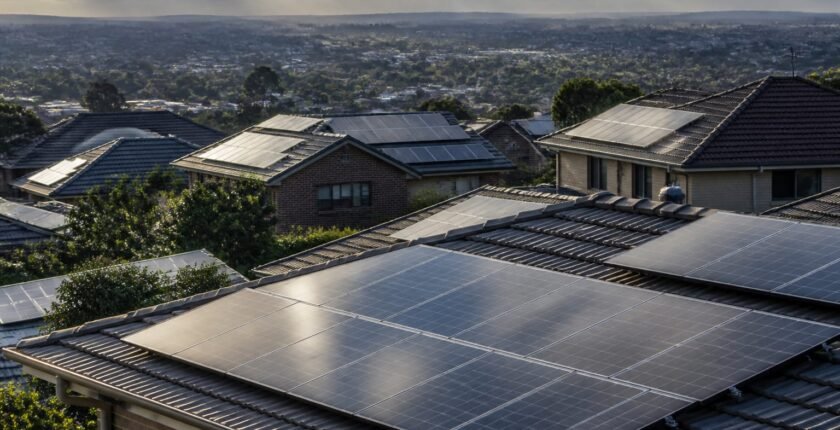
Estimated reading time: 5 minutes · Last updated:
GreenSketch, a solar software company, modelled more than 15 million UK homes and estimates that an optimised rooftop solar and battery system could save the average household around €1,100 a year. That figure — framed as a ‘sunlight salary’ — holds even in cloudier parts of Britain: averages in Scotland, Wales and Northern Ireland topped €930. GreenSketch’s modelling combined satellite imagery, roof slope and orientation, local hourly demand and hourly solar generation to calculate savings, showing that electricity prices, storage and export payments matter as much as raw sunshine. The primary keyword rooftop solar savings appears throughout this analysis.
Key takeaways
- Payback times: The Energy Saving Trust estimates a typical rooftop solar system can pay for itself in 10 to 12 years.
- Europe-wide potential: The Joint Research Centre finds that rooftop solar could meet 40 per cent of the EU’s long-term electricity demand by 2050, while one in ten European rooftops currently has panels.
Table of contents
Why a rooftop can deliver about €1,100 a year in savings
GreenSketch built a city-by-city model rather than using regional averages. It combined satellite imagery with roof slope and orientation, local hourly consumption patterns and hourly solar output to estimate household savings. That granular approach is why the company reports an average saving of around €1,100 a year for an optimised rooftop solar and battery system in the UK.
The model treats battery storage as a multiplier of value: storing midday generation for evening use reduces purchases at higher retail prices and raises self-consumption. It also factors in what households are paid for exports to the grid, so two identical roofs can show different savings in areas with different export tariffs.
Those mechanics explain the gap between regions: a roof that captures more afternoon sun, or sits where retail electricity is expensive, produces a higher ‘sunlight salary’ even if annual irradiance is modest.
Solar under grey skies and why panels still make sense
Panels do not stop working when clouds move in. Modern photovoltaic modules continue to generate on overcast days, and GreenSketch’s results show that household savings remain substantial beyond the sunniest parts of the country.
The company found estimated average savings above €930 for households in Scotland, Wales and Northern Ireland, illustrating that local weather and geography — roof angle, shading and prevailing cloud cover — influence returns as much as latitude. Southwest Wales and southeast England land at the top of GreenSketch’s list with around €1,160 and about €1,150 respectively.
The Energy Saving Trust’s guidance that a typical system can repay its cost in 10 to 12 years helps explain why panels are being considered even where annual irradiance is lower: after the payback window, ongoing savings contribute directly to household budgets.
How much room there is for Europe to grow and what limits it
The Joint Research Centre (JRC) calculates an enormous technical opportunity: rooftop solar could meet 40 per cent of the EU’s long-term electricity demand by 2050. Yet uptake remains low — about one in ten European rooftops currently has panels — leaving large potential gains on the table.
Constraints are practical as much as technical. Roof suitability, local planning rules, installation costs and the structure of retail and export tariffs all shape whether a household sees the GreenSketch-style €1,100 outcome. Non-residential roofs can be particularly attractive: the JRC says in Finland and Denmark such roofs alone could deliver at least 95 per cent of their national 2030 solar capacity targets.
Policy and market design will determine how quickly that potential translates into installations. Where batteries and favourable export arrangements improve household economics, adoption tends to rise; where upfront costs and long payback periods dominate the decision, uptake stalls.
| Region | Estimated annual saving |
|---|---|
| Southwest Wales | €1,160 |
| Southeast England | €1,150 |
| UK average (GreenSketch) | €1,100 |
| Scotland, Wales & Northern Ireland (average) | topped €930 |
How rooftop solar savings could evolve
The case for
- Batteries and time-of-use pricing will raise household self-consumption and increase annual savings per home, as GreenSketch’s model shows.
- Falling hardware and installation costs shorten payback: the Energy Saving Trust’s 10-to-12-year estimate becomes a stronger incentive if component prices drop or subsidies are available.
The case against
- Low current uptake — about one in ten European rooftops fitted — and long upfront costs may keep deployment sluggish without stronger policy support.
- Local weather variability and roof unsuitability mean many homes will never reach the GreenSketch average, so national averages can mask pockets of weak economics.
What to be careful about
- Upfront capital and installation costs stretch the payback period and may deter homeowners despite projected annual savings.
- Changes in export tariffs or retail electricity pricing can significantly reduce household savings if grid payments fall.
- Roof condition, orientation and shading limit which homes can achieve the modelled savings, constraining realistic uptake.
- Regional weather patterns produce variability in annual generation, so local outcomes may undershoot national averages.
The bottom line
The headline ‘sunlight salary’ number is not an abstract marketing figure but an output of modelling that combines roof geometry, local demand and hourly generation. GreenSketch’s estimate of around €1,100 a year for the average UK household shows that pairing panels with batteries and favourable export or retail pricing can make installations worthwhile even outside the sunniest regions. Translating that technical potential into broad adoption will depend on reducing upfront costs, improving export and retail tariff design, and addressing practical roof suitability issues so more of Europe’s underused rooftop area moves from potential into production.
What to watch
- Watch progress toward 2030 rooftop solar targets, including how non-residential roofs in Finland and Denmark contribute to national 2030 capacity goals.
- Watch EU-level reporting on rooftop contributions to the 2050 electricity plan; the JRC projects rooftops could meet 40 per cent of long-term demand by 2050.
Frequently asked questions
How much could a UK household save with rooftop solar?
GreenSketch’s analysis of more than 15 million UK homes estimates that an optimised rooftop solar and battery system could save the average household around €1,100 a year.
Do solar panels still pay off in cloudy parts of the UK?
Yes. GreenSketch found averages in Scotland, Wales and Northern Ireland topped €930 a year, and regions such as Southwest Wales and southeast England showed estimated averages of about €1,160 and €1,150 respectively.
How long until a rooftop system pays for itself?
The Energy Saving Trust estimates a typical rooftop solar system can pay for itself in 10 to 12 years, depending on installation cost, local tariffs and how much electricity the household consumes versus exports to the grid.
Related reading
This article is information, not financial advice. Anyone acting on it should do their own checks.