
Blog
Rose-tinted solar panels let crops and power share land
Estimated reading time: 5 minutes · Last updated:
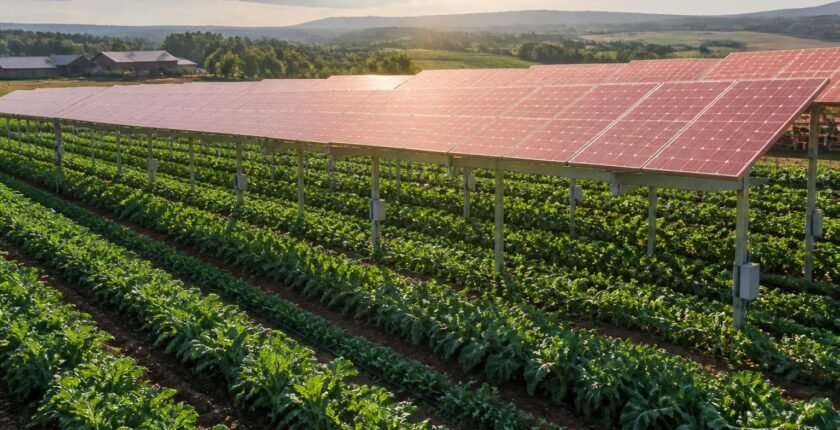
Silvia Ma Lu of Mälardalen University tested rose-tinted, semi-transparent solar panels that pass most red and blue wavelengths while generating electricity. During the growing season those magenta panels generated about 224.7 MWh per hectare. Ma Lu grew broccoli (Brassica oleracea) beneath two panel setups — 50% and 70% transparency — on separate 20-square-meter plots and compared them with full-sun control plots. Total yields were comparable to full sun, but crops under the panels reached harvest 25 days later; measured light-use efficiency increased by a factor of 4.5 under the denser (50%) panels and by 2.8 under the 70% panels.
The basic concept is quite straightforward,
Silvia Ma Lu
Key takeaways
- Electricity generation: Over the growing season the magenta solar cells produced about 224.7 MWh per hectare of electricity.
- Crop yield and timing: Broccoli yields under magenta panels matched full sun, but plants took 25 days longer to reach harvest.
- Transparency and efficiency: Light-use efficiency rose 4.5 times under the 50-percent-transparency panels and 2.8 times under the 70-percent panels.
- Trade-off with conventional panels: The magenta setup produced about 100 MWh per hectare less electricity than conventional solar panels of similar size.
Table of contents
- Key takeaways
- How the team tested rose-tinted, semi-transparent panels
- Plant responses: yields matched but crops took longer
- Electricity produced and the economic trade-offs
- Where rose-tinted panels might fit and the remaining unknowns
- Arguments for and against near-term uptake
- What to be careful about
- Frequently asked questions
How the team tested rose-tinted, semi-transparent panels
Ma Lu and colleagues mounted commercially available magenta glazing with embedded cadmium telluride (CdTe) strips over three 20-square-meter plots planted with broccoli. One plot was left in full sun as the control; the other two sat beneath magenta panels set to 50 percent and 70 percent transparency. The magenta glass transmits red and blue wavelengths while filtering green light; the CdTe strips harvest energy where they sit on the panel glass.
Using three matched plots allowed the authors to compare plant development and the panels' electricity output over the same growing period. The paper, published in Cell Reports Physical Science, reports the experimental layout and the choice of broccoli because it is a cultivar of Brassica oleracea, the species that also includes cabbage, cauliflower, kale, Brussels sprouts and kohlrabi. The team notes the magenta glazing was originally intended for building design and was repurposed here because it was commercially available for prototype testing.
Plant responses: yields matched but crops took longer
Across the two magenta configurations the broccoli produced similar harvested mass to the full-sun control, yet development was slower: plants under the magenta panels took 25 days longer to reach harvest. The researchers interpret that as greater efficiency in how the plants used available light: despite receiving less total light, they produced comparable yield.
The paper quantifies the shift in how plants used light: under panels with 50% transparency light-use efficiency increased by a factor of 4.5, while under the 70% panels it rose by 2.8. The authors say directing more red and blue light (and less green) can change how crops allocate energy, but they caution the findings reflect this specific experiment and need testing across more seasons and crop types.
Electricity produced and the economic trade-offs
Across the season the magenta panels delivered roughly 224.7 MWh per hectare, which the authors report is about 100 MWh per hectare less than conventional panels of similar footprint. Ramesh Rayudu, a power-systems engineer who was not involved in the work, translated that gap into economic terms: depending on electricity prices and the value of broccoli, the reduced generation would need approximately 1.2 to 3.2 tonnes of additional broccoli per hectare to offset the shortfall.
That arithmetic highlights the central trade-off for agrivoltaic designs that alter spectral availability: land and spectrum allocated to crops can raise agricultural value per square metre, but any reduction in energy output must be remunerated through higher crop value or other co-benefits. The experiment does not yet separate how much of the crop response comes from the magenta filter itself versus the overall reduction in light level, nor does it quantify the panels' commercial electricity yield by transparency level.
Where rose-tinted panels might fit and the remaining unknowns
Ma Lu suggests configurations similar to the prototype may suit smaller-scale applications, saying they could be suitable for community gardens or integration into greenhouse roofs rather than immediate deployment over large agricultural areas. That positioning follows from the panels being commercially available glazing for buildings; their use over large fields would require engineering refinements to recover green-spectrum energy and to manage microclimate effects beneath glass.
The study flags several gaps before scale-up: the current magenta glass blocks green light that the CdTe strips do not capture; the experiment did not quantify the greenhouse effect created by overlaying glass; and tests ran for a single season and a single crop. The authors and outside experts therefore call for multi-season trials, targeted cell designs that harvest a broader spectral band, and real-world greenhouse pilots to measure temperature, humidity and pest interactions under the panels.
| Condition | Transparency | Plot size | Harvest timing vs full Sun | Light-use efficiency vs full Sun | Electricity produced |
|---|---|---|---|---|---|
| Full Sun (control) | N/A | 20-square-meter plots | Baseline | Baseline | N/A |
| Magenta panels — denser | 50 percent | 20-square-meter plots | 25 days longer | 4.5 times greater | 224.7 MWh per hectare |
| Magenta panels — lighter | 70 percent | 20-square-meter plots | 25 days longer | 2.8 times greater | 224.7 MWh per hectare |
Arguments for and against near-term uptake
The case for
- Ma Lu argues the panels could deliver dual use on small sites: they pass red and blue light that crops need while producing electricity, making them immediately attractive for community gardens and greenhouse roofs.
- Wavelength-selective designs could raise land productivity by pairing food and power on the same footprint if future cells harvest currently unused spectra or if high-value crops compensate reduced generation.
The case against
- The magenta configuration produced about 100 MWh per hectare less than conventional panels, creating an economic gap that must be closed by higher crop returns or by capturing more of the spectrum.
- Engineering gaps remain: the current panels do not harvest blocked green light, and the experiment did not measure the greenhouse effect of overlaying glass or multi-season performance.
What to be careful about
- Lower electricity yield: magenta cells produced around 224.7 MWh/ha, roughly 100 MWh/ha less than conventional panels of similar size.
- Slower crop development: broccoli under magenta panels took 25 days longer to reach harvest.
- Unquantified microclimate effects: the trial did not measure the greenhouse effect of glass overlay, which could change water, temperature and pest dynamics.
- Spectral loss: the magenta filter blocks green light that the current CdTe strips do not capture, leaving potential energy on the table.
The bottom line
The trial by Silvia Ma Lu’s team shows a practical proof of concept: commercially available rose-tinted glazing, combined with strips of CdTe solar cell, can pass the red and blue wavelengths crops need while producing measurable electricity—about 224.7 MWh per hectare in this experiment—without reducing harvested broccoli mass. The results frame a familiar agrivoltaic trade-off: slower crop development (25 days longer here) and lower electricity versus the benefit of co-locating food and power. Before any large-scale rollout, engineers must close the roughly 100 MWh/ha generation gap, test designs that harvest blocked green light, and validate outcomes across seasons, crops and greenhouse conditions.
What to watch
- Watch for multi-season field trials that replicate these 20-square-meter experiments; no date has been set.
- Watch for greenhouse-roof pilot projects using magenta glazing to report microclimate data; no date has been set.
- Watch for engineering papers or patents testing wavelength-selective cells that harvest green-spectrum light; no date has been set.
Frequently asked questions
How much electricity did the magenta panels produce in the trial?
The authors recorded approximately 224.7 MWh of electricity per hectare from the magenta cells over the growing period.
Did broccoli grown under the panels produce lower yields?
No: harvested yields matched the full-sun control, but broccoli under the magenta panels reached harvest 25 days later.
What transparency settings were tested and at what plot size?
Researchers tested two magenta configurations at 50 percent and 70 percent transparency, each planted on 20-square-meter plots and compared with a full-sun 20-square-meter control.
Related reading