
Blog
RWE Hydrogen-Ready Power Plants Land TR €1.5bn Contracts
Estimated reading time: 6 minutes · Last updated:
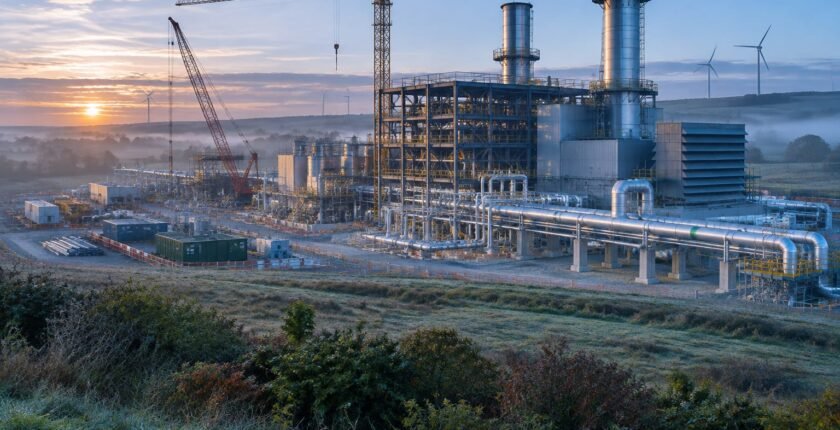
Técnicas Reunidas has won contracts worth more than €1.5bn ($1.6bn) to build three hydrogen-ready power plants for RWE in Germany. The Spanish engineering group will deliver combined cycle gas turbine units at Voerde, Werne and Weisweiler, around 2.1GW of capacity in total, through its subsidiary TR Power. Work on one of the projects is already under way, the company said, following RWE's final investment decision. The German government commissioned the three plants. They count towards Berlin's goal of 12GW of hydrogen-ready power plants by 2045, which is also the year the units are meant to run entirely on hydrogen. What fuel they will burn when they start up has not been disclosed.
Key takeaways
- Contract value: Técnicas Reunidas holds more than €1.5bn ($1.6bn) of contracts to build three hydrogen-ready CCGT plants for RWE in Germany.
- Sites and capacity: The plants at Voerde, Werne and Weisweiler add up to around 2.1GW, roughly 17.5% of Germany's 12GW hydrogen-ready target for 2045.
- Work under way: TR Power has started execution on one of the three plants after RWE took its final investment decision.
- Efficiency trade-off: Converting electricity to hydrogen and back to power returns around 30% to 40% of the original energy once electrolysis, storage and generation are counted.
Table of contents
What Técnicas Reunidas Will Deliver at Three German Sites
The contracts make Técnicas Reunidas responsible for each plant from the design stage to commercial operation. TR Power, the group's subsidiary for combined cycle work, will handle engineering design and equipment supply. It will then build the units, run their early tests and bring them into service. A combined cycle gas turbine, or CCGT, generates electricity in a gas turbine and then captures heat from its exhaust to drive a second generating stage.
Execution has already begun on the first of the three projects. Técnicas Reunidas said the work started once RWE, the German energy company, reached a final investment decision. That is the point at which a developer commits money to construction instead of continuing to plan. No one has said publicly which of Voerde, Werne and Weisweiler comes first, and no start dates have been given for the other two.
Neither company has broken the value or the capacity down by site. Split evenly, more than €1.5bn across three plants would come to roughly €500m each, and around 2.1GW would give about 700MW per plant. These averages are a guide to scale and are not reported figures. The real division could look quite different.
How 2.1GW Fits Germany's 12GW Hydrogen-Ready Target
Germany wants 12GW of hydrogen-ready power plants installed by 2045, and the three RWE units belong to that programme. At around 2.1GW, they cover about 17.5% of the target between them. A hydrogen-ready plant is built so it can move onto hydrogen as production, storage and transport for the fuel are put in place. Supporters see that staged approach as a practical route to low-carbon power.
The RWE plants are not alone. Germany contracted seven further CCGTs in early November 2026, and those units have the same 2045 deadline for running wholly on hydrogen. Together they make up a fleet whose climate case depends on one future date and not on the day each plant opens.
What the plants will burn at start-up has not been disclosed. That gap matters, because a hydrogen-ready plant does nothing for emissions until it switches fuel. If the units open largely on natural gas, the 2045 date becomes the real test of the programme, more than any construction contract signed today.
Why Hydrogen Power Recovers Under Half Its Energy
The main criticism of hydrogen-fired turbines is poor round-trip efficiency. Round-trip efficiency is the share of energy that survives the journey from electricity to hydrogen and back to electricity. Once electrolysis, storage and generation are counted together, around 30% to 40% of the starting energy comes back out. Put the other way, roughly 60% to 70% is lost along the chain.
The argument in favour is about timing, not efficiency. When wind and solar output runs high, surplus power can feed electrolysers and be stored as hydrogen. When renewable generation drops, plants like those at Voerde, Werne and Weisweiler could burn that hydrogen to keep the grid supplied. Excess output then becomes power available on demand, which is the kind of flexibility a grid heavy with renewables needs.
That trade is the bet behind Germany's programme. Losing most of the energy makes sense when the electricity going in would otherwise be wasted, and when a hydrogen supply chain exists by the time the turbines need one. The construction contracts settle neither question. They make sure the turbines will be ready when those answers arrive.
What could make or break the three plants
The case for
- RWE's final investment decision has turned the three sites into active construction, with execution already started on one project.
- Around 2.1GW gives Germany roughly 17.5% of its 12GW hydrogen-ready goal from a single developer.
- Hydrogen-capable turbines could absorb surplus renewable output and return it as power when wind and solar generation is low.
The case against
- Around 30% to 40% of the energy returns after electrolysis, storage and generation, so most of it is lost.
- The fuel mix at start-up is undisclosed, which leaves open how long the plants could run before switching to hydrogen.
- Full hydrogen operation by 2045 depends on production, storage and transport infrastructure that has to be built alongside the plants.
What to be careful about
- The plants' emissions benefit depends on a switch to hydrogen that is not due until 2045, and the starting fuel has not been disclosed.
- Round-trip losses of roughly 60% to 70% could make hydrogen-fired output expensive if surplus renewable power is scarce.
- The three sites rely on hydrogen production, storage and transport capacity that does not yet exist at the scale they would need.
The bottom line
RWE's decision turns three sites in Germany's hydrogen plan from contracts on paper into construction work. It also gives Técnicas Reunidas more than €1.5bn of engineering and building to deliver. The open questions sit on either side of that work. Before start-up, nobody has said what fuel the plants will burn. After it, full hydrogen operation by 2045 depends on supply chains that have not been built yet, and on accepting that around 30% to 40% of stored energy comes back as power. The award also widens Técnicas Reunidas's hydrogen business beyond power generation. The group was recently picked for front-end engineering on a 66,000-tonne-a-year Swedish aviation fuel project aiming to produce in 2031.
What to watch
- Watch for RWE or Técnicas Reunidas to say what fuel mix the Voerde, Werne and Weisweiler plants will use when they start up; no date has been set.
- Watch for execution to begin on the second and third plants once the first is under way; no timetable has been published.
- The 2045 deadline for full hydrogen operation at all three plants, and at the seven other CCGTs Germany contracted in early November, is the date that will show whether the programme delivers.
Frequently asked questions
Who is building RWE's hydrogen-ready power plants in Germany?
Spanish engineering group Técnicas Reunidas is building them through its subsidiary TR Power, under contracts worth more than €1.5bn, or about $1.6bn. The three plants are at Voerde, Werne and Weisweiler.
When will RWE's new gas plants run on hydrogen?
The plants are meant to run fully on hydrogen by 2045, the same deadline as Germany's 12GW hydrogen-ready programme. The fuel they will use when they first start up has not been disclosed.
What other hydrogen projects is Técnicas Reunidas working on?
In Sweden, a plant that would turn green hydrogen into sustainable aviation fuel has recently brought in Técnicas Reunidas for its front-end engineering design. Planned capacity stands at 66,000 tonnes a year, with production targeted for 2031.
Related reading