
Blog
Solar-Powered Data Centers Tap Curtailed DC Solar
Estimated reading time: 5 minutes · Last updated:
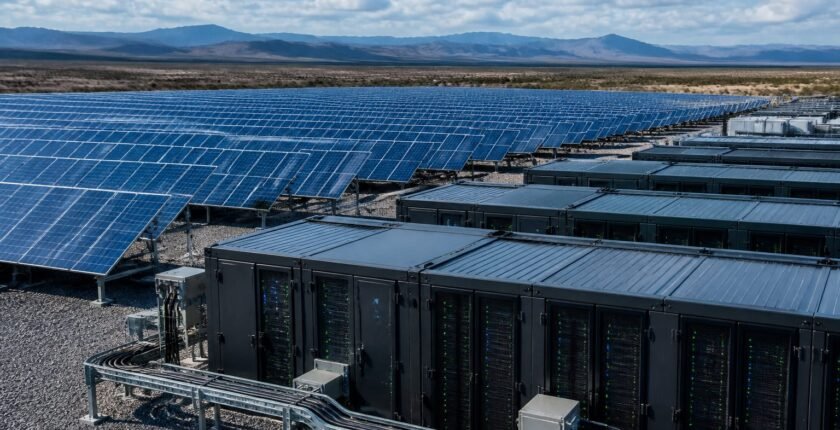
Many solar-powered data centers are built to use the DC electricity that utility-scale solar farms would otherwise curtail. Vanessa Bates Ramirez reported that San Francisco startup Rune Energy assembles RELIC modular data-center boxes that plug into a solar array’s DC link; each RELIC can draw up to 100 kilowatts and contains on-board GPUs and batteries. Rune says it manufactures RELICs in Mountain View, California, and plans to scale to 100 megawatts of compute over the next 12 months. The approach aims to convert generation the grid cannot absorb into dedicated AI inference and small training capacity, as first reported by IEEE Spectrum.
It’s our estimate that there’s 50,000 gigawatt hours of energy wasted by utility-scale solar every year.
William Layden, Rune co-founder and CEO
Key takeaways
- Rune Energy is a San Francisco startup that manufactures RELIC modules in Mountain View, California.
- A single RELIC module measures about eight feet long by two feet wide by five feet high, weighs about 2,000 pounds, and can draw up to 100 kilowatts.
- William Layden, Rune co-founder and CEO, says “It’s our estimate that there’s 50,000 gigawatt hours of energy wasted by utility-scale solar every year.”
- Rune says one RELIC can hold from 128 Nvidia B300 GPUs to over 2,000, and the company plans to reach 100 megawatts of compute in 12 months.
Table of contents
- Key takeaways
- How RELIC modules tap curtailed solar and bypass inverter clipping
- Design, capacity and deployment of the modular boxes
- Handling intermittency: on-board batteries and sizing decisions
- Commercial scale, customers and where this fits in the market
- Case for and against rapid adoption
- What to be careful about
- Frequently asked questions
How RELIC modules tap curtailed solar and bypass inverter clipping
Rune’s RELIC units connect directly to the DC output of a solar array instead of waiting for AC from the grid. That avoids losses and production limits that occur when an inverter clips output because an array produces more DC power than its inverter can handle. William Layden, Rune co-founder and CEO, frames the opportunity as using generation the grid cannot absorb; he estimates 50,000 gigawatt hours per year of utility-scale solar are unused.
The company signs power-purchase agreements (PPAs) with solar-farm owners and conditions DC power through DC-to-DC converters so GPUs can consume it. Varun Palivela, Rune co-founder and CTO, notes utility-scale solar standardizes around roughly 1500 volts and that RELICs step that down and condition it rather than converting it to AC for the grid first. The arrangement gives solar owners incremental revenue for power that would otherwise be curtailed.
Design, capacity and deployment of the modular boxes
Each RELIC module is a self-contained compute and power stack: networking, cooling, power electronics, GPUs and batteries in a container roughly eight feet by two feet by five feet, and weighing about 2,000 pounds. Rune says a RELIC can draw up to 100 kilowatts, and multiple modules can be linked to scale capacity without building a conventional centralized data center.
Rune positions RELIC as a product rather than a construction service; the units are manufactured at the Mountain View facility and built for rapid field hookup. William Layden said the company fulfilled a request to bring a site online within a week, and Varun Palivela said the design sidesteps the long lead times for large transformers and switchgear found in traditional facilities. Rune targets inference workloads and small training or fine-tuning runs on state-of-the-art models.
Handling intermittency: on-board batteries and sizing decisions
Rune integrates batteries at the RELIC level so modules can supply compute 24/7 without a grid connection, a design choice the company emphasizes. William Layden said batteries are built into RELIC to maintain uptime; Georgia Tech assistant professor Constance Crozier, who researches data-center energy demand, warned that correct battery sizing is critical because some solar production must be reserved for charging batteries rather than powering compute directly.
Rune uses historical site data and modelling to size modules and batteries for each solar location. Sites named in the reporting include California, Texas and Massachusetts. Crozier also noted that while DC-to-AC conversion is typically 95 to 97 percent efficient, the more significant gains for Rune may come from reduced component cost and operational flexibility when co‑locating generation, storage and compute.
Commercial scale, customers and where this fits in the market
Rune aims to scale to 100 megawatts of compute in the twelve months after the report, pursuing customers that need inference and short training jobs. One RELIC can contain between 128 Nvidia B300 GPUs and over 2,000, so a fleet-scaling approach lets Rune aggregate compute by adding modules rather than building a single large facility.
The model is part of a broader industry trend of data centers seeking behind‑the‑meter connections to generation sources to avoid constrained grid hookups. Rune’s approach converts curtailed solar into incremental revenue for solar owners while keeping some power off the grid through co-located batteries, but its commercial success will depend on PPA terms, battery costs and how customers value the location-linked compute offering.
Case for and against rapid adoption
The case for
- Direct DC coupling reduces some conversion steps and can monetize otherwise curtailed generation, creating revenue for solar-farm owners and an on-site power source for compute.
- Modular RELIC deployment avoids long procurement cycles for transformers and switchgear, enabling faster scaling and incremental capacity additions.
The case against
- Intermittency and the need to reserve solar production for battery charging reduce immediate compute capacity and raise capital costs for energy storage.
- Commercial viability depends on PPAs and customer willingness to accept compute tied to specific solar locations rather than a conventional datacenter site.
What to be careful about
- Run-to-run availability depends on accurate battery sizing because RELIC modules do not include a backup grid connection.
- Holding curtailed solar requires PPAs and contractual terms that ensure solar owners will supply DC power when available.
- Capital and operational costs for on‑board batteries could erode the economic case if battery chemistry or replacement cycles are costly.
The bottom line
Direct DC coupling and modular, battery-paired compute offer a practical route to convert curtailed solar into usable AI capacity without waiting for grid upgrades. Rune Energy’s RELIC modules assemble networking, cooling, power electronics, GPUs and batteries into field-deployable boxes that plug into a solar array’s DC link; the company names Mountain View manufacture and plans to scale to 100 megawatts of compute over the next 12 months. The model can lower some component costs and monetise otherwise unused generation, but its scalability hinges on battery economics, PPA terms and customers accepting compute tied to specific solar sites.
What to watch
- Watch for Rune to report reaching 100 megawatts of compute by 11 October 2027; the company says it will scale to 100 megawatts 'over the next 12 months'.
- Watch for announcements of large-volume RELIC shipments from Rune's Mountain View manufacturing facility by 11 October 2027; the company states it manufactures modules there and emphasises fast deployment.
Frequently asked questions
How much power can a RELIC module draw and how big is it?
A RELIC module can draw up to 100 kilowatts and is roughly eight feet long by two feet wide by five feet high; Rune says a module weighs about 2,000 pounds.
How does Rune keep compute running when the sun is down or it’s cloudy?
Rune integrates batteries at the RELIC level so modules can supply compute 24/7; the company and Georgia Tech researcher Constance Crozier both underscore that correct battery sizing is essential because some solar output must charge batteries rather than powering compute directly.
What kinds of AI workloads are RELICs intended for and how many GPUs fit in one unit?
Rune targets inference and small training or fine-tuning runs; it reports that a single RELIC can hold from 128 Nvidia B300 GPUs up to more than 2,000, enabling fleet aggregation for larger jobs.
Related reading